Tag Archives: politics

Peter Watts: the Bush presidency was the most successful ever

Bush Street signSo, America, you’ve got a new President – and high time too. But here burst your bubble and put your hopes into perspective is science fiction author Peter Watts, who not only warns against expecting Obama to be anything other than a politician, but also points out that the Bush presidency was the most successful presidency ever:

This may strike some as an odd position to take. After all, the Cheney/Bush years saw the world’s most powerful nation descend from surplus into trillion-dollar deficit; saw the prosecution of two unnecessary and (so far) unsuccessful wars; saw the evisceration of civil rights at home and US reputation abroad, the gutting of environmental protection, the relentless remorseless grinding of science beneath the heel of political expediency, and— finally, inevitably— the meltdown of a global economy based, even at the best of times, on consensual hallucination. And yet, to criticize that administration for these things is like describing me as a shitty writer because my novels don’t appeal to fundamentalist Christians. You don’t impugn the archer for missing the bullseye when he was aiming for a deer; success must be judged against the intended goal.

Ouch; read the whole thing. [image by Jef Poskanzer]
Will Obama usher in the age of Digg democracy?

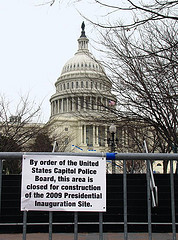
inauguration site construction notice, Washington DCOne of the more interesting sections of the Change.gov website built by the incoming Obama administration is the Citizen’s Briefing Book. It’s essentially a kind of Digg-like system where registered users can pick policies and issues to vote upwards or downwards on an ordered list, the idea being that the matters that matter the most will rise to the top, presumably to have attention paid to them by policy makers. [image by ajagendorf25]

It’s an intriguing idea, very typical of the Obama crew, and a tentative step toward a more atomised and participatory form of democracy that might effectively engage those who, traditionally, have been least engaged by politics in recent times. The downswing being, of course, that it’s effectively a crude kind of popularity contest, as Steven Johnson pointed out at BoingBoing:

Right now, the top three most popular proposals are: 1) Ending Marijuana Prohibition, 2) Bullet Trains and Light Rail, and 3) An End To Government Sponsored School Abstinence Programs. In other words, what the people want are stoned kids having sex on bullet trains. Sounds about right to me!

To be totally clear, those are three policies that – were I an American citizen – I would certainly support; it’s just that given the current state of the world in general and the US in particular, I don’t think they are really the hot-button issues that most need to be addressed…

Of course, the Citizen’s Briefing Book is only a type of polling mechanism rather than a direct lever on the policy machine. I only hope for the sake of all Americans it doesn’t become as farcical an echo-chamber of petty idiots as the Downing Street Petitions site. Or Digg, for that matter.

Migration controls: the new apartheid?

border control signIf you pay attention to the tabloid media in the US and the UK, you’ll be familiar with the idea that immigration is a terrible problem that must be stemmed at all cost, with hordes of desperate foreigners waiting beyond our borders to steal away scraps of our hard-earned prosperity and run our public services into the ground. [image by mockstar]

According to Fred Pearce of New Scientist, however, there’s another way of looking at the present system which doesn’t portray those of us in the richest nations as the victims: it’s a form of legitimised apartheid.

It has always struck me as odd that we are so keen to allow the flow of cash and goods across borders without let or hindrance, but try so hard to deny the same rights to people. That is both unfair and a denial of the free-market theories on which much of the world’s economy is built.

Surely if free trade and the free movement of capital is so good for an efficient global economy, then the same should apply to the free movement of labour?

I can’t see the fault in that logic. And for the apostles of the free market to deny it reeks to me of racism and xenophobia. Worse, the stench is disguised by a cheap perfume of do-gooding development theory and environmental hand-wringing.

Pearce goes on to suggest that strict border controls actually give us what we really want – economic disparity, and an easily cowed pool of illegal immigrant labour to do the jobs that no citizen will take for the money we’re willing to pay.

There are definitely some big holes in Pearce’s theory behind the rhetoric, but he’s also pointing at some rather uncomfortable truths. So here’s your challenge for the comments: argue against Pearce without falling back on arguments such as “why not make your own country as great as the one you want to move to”, and without making sweeping generalisations about people based on their race or nationality. Go!

GOSPLAN emergent?

The ever-interesting Yorkshire Ranter makes a good point (nearly a month ago, but nevertheless…) that certain elements of retail behemoth Tesco’s logistical setup bear a theoretical resemblance to Soviet-style command economies:

An unremarked-on aspect of the 1.5% interest rate cut last week. Namely, are we already living in a near-real time planned economy, as Stafford Beer foresaw? It sounds like I must be joking. But how else are we to interpret Sir Terry Leahy’s trip to see the Bank of England and the Treasury? Tesco boasts that one in every eight pounds spent in the UK passes through its tills; this bit is always in the papers. They rarely mention their huge management-information system, except to the trade.

If you wanted close to real-time information about the consumer economy, I can’t think of anything that would work better.

It’s quite a leap of the imagination, but this segues very nicely with Ken MacLeod’s recent comment on the future of IT security. MacLeod suggests that we are seeing a move in politics away from decentralised, bottom-up, market-based solutions and towards centralised, top-down, state-based solutions:

What if right now, we’re at a moment when trends that looked inexorable have reached a turning point? What if the common sense of the age is about to flip from free-market capitalism to state-regulated capitalism? Of course, turning that into actual policy won’t happen overnight, or smoothly – too much political legacy code – but if it does happen then over the next ten years or so we’ll be in an age of big government projects, some sort of new New Deal. We’d find ourselves back in the day before yesterday‘s tomorrow.

Further reading with decidedly SFnal tones includes operations systems specialist Stafford Beer‘s Project Cybersyn for the Chilean government and the USSR’s five year plans.

[image from kevindooley on flickr]

George Monbiot unimpressed by climate report

Environmentalist and activist George Monbiot is unimpressed by the the British Committee on Climate Change’s latest report, entitled Building a Low Carbon Economy, claiming it doesn’t go far enough in what it demands:

[The] report, published yesterday, is long, detailed and impressive. It has the admirable objective of trying to cap global warming at two degrees or a little more. This, it says, means that greenhouse gas pollution in the UK should fall by 80% by 2050 and by 31% by 2020.

But there’s a problem. There is no longer any likely relationship between an 80% cut and two degrees of warming. This gets a little complicated, but please bear with me while I explain why [the report’s] proposal is about as likely to stop runaway climate change as the Maginot Line was to hold back the Luftwaffe.

The key findings and suggestions of the report are summarised here. Monbiot believes further action than is suggested in the report is necessary, including raising the top rate vehicle excise duty from £400 to £3000, and reducing the number of airline landing slots in the UK to 5% of current capacity.
[image from kevindooley on flickr]