Tag Archives: privacy

EU demanding your “right to be forgotten”

Shades of Eric Shmidt’s deniable childhoods in the news that the European Commission wants to enshrine the right of every citizen to be “forgotten” by the titans of the web, should they so choose. Take it away, Ars Technica:

As part of its newly outlined data protection reform strategy, the EU says it believes individuals have a “right to be forgotten.” That is, people should be able to give informed consent to every site or service that processes their data, and they should also have the right to ask for all of their data to be deleted. If companies don’t comply, the EU wants citizens to be able to sue.

“The protection of personal data is a fundamental right. We need clear and consistent data protection rules,” EU Justice Commissioner Viviane Reding said in a statement.

[…]

The new guidelines focus on more than just the right to be forgotten—the EU wants to cover most aspects of an individual’s personal data and how it can be used. For example, rules for how someone’s personal information can be used in a police or criminal justice setting will be changed, as well as how citizens can securely transfer their data to places outside the EU.

A laudable sentiment, but one which I rather suspect will be impossible to enforce in any realistic way. But hey, at least the right to sue will keep all those poor starving lawyers in work, right?

Hiding in plain sight: social steganography

There’s always room for another compound neologism! Via Bruce Schneier, Danah Boyd on social steganography:

Carmen is engaging in social steganography. She’s hiding information in plain sight, creating a message that can be read in one way by those who aren’t in the know and read differently by those who are. She’s communicating to different audiences simultaneously, relying on specific cultural awareness to provide the right interpretive lens. While she’s focused primarily on separating her mother from her friends, her message is also meaningless to broader audiences who have no idea that she had just broken up with her boyfriend. As far as they’re concerned, Carmen just posted an interesting lyric.

Social steganography is one privacy tactic teens take when engaging in semi-public forums like Facebook. While adults have worked diligently to exclude people through privacy settings, many teenagers have been unable to exclude certain classes of adults – namely their parents – for quite some time. For this reason, they’ve had to develop new techniques to speak to their friends fully aware that their parents are overhearing. Social steganography is one of the most common techniques that teens employ. They do this because they care about privacy, they care about misinterpretation, they care about segmented communications strategies. And they know that technical tools for restricting access don’t trump parental demands to gain access. So they find new ways of getting around limitations. And, in doing so, reconstruct age-old practices.

And in doing so, make Google CEOs look surprisingly clueless.

(Incidentally, Schneier does this, too; most people who aren’t sf fans don’t know that Schneier’s an sf fan, but he leaves little Easter Eggs from time to time if you know what to look for.)

Destroying the chrysalis of your online childhood

Google CEO Eric Schmidt has suggested that in the near future every person might be entitled to change their name on reaching adulthood, in order that they can live unhindered by the online record of their youthful indiscretions. Now, Eric Schmidt is almost certainly a much smarter man than I am… but that idea is clearly batshit nuts, especially coming from a Google bigwig.

I mean, think about it – most people use pseudonyms and handles online as it is. How many names and identities will you be allowed to abandon? One? Some? All? And as the vigilante efforts of Anonymous prove time and time again, even folk making a big effort to conceal their identity can have it exposed against their will. If Schmidt is implying (as he seems to be – it’s hard to tell from such a throwaway comment, to be fair) that the digital record would remain after this identity disconnection, how exactly would you prevent people from doing a combination of internet sleuthing and good old-fashioned meatspace gumshoe work in order to connect xCrazyLarry1989x to Lawrence Michaels, aspiring tort lawyer and gubernatorial candidate for his local Chamber of Commerce?

Given the way web technology keeps advancing, it may not even be much of an effort. Hell, Google itself offers a neat little app called Goggles that can identify famous faces and objects by comparing them to archived images on the web (as for values of ‘famous’, John Scalzi is apparently famous enough for this to work); given the sheer number of photos on the Facebook profiles of most young people, how are you going to prevent someone using this sort of image search and linking your newly-renamed Adult Person to the child they were?

Simple answer: you’re not. If what Schmidt actually means is that there’ll be some sort of legally-enshrined disconnect between an adult and their behaviour before adulthood, then maybe it’s not quite such a crazy suggestion… but it’s still pretty crazy. Personally, I tend to agree with Stowe Boyd and others: I think we underestimate the common sense kids apply to social media based on the high-profile idiocy of a tiny minority, and I think we overestimate the impact that youthful (or even not so youthful) indiscretions in the digital fossil record will have on how the people who left them behind will be viewed. As a crude numbers-from-the-air example: if one in five kids is pictured somewhere on the web taking a hit from a bong, is society more likely to (a) refuse to employ 1/5 of the population, or (b) figure that kids smoking weed really isn’t such a big deal?

Trouble is, we keep applying the social mores of today to the society of a decade hence. Think about how different the world felt just five years ago; attitudes change fast. By the time the internet’s knowledge of our past is sufficient to be causing problems for the majority of people, my bet is that we’ll be worrying about something else entirely. Or, to put it another way: when you have evidence that pretty much everyone has been a little bit naughty at some point in their lives, your assessment of how much naughtiness is forgivable will shift accordingly. Transgression is implicitly assessed against a baseline of ‘normality’; a searchable childhood for everyone will move that baseline. In fact, I’d even go so far as to suggest it’ll be the people with squeaky-clean pasts who end up looking the most suspicious…
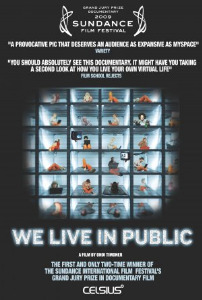
Watch this movie: We Live In Public

promo poster fo We Live In PublicA couple of nights ago, I sat down and watched We Live In Public, Ondi Timoner’s award-winning documentary about Josh Harris, Pseudo.com, the Quiet experiment, and the eponymous project that involved Harris streaming every mundane moment of his life onto the web for anyone to watch. I was particularly amazed that Quiet – a darkly and deliberately Orwellian behavioural experiment involving real people that not only prefigures but utterly eclipses much of the more recent reality television – isn’t better known and more widely discussed (though I believe it was a big influence on Douglas Rushkoff, who appears as an interviewee in the film and who was certainly part of the New York dot-com boom scene that floated Harris to prominence, and which I presume influenced and informed Rushkoff’s flawed but fascinating novel The Ecstasy Club).

The same applies to Harris, who comes across as a fascinating and damaged genius and visionary who foresaw – and concretised – many of the privacy and publicy issues that are hot button topics on today’s intertubes. I’m not sure I believe that Harris’ vision of a totally mediated world is inevitable, or even possible, but the extremity of the example he created is a valuable lesson and cautionary tale… as is his life as a whole.

The caveat here is that Timoner’s previous big success (and Sundance Festival winner) is the controversial rockumentary Dig!, which has been accused by Anton Newcombe of The Brian Jonestown Massacre of portraying him and his band in a selectively negative light as compared to the film’s other main subjects, The Dandy Warhols. Much as I’m a fan of Newcombe and his work, however, it’s pretty clear that he’s a damaged genius (like Harris, though in a very different manner), and whether or not Timoner’s editing really was deliberately skewed to cast Newcombe as the bad penny will remain a mystery to anyone who wasn’t involved in the project. Sensation sells, after all… and the footage of Quiet in We Live In Public makes much of its more shocking aspects; I guess what I’m saying is that the same pinch of salt you’d apply to any other modern media is surely worth using here.

But that pinch of salt does nothing to negate a powerful story, and one that I think any internet habitue should watch. Residents of the United Kingdom have another 22 days (as of publication of this post) to watch it for free on Channel 4’s 4od service, and I urge you to take advantage of it while you can. Everyone else – keep your eyes peeled for an opportunity of your own. This is a hugely important document in the history of mediated network culture.

Smart Grids == Spy Grids?

We’ve talked about smart grids before – infrastructure networks for basic utilities that incorporates all sorts of networked active monitoring technologies to make our use of energy and water more efficient. Sounds like a win-win situation for consumers and utilities companies alike, doesn’t it?

That altogether depends on how worried you are about extensive data on your lifestyle and consumer choices becoming easily scraped up by your utility suppliers

It knows how often you use your microwave, how many loads of laundry you do every week, what kind of television you own and even how often you shower. It can tell how many people live in your home, what time they go to bed and when the house is empty. All of this information and more is gathered by smart grid meters…

[…]

The information could be used in all kinds of ways, legitimate or not, from cities seeking broad information about how well energy-efficiency programs are working to burglars looking for expensive electronics.

Law enforcement agencies want to use smart meters to spot potential marijuana-growing operations or the location of an underground sweatshop. Companies hope the data will help them target marketing to consumers.

Where there’s data, there’s money… and you can’t always trust organisations who promise never to sell your data to third parties to actually keep their word. AMIRITE, Mr Zuckerberg? Smart grids will be a boon to our increasingly energy-hungry planet, but they’ll also be another battleground for the privacy war that’s slowly lumbering its way into the Now.

But hey, think positive: there’s an upside to the fact that utilities companies monitor their grids. If you get lost in the middle of nowhere without a cellphone, you can just cut down an electricity pylon and wait for the repair crew to arrive[both links via John Robb]