Tag Archives: privacy

Wi-fi makes walls see-through

wi-fi routerRemember me mentioning the special paint for making wi-fi cold-spots?

Well, here’s a reason you might want to invest in some – via Bruce Schneier we discover that some folk at the University of Utah have found a way to surveil the inside of a building using wireless signals:

The surveillance technique is called variance-based radio tomographic imaging and works by visualizing variations in radio waves as they travel to nodes in a wireless network. A person moving inside a building will cause the waves to vary in that location, the researchers found, allowing an observer to map their position.

The researchers, electrical engineering graduate student Joey Wilson and his faculty advisor Neil Patwari, have tested the technique with a 34-node wireless network using the IEEE 802.15.4 wireless protocol, according to the MIT Technology Review. By “interrogating” the space with signals and multiple receivers, the researchers found they were able to read the waves to detect the location of a moving object within a meter of accuracy.

OK, so it’s not quite kit you can buy from the local Electronics Barn… but you can pretty much guarantee that now the proof-of-concept has been done, all sorts of smart types will be looking at making affordable homebrew versions. [image by delta_avi_delta]

Money can buy privacy… and surveillance

CCTV camerasThe world may be becoming something of a panopticon, but you can always buy yourself a safe haven… provided you’ve got the necessary cash, of course. Russian billionaire businessman Roman Abramovich isn’t feeling the credit crunch, it seems, as one of the latest additions to his private “yacht” (which looks bigger than most commercial passenger ferries, to be honest) is a laser-screening system for preventing sneaky photography:
The 557-foot boat Eclipse, the price tag of which has almost doubled since original plans were drawn to almost $1.2 billion, set sail this week with a slew of show-off features, from two helipads, two swimming pools and six-foot movie screens in all guest cabins, to a mini-submarine and missile-proof windows to combat piracy.

It might not seem like somebody with such ostentatious tastes would crave privacy, but along with these expensive toys, Ambramovich has installed an anti-paparazzi “shield”. Lasers sweep the surroundings and when they detect a CCD, they fire a bolt of light right at the camera to obliterate any photograph. According to the Times, these don’t run all the time, so friends and guests should still be able to grab snaps. Instead, they will be activated when guards spot the scourge of professional photography, paparazzi, loitering nearby.

Now, you’ll not see me shedding any tears for the poor paparazzi, but that’s some potentially nasty technology right there. For example, the UK government has become obsessively paranoid about photography of late – where might they decide to install something similar? Y’know, to prevent terrorism?

Somewhat further down the financial scale (and hence more accessible to the anxious middle classes), technologies are now available to surveil your own children at all times – like a GPS-enabled wristwatch that will plot your youngster’s location on Google Maps [via SlashDot]:

The watch, which is designed in bright colours to appeal to children, can be tightly fastened to a child’s wrist and sends an alert if forcibly removed.

Parents can see the location of their child on Google maps by clicking ‘where r you’ on a secure website or texting ‘wru’ to a special number. Safe zones can also be programmed with parents being alerted if their child strays outside this zone.

The makers of the num8 watch claim it gives peace of mind to parents and makes children more independent but critics say tagging children like this is a step too far in paranoia about child safety.

File me under the latter bracket, please – although I suppose tracking your kids via GPS is slightly preferable to keeping them shut in the house all the time in response to tabloid-inflated fears about predators. Whichever smart and exploitative bugger manages to mash up this technology with an overlay map of suspected paedophiles will be raking in the money… probably enough to buy a photo-screened yacht. [image by killbox]

Which highlights the real problem, I think – the supposed security of real-time surveillance, and the immunity to it, are both functions of affluence.  Will the gap between rich and poor become increasingly defined by the degree to which one can chose one’s place in the panopticon?

Gaze-tracking software to keep your screen secret

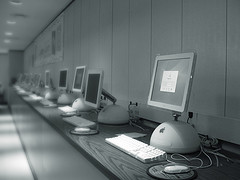
row of computersSick of people shoulder-surfing while you use your computer? A new suite of gaze-tracking software could be just what you’re looking for – it authenticates you by the patterns of motion in your eyes on the screen, and shows garbled text to anyone other than you:

Chameleon uses gaze-tracking software and camera equipment to track an authorized reader’s eyes to show only that one person the correct text. After a 15-second calibration period in which the software essentially “learns” the viewer’s gaze patterns, anyone looking over that user’s shoulder sees dummy text that randomly and constantly changes.

To tap the broader consumer market, Anderson built a more consumer-friendly version called PrivateEye, which can work with a simple Webcam. The software blurs a user’s monitor when he or she turns away. It also detects other faces in the background, and a small video screen pops up to alert the user that someone is looking at the screen.

Crafty. If the system gets cheap enough, we’ll see internet cafes start to offer private browsing as their unique selling point… although if you’re worried about people seeing what you’re looking at, you probably shouldn’t be doing it in an internet cafe to start with. [via Bruce Schneier; image by Kevin Zollman]

Stross and Doctorow on privacy in the modern age

A few weeks back the Open Rights Group held a benefit talk just up the tracks from me in London that I was meant to go to, though sadly the realities of self-employment intruded and kept me at home. The speakers were Charlie Stross and Cory Doctorow – two very smart guys who, even if you’re not a fan of their fiction, have a lot of very interesting stuff to say on the matter of privacy and surveillance in the modern world.

Luckily for me (and everyone else) there’s video footage of the whole thing – and I heartily suggest you watch it. While somewhat focussed on the UK situation, the stuff about data security and information harvesting and ubiquitous surveillance is applicable to anyone who uses the web, has a government that uses computers or lives in a city or town with a CCTV presence… which (I imagine) covers pretty much everyone reading Futurismic right now.

There’s ninety minutes of video; the discussion between Stross and Doctorow fills a little less than the first half, but make the time to listen to the Q&A section afterwards as well. I’ve found myself with about four pages of notes and story ideas just from my first pass through, and I imagine there’ll be more when I go back to it. So get watching:

You know what would have made this even more interesting, though? If David Brin had been on the panel… now that would have been hands-down the debate of the year, at least for me.

On the internet, *everyone* knows you’re a dog

social network analysisWell, maybe not everyone – but some clever types from the University of Austin have determined that even when your social networking data is divorced from your identity, it’s a relatively easy job to do some analysis and fit the names to the profiles.

In tests involving the photo-sharing site Flickr and the microblogging service Twitter, the Texas researchers were able to identify a third of the users with accounts on both sites simply by searching for recognizable patterns in anonymized network data. Both Twitter and Flickr display user information publicly, so the researchers anonymized much of the data in order to test their algorithms.

The researchers wanted to see if they could extract sensitive information about individuals using just the connections between users, even if almost all of the names, addresses, and other forms of personally identifying information had been removed. They found that they could, provided they could compare these patterns with those from another social-network graph where some user information was accessible.

The prime appeal of that data is, of course, the ability to use it for targeting advertising over the most desirable demographics – which, for many people, is objectionable in and of itself. More worrying is the potential for unearthing data that –  under a restrictive regime, for example – could be used to persecute or criminalise:

For example, the algorithm could theoretically employ the names of a user’s favorite bands and concert-going friends to decode sensitive details such as sexual orientation from supposedly anonymized data. Acquisti believes that the result paints a bleak picture for the future of online privacy. “There is no such thing as complete anonymity,” he says. “It’s impossible.”

Leaving the risks aside for the moment, though, this research has produced some rather fascinating insights into the nature of social networks and human behaviour as a unique identifier:

“The structure of the network around you is so rich, and there are so many different possibilities, that even though you have millions of people participating in the network, we all end up with different networks around us,” says Shmatikov. “Once you deal with sufficiently sophisticated human behavior, whether you’re talking about purchases people make or movies they view or – in this case – friends they make and how they behave socially, people tend to be fairly unique. Every person does a few quirky, individual things which end up being strongly identifying.

I wonder if the open-source argument about security would apply here? Open software advocates say that having the source code out in the open means that everyone can work on making a program more secure and efficient, rather than just the developers and the crackers; should these analysis methods be made public so we can keep up in the arms race with the snoops and marketeers? [image by luc legay]

What’s almost certain, though, is what any good security expert will have been saying all along – if you’re even slightly worried about something about you becoming public knowledge, assuming you can put it somewhere on the web and keep it private is an act of uninformed delusion. If you want to keep your privacy, it’s down to you to do it.