Tag Archives: psychology

You are reading Futurismic. You find a post about how you imagine the events described in narratives…

406px-Kuniyoshi_Utagawa,_Woman_reading I mostly write novels in third person, although one of my YA novels (Andy Nebula: Interstellar Rock Star) was written in first. Now research has come along that examines how pronouns influence the way we imagine events being described in narratives (Via PhysOrg):

In these experiments, volunteers read sentences describing everyday actions. The statements were expressed in either first- (“I am…”), second- (“You are…”) or third-person (“He is…”). Volunteers then looked at pictures and had to indicate whether the images matched the sentences they had read. The pictures were presented in either an internal (i.e. as though the volunteer was performing the event him/herself) or external (i.e. as though the volunteer was observing the event) perspective.

The results, reported in Psychological Science, a journal of the Association for Psychological Science, indicate that we use different perspectives, depending on which pronouns are used. When the volunteers read statements that began, “You are…” they pictured the scene through their own eyes. However, when they read statements explicitly describing someone else (for example, sentences that began, “He is…”) then they tended to view the scene from an outsider’s perspective. Even more interesting was what the results revealed about first-person statements (sentences that began, “I am…”). The perspective used while imagining these actions depended on the amount of information provided – the volunteers who read only one first-person sentence viewed the scene from their point of view while the volunteers who read three first-person sentences saw the scene from an outsider’s perspective.

So if you really want someone to imagine they’re experiencing the events described in a story first-hand, you need to write in second person. Even with first-person fiction, your readers step outside your narrator’s point of view and imagine things as if they’re viewing it on TV.

Does this presage a vast upswelling of second-person fiction?

I hope not. ‘Cause the one thing the researchers haven’t explained is why second-person fiction is so intensely annoying. Plus it makes everything sound like a Choose Your Own Adventure book.

“You are reading a novel written entirely in second person. You try one paragraph, then a second. Then a third. You get fed up with the constant repetition of the word ‘you’. You swear at the author. You throw the book across the room…”

(Image: Kuniyoshi Utagawa, via Wikimedia Commons.)

[tags]reading, writing, fiction, brain, psychology[/tags]
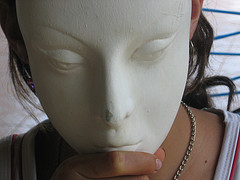
Judging a book by its cover – faces and personality

face behind the mask“You can’t tell what someone’s really like just by looking at them,” my mother told me once. But then again she also told me that “first impressions last,” and it turns out she was right on both counts – despite the seeming contradiction.

It turns out that we judge the personalities our fellow humans by their facial layout all the time, and evidence suggests that there may be a grain of truth in the judgements:

People also act on these snap judgements. Politicians with competent-looking faces have a greater chance of being elected, and CEOs who look dominant are more likely to run a profitable company. Baby-faced men and those with compassionate-looking faces tend to be over-represented in the caring professions. Soldiers deemed to look dominant tend to rise faster through the ranks, while their baby-faced comrades tend to be weeded out early. When baby-faced men appear in court they are more likely than their mature-faced peers to be exonerated from a crime. However, they are also more likely to be found guilty of negligence.

There is also a well-established “attractiveness halo”. People seen as good-looking not only get the most valentines but are also judged to be more outgoing, socially competent, powerful, sexually responsive, intelligent and healthy. They do better in all manner of ways, from how they are greeted by other people to how they are treated by the criminal justice system.

In other words, we all do it instinctively… as much as we might like to think otherwise. The latest research implies that it’s almost certainly an overgeneralisation based on an evolved response, but that means it’s been there for thousands of years, and probably isn’t going to go away any time soon.

Will we eventually end up with a political class that look like clones of one another*, all carefully sculpted to have agreeable and trustworthy by the most subtle and discerning elective surgeries? Will soldiers be re-cut to look more intimidating and fearless? What other subtle messages might we hide in our faces… and what would our willingness to do so say about the true character beneath? [via FuturePundit; image by xenia antunes]

[ * – OK, I meant even more so than currently. ]

Writing a diary makes you happier

hand-written journalBrain scans suggest that daily writing about your emotions can help you feel better about things; writing by hand is apparently more effective than typing:

The psychologists investigated the effect by inviting volunteers to visit the lab for a brain scan before asking them to write for 20 minutes a day for four consecutive days. Half of the participants wrote about a recent emotional experience, while the other half wrote about a neutral experience.

Those who wrote about an emotional experience showed more activity in part of the brain called the right ventrolateral prefrontal cortex, which in turn dampened down neural activity linked to strong emotional feelings.

If pouring your heart into dreadful poetry and song lyrics really is an emotionally beneficial outlet, does it then follow that MySpace deserves some sort of award for keeping teenagers from committing suicide? [image by Boa-sorte&Careca]

How to encourage frugality: make it a contest

sad face and happy faceThe New York Times reports on an intriguing – and apparently effective – method of encouraging consumers to curb their energy habits. A Sacramento utility company printed comparisons of energy use on their bills, and rated the consumers by comparison to their neighbourhood’s averages and best figures, labelling their success or failure with a happy or sad face respectively.

When the Sacramento utility conducted its first assessment of the program after six months, it found that customers who received the personalized report reduced energy use by 2 percent more than those who got standard statements…

Some clients complained and the utility stopped deploying the frowning faces, but the idea has apparently been taken up by other companies elsewhere. It’s interesting to note that this method is apparently more effective in encouraging efficient energy habits than emphasising the financial benefits or environmental impacts.

But of course, it’s playing on the urge to conformity, and there will always be those who react against such angles of attack. And while the end in this case is benign, it’s a strong reminder that anyone with a psychology (or marketing) degree has a lot more power to manipulate you than you might suspect. [story via WorldChanging; image by Emmaline]

NEW FICTION: ERASING THE MAP by Marissa Lingen

We’ve published a lot of wild and gonzo stuff at Futurismic in recent months, but we wouldn’t want you to make the mistake that’s all we like. And here’s an example: “Erasing the Map” by Marissa Lingen, which is subtle, quietly assertive, and handled perfectly.

Its thesis: If you could have traumatic memories surgically removed, would you take the risk of losing some of the memories you treasure? Read first, then make your mind up and tell us in the comments!

“Erasing the Map”

by Marissa Lingen

There was this one time, in college. I was arguing politics with this girl. Young Republican type. She had the blonde bob and the baby blue sweater, the whole works. I’d even seen her wear penny loafers. I liked her anyway. We were arguing about gun control, and I said there was absolutely no feeling in the world worse than killing another person.

I think if it had been another circumstance, another time, she would have responded by reaming me out about all the things she could think of that were worse. But it was a party. Maybe she thought I was cute. So instead, she batted those contact-lens-blue eyes at me and said, “And how many people have you killed?”

I said, “Just the one.”

It was the wrong answer, I knew, and the flirting look went off like a switch. But it was the only answer I could give. After she stared at me for a minute, I said, “It was an accident. I was ten years old.” She still didn’t say anything, so I said, “His name was Anthony, and he was my best friend.” Continue reading NEW FICTION: ERASING THE MAP by Marissa Lingen