Tag Archives: psychology

Watch this movie: We Live In Public

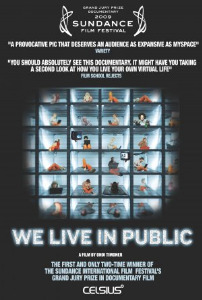
promo poster fo We Live In PublicA couple of nights ago, I sat down and watched We Live In Public, Ondi Timoner’s award-winning documentary about Josh Harris, Pseudo.com, the Quiet experiment, and the eponymous project that involved Harris streaming every mundane moment of his life onto the web for anyone to watch. I was particularly amazed that Quiet – a darkly and deliberately Orwellian behavioural experiment involving real people that not only prefigures but utterly eclipses much of the more recent reality television – isn’t better known and more widely discussed (though I believe it was a big influence on Douglas Rushkoff, who appears as an interviewee in the film and who was certainly part of the New York dot-com boom scene that floated Harris to prominence, and which I presume influenced and informed Rushkoff’s flawed but fascinating novel The Ecstasy Club).

The same applies to Harris, who comes across as a fascinating and damaged genius and visionary who foresaw – and concretised – many of the privacy and publicy issues that are hot button topics on today’s intertubes. I’m not sure I believe that Harris’ vision of a totally mediated world is inevitable, or even possible, but the extremity of the example he created is a valuable lesson and cautionary tale… as is his life as a whole.

The caveat here is that Timoner’s previous big success (and Sundance Festival winner) is the controversial rockumentary Dig!, which has been accused by Anton Newcombe of The Brian Jonestown Massacre of portraying him and his band in a selectively negative light as compared to the film’s other main subjects, The Dandy Warhols. Much as I’m a fan of Newcombe and his work, however, it’s pretty clear that he’s a damaged genius (like Harris, though in a very different manner), and whether or not Timoner’s editing really was deliberately skewed to cast Newcombe as the bad penny will remain a mystery to anyone who wasn’t involved in the project. Sensation sells, after all… and the footage of Quiet in We Live In Public makes much of its more shocking aspects; I guess what I’m saying is that the same pinch of salt you’d apply to any other modern media is surely worth using here.

But that pinch of salt does nothing to negate a powerful story, and one that I think any internet habitue should watch. Residents of the United Kingdom have another 22 days (as of publication of this post) to watch it for free on Channel 4’s 4od service, and I urge you to take advantage of it while you can. Everyone else – keep your eyes peeled for an opportunity of your own. This is a hugely important document in the history of mediated network culture.

The golden age of egalitarianism is twelve

Ars Technica reports on a research paper that suggests children abandon egalitarianism and develop meritocratic attitudes as they enter adolescence:

… they set up a game where teams of children in grades five through twelve were given access to two websites. One allowed them to earn credits by completing tasks, an analogue of hard work, and the other let them play games or watch videos. At the end of each round, each pair of kids was awarded either 8¢ or 4¢ for each credit he earned, a measure that introduced an element of luck.

The researchers then added the pairs’ earnings together, and asked one of the kids to divide the  money between them. They found that kids in fifth grade tended to be more egalitarian, dividing the money equally regardless of how much either had earned.

However, meritocratic views began to sneak in as the subjects’ age increased: older adolescents not only gave partners less money for earning less, but also awarded themselves less when they had not been as productive. There was also a small but steady number of what the researchers termed  “libertarian” subjects, who divided the money exactly as it had been paid out, without considering the aspect of luck.

Interesting results. However, the real question here is an old favourite: nature or nurture? Is the emergence of meritocratic thinking hardwired into our development, or is it learned socially, from family, friends and media? Plenty of opportunity for further research, methinks… would these results pan out in societies with notably different attitudes to wealth and property ownership?

Virtual bodies, mutable genders

Here’s an interesting bit of research from sunny Barcelona: men wearing a virtual reality headset that allowed them to perceive themselves as a female avatar started to identify strongly with their temporarily-assumed gender.

… men donned a virtual reality (VR) headset that allowed them to see and hear the world as a female character. When they looked down they could even see their new body and clothes.

The “body-swapping” effect was so convincing that the men’s sense of self was transferred into the virtual woman, causing them to react reflexively to events in the virtual world in which they were immersed.

Men who took part in the experiment reported feeling as though they occupied the woman’s body and even gasped and flinched when she was slapped by another character in the virtual world.

[…]

Later in the study, the second character lashed out and slapped the face of the character the men were playing. “Their reaction was immediate,” said Slater. “They would take in a quick breath and maybe move their head to one side. Some moved their whole bodies. The more people reported being in the girl’s body, the stronger physical reaction they had.”

Sensors on the men’s bodies showed their heart rates fell sharply for a few seconds and then ramped up – a classic response to a perceived attack.

As expected, the body swapping effect was felt more keenly by men who saw their virtual world through the female character’s eyes than those whose viewpoint was slightly to one side of her. In all cases, the feeling was temporary and lasted only as long as the study.

Plenty of opportunity for further research there; I’m no expert, but that looks to me like a validation of the theory that gender roles are socially constructed… but then that theory has been borne out by my personal experiences in virtual worlds, in my own behaviour as well as that of others.

I’ve heard it suggested before that a way to break down some of the more persistent gender prejudices in modern culture would be for everyone to spend a month living the life of the gender they consider themselves “opposite” to – maybe VR and synthetic worlds offer us the closest approximation of that classic science fictional plot device (Stross’s Glasshouse, anyone?).

Foreign Accent Syndrome

Strange things are afoot in the language centres of our brains. Just the other week, we had the story of the Croatian teenager who woke from a coma unable to speak her native language, but mysteriously fluent in German. Slightly more mundane (but still pretty weird) is Foreign Accent Syndrome, wherein traumas and/or triggers unknown cause the afflicted person to speak their native tongue in a seemingly foreign accent.

So much we don’t understand about that cauliflower of grey meat…

Rodent dilemmas and simian doubts

These just in from the Animal Psychology Department; first up, rats are surprisingly good at the classic Prisoner’s Dilemma [via BoingBoing]:

It may not be entirely surprising that rats cooperated in the Prisoner’s Dilemma.  After all, animals often cooperate in nature to altruistically serve the group, whether that means hunting in packs to get more meat, or a surrogate mother animal adopting an abandoned baby to boost the pack’s numbers.  Still, there’s no direct evidence that shows rats grasp the concept of direct reciprocity.  Given that the rats in this study changed their strategy based on the game their opponent was playing, and cooperation rates were only high when the rats played against a tit-for-tat opponent, the authors showed, perhaps for the first time, that rats directly reciprocate. But an even more surprising finding was how well the rats played the game.  They plotted and schemed.  They manipulated their opponents by taking calculated strategic risks for the high payout reward. In essence, these rodents challenged our perception of animal intelligence and proved that they, too, can master both the game, and the psychological component of competition.

Furthermore, apes have been discovered to have the capacity to doubt their own decisions [via George Dvorsky].

Josep Call […] put food in one of two opaque plastic pipes and had watching bonobos, chimpanzees, gorillas and orangutans pick the one with the food. If they were made to wait, the apes sometimes forgot where the food was, but by and large they did well on the task.

To test if the apes doubted their own decisions, Call gave them the option to peek into the end of the pipes before they chose one. He found that the apes were more likely to check the pipes if they had to wait before picking one. Call says this suggests that the apes had begun to doubt their memory.

That consensus definition of “human” is starting to look a lot less exclusive than it used to, no?