Tag Archives: publishing

Packaging the genre: publishers as curators

There aren’t many business methods worth copying from the record business at the moment, but should book publishers be trying to work more like record labels? Over at the if:book blog, one Bob Stein thinks there’s something to be learned from the days when books had a distinctive look that immediately identified their publisher as well as the author:

I find myself thinking a lot about what i call the “Foyles” model. in the not too recent past Foyles in London shelved books, not alphabetically by subject or genre, but by publisher such that there was the Penguin section and the Bloomsbury section. For a more recent example, video stores usually shelve Criterion titles on their own — precisely because of the power of the brand. From this perspective I see two sorts of physical store plays — one could open a completely new sort of superstore . . . . where publishers, like perfume companies, effectively rent space to show their wares (fulfilling in some cases with actual books but also via POD and online). The second is a publisher branded cafe/store…

It’s not that crazy an idea, really… it’s pretty evident the current book-barn approach isn’t working so well. Perhaps I’m more attracted to the idea through being a genre reader, where publisher trust is stronger and more focussed: I’m statistically more likely to be interested in a book published by Gollancz or Tor than I am one from Penguin or Bloomsbury, for instance.

Visual branding plays a part, too, as pointed out by Joanne McNeill at Tomorrow Museum:

If there were a Tony Wilson of publishing, you bet I would buy every book printed…

Well, yes!

This all ties in rather neatly to Jonathan’s Blasphemous Geometries column from December last year, where he suggested that someone should give science fiction the Criterion Collection treatment. And there’s a new column from Mr McCalmont due later today, as it happens…

How strongly does a book’s publisher influence your likelihood to buy that book, if it’s by an author you’re not familiar with? And what about packaging? I rather liked the look of the Gollancz Future Classics collection, but I know a lot of other folk found them ugly or odd.

Ebooks cost a lot of money to make; will no one explain why that has to be so?

Andrew Wheeler wants people to stop saying that ebooks don’t cost publishers lots of money to make:

Creating an individual ebook format — one of the current suite of them — costs roughly as much as creating a print-on-paper edition; the costs of the actual paper and ink are vanishingly small in this equation. Some ebook formats, such as the currently fashionable one, have a baroque process of creation that involves multiple transformations and iterations of quality control, which drives up costs further. And the cost per unit is massively higher for ebooks than for printed books — infinitely so in some cases, since there are plenty of ebook editions that have never sold a single copy.

Now, I feel the need to respond to this post, because I’ve chimed in on ebook economics before and it’s a topic I care a lot about. However, I’m going to first point out that I have a great deal of respect for Andrew Wheeler, both as a blogger and an editor, and I’m fully aware that he knows a lot more about the inner workings of the publishing industry than I do; I’m not going to tell him he’s wrong, because he isn’t. I’m not going to refute the claim that ebooks currently cost a lot of money to make. I am, however, going to say that they shouldn’t cost a lot of money to make, that they don’t have to, and that the longer they do, the smaller the chances of them ever becoming a viable industry in their own right.

Part of this isn’t the fault of the publishers; as Wheeler points out, there are a dozen competing ebook formats with arcane creation processes; there are DRM frameworks; there are ebook vendor requirements that predicatably take advantage of the over-the-barrel status of the publisher and milk them for as much as they think they can get away with. This is pretty much how new technologies always work; I can see parallels with the digital music business as it meared the Napster era. The publishers dragged their feet then, as well, and in the process allowed an openly accessible file format (the mp3) to gain ascendancy in a series of distribution networks that they had no investment in or control over. I expect book publishers are well aware of this parallel; what surprises me is that they’re not talking to the consumers about it more actively.

I do need to quibble on one of Wheeler’s points:

… the cost per unit is massively higher for ebooks than for printed books — infinitely so in some cases, since there are plenty of ebook editions that have never sold a single copy.

Now, again, I’m not saying he’s wrong here – he’s seen figures and spreadsheets that I’ll never be shown, of that I’m certain. But if you’re running a set-up where the per-unit cost of an infinite good is higher than that of the physical finite version, either there’s something massively wrong somewhere in the production chain, or my understanding of the publishing process has a huge flaw which I would sorely appreciate being corrected on.

Allow me to explain: some of you may be aware that I work for UK small press PS Publishing. Now, we don’t sell ebooks (yet), but we make PDF versions of our books available to reviewers. Those PDFs are almost identical to the file we send to the printers, except for being saved at a lower resolution to save on disk space and download times. In other words, the work to produce a template for the reproduction of a physical book or an electronic one can be exactly the same; the same editing, proofing and typesetting/layout process, all the way up to the stage where the book is released to duplication.

The obvious answer to that statement is “well, you’re using PDFs and no other formats, so of course it’s easy”. Well, yes; and that’s kinda my point – if the publishing industry continues to allow intermediary vendors to shaft them with ludicrous hoop-jump requirments and costs for multiple proprietary formats, then they’re never going to make a dime out of selling ebooks. There needs to be a concerted push by the industry for a single, simple and secure digital format that everyone uses; then leverage can be applied to the makers of reader hardware to support that format, plus the formats used by public domain material (e.g. the humble and ubiquitous PDF, which is either unsupported or charged for on most current readers of which I am aware).

Part of the establishment of that file format should include software for easy conversion of proofed electronic galley files directly into it, so that once a book is ready for printing, it’s also ready for ebooking in one click. At this point, there’s no way the per-unit cost for ebooks can be higher than print, because that ebook is ready to ship, and any intermediary vendors should be willing to eat the storage and distribution costs out of their final to-consumer price. If they’re not, you go with the one who will; the rest will soon follow. Now, sure, you’ve still got your marketing and promotion budget to consider in to that per-unit cost, but that’s the same outlay for both editions up to this point in the process, and with a digital format that cost is spread over a theoretically infinite number of units at no extra cost.

By comparison, after that final file is deemed ready for production, printed books must be printed, warehoused, shipped, lifted onto shelves in brick-and-mortar stores and run past the till scanners there, too… and all that money has to be coming from the profit margins. By any rational analysis from outside (with the caveat that I’m not an economist or an accountant), that must cost more than making digital books available; I’m prepared to believe that there may be reasons that it doesn’t, but I’d suggest that those mysterious reasons point to a heroic flaw in the economics of book publishing as it stands.

To reiterate: I’m not saying Andrew Wheeler is wrong to say that ebooks cost more to make than dead-tree books; I’m saying that disparity in cost is impossible to understand for anyone not privy to the way the system works – people like me, and people like the ones who want to buy ebooks but find them either unavailable due to antiquated regional licencsing, hobbled or useless thanks to proprietary and restrictive file formats, or just simply too damned expensive by comparison to the dead-tree version.

Wheeler’s final point s that many ebooks never sell a single copy, which surely only underlines my point that making every effort to reduce that inexplicably high per-unit cost is the only way to make them a viable business. As Blue Tyson says in the comments below the post, “[p]ricing them double is a pretty good strategy to sell zero, certainly.” If your current system means you have no choice but to charge an arm and a leg for an infinte good, your system is surely broken. I think part of the problem is considering the physical and electronic versions as two separate products; that proofed and typeset file is the product, and the ebook or bound paper are just the delivery systems for it.

Now, I’m fully prepared to admit that there are things I don’t know about how the system works, as mentioned above. The point I’m trying to make here is that until the consumer has been shown why that price must be so high, they will never stop complaining about it. I’d genuinely like to know the truth of the matter, and as such I’d like to invite Andrew Wheeler (and anyone else with the pertinent experience and knowledge) to set us straight; I’ll happily publish a response here, or link to it if published elsewhere. Sunlight is the best disinfectant, so they say. 🙂
Amanda Palmer on passing the hat for art

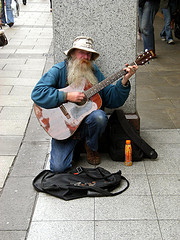
guitarist buskerI imagine many of you have seen this elsewhere (judging by the dozens of different sources I saw it bounce through yesterday) but if not, here’s the one and only Amanda Palmer explaining why she’s not ashamed to ask her fans for money:

artists need to make money to eat and to continue to make art.

artists used to rely on middlemen to collect their money on their behalf, thereby rendering themselves innocent of cash-handling in the public eye.

artists will now be coming straight to you (yes YOU, you who want their music, their films, their books) for their paychecks.
please welcome them. please help them. please do not make them feel badly about asking you directly for money.
dead serious: this is the way shit is going to work from now on and it will work best if we all embrace it and don’t fight it.

unless you’ve been living under a rock, you’ve surely noticed that artists ALL over the place are reaching out directly to their fans for money.
how you do it is a different matter.
maybe i should be more tasteful.
maybe i should not stop my concerts and auction off art.
i do not claim to have figured out the perfect system, not by a long shot.

BUT … i’d rather get the system right gradually and learn from the mistakes and break new ground (with the help of an incredibly responsive and positive fanbase) for other artists who i assume are going to cautiously follow in our footsteps. we are creating the protocol, people, right here and now.

i don’t care if we fuck up. i care THAT we’re doing it.

It’s worthwhile reading for anyone who writes with the intent to sell their work, or those who publish at the small scale of webzines or print mags (or iPhone apps, or whatever other way you’ve decided to do it). As has been suggested before, dead-tree publishing is going to take a comparatively long time to catch up with the business models of the music industry, because the pressures of piracy and freely-available content aren’t so strong yet. But they will be… and it’ll happen sooner than you expect, especially if you just sit on your hands waiting for someone to give you the answer.

So be bold, try things. Throw the spaghetti at the wall and see if it sticks. Hal Duncan’s got the right idea – he’s doing a direct-to-audience publishing experiment on his blog right now. So go throw a few bucks in his hat, and know that you’ve bought good art… and helped feed the person who made it. [image by Martin Pettitt]

(Go throw Amanda Palmer a few coins, too; she’s not just a fine musician but a crusader for independent art, and that alone deserves your support.)

The replicator analogy: why infinite ebooks make more jobs

The common wisdom of record labels and publishing houses alike is that the redistribution of infinite goods – digital music files, say, or ebooks – will be the doom of the industry: if no one needs to pay for the end product, the end product will eventually disappear, as will the jobs that currently create said product.

Now, that seems logical enough, doesn’t it? But that’s because we’re used to thinking in terms of artificial scarcity. Jon Renaut has sat down and written out an analogy to explain why he thinks the conventional wisdom about infinite goods is wrong… and it’s based on the replicators from Star Trek.

A better analogy [for the music or publishing industry] would be if the replicator only made tomatoes. You could have as many tomatoes as you wanted, they’d always be perfect and delicious, and they’d always be free. This would put tomato farmers out of business. But these tomato farmers could likely start growing something else instead. And what happens to the rest of the economy? Pizza and pasta restaurants suddenly find that a major ingredient in many of their dishes just became free. Now, for the same dish, they can charge less, or buy higher quality ingredients, or make more profit. And if you’re a really talented cook specializing in tomatoes? Your skills are now in very high demand.

And there is still a demand for the people who bring the tomatoes from the replicator to your table. There is still a demand for the person who stews and cans the tomatoes, or dices and seasons them. And all the other food items, the ones that aren’t in infitnite supply, still need people to produce, process, and distribute them.

This is what’s happening in the music industry, and starting to happen in the publishing industry. Some parts of the industries are finding their functions obsolete. Instead of looking at the money they could save with electronic distribution, and what good use they could put that money to, the industry is seeking new laws and regulations to limit the infinite supply so business can continue as usual.

Even if every single song, book, and movie was distributed digitally for free, there would still be a need for the music, publishing, and movie industries. There would still be demand for editors, producers, marketers, and all sorts of other services that these industries have always provided.

As is discussed in the comments, the analogy doesn’t hold for other non-infinite goods – medicines, for example. But for goods that can be duplicated endlessly without degrading, there’s plenty of opportunity to build value-adding business models around the free stuff. [via TechDirt]

Your thoughts?

Profitable post-web publishing: is patronage the answer?

OK, it may be a little cruel to ask you to do the thinking on a Monday morning (especially as you Statesiders are probably still recovering from Labour Day weekend), but I think it’s high time this one was thrown open to the floor – and by “this one” I mean, of course, the perennial question of how to make fiction publishing a viable business in the internet age.

The trouble is, there’s no shortage of potential business models to choose from. For example, Tor.com is ad-supported, but has the advantage of being associated with a strong publishing brand in its chosen genre; meanwhile, Strange Horizons is a not-for-profit that relies on donations, but even they’ve found it tough to bring in the necessary funds without the welcome publicity and assistance of notables such as John Scalzi. Both of those are purely web-based publications; print brings its own logistical and economic difficulties to the proceedings, as the decline of the “Big Three” and the shuttering of many smaller magazines demonstrates all too clearly.

I’m increasingly coming to believe that visibility is half of the battle, which is why I was intrigued by Cory Doctorow’s latest Locus column, in which – after demolishing many of the standard objection raised against the methodologies of his own success as a novelist – he mentions his “With A Little Help” project, which intends to investigate whether public donations are sufficient to support the writing and publication of a novel, and what degree of work is needed to equal the promotional support of a traditional publisher for such a project.

The results will be interesting regardless, but Doctorow has the advantage of a ready-made audience – one that he has worked hard to build rather than simply blundered into, I might add. But the question remains more open for lesser-known authors… and for fiction magazines, be they dead-tree or digital. The Scalzi/Strange Horizons avalanche shows that people will donate to support short fiction publishing online, but how much of that generosity is due to SH being a not-for-profit organisation? How much is due to them paying professional fees for their stories? How many of the Scalzi donors will donate again if they’re not encouraged by Scalzi or a similar figure?

Only time will answer those questions. But what is becoming obvious is that patronage is crucial to supporting niche publishing – be it direct financial patronage from readers, or the patronage of a vocally supportive figurehead (the patronage of publicity, if you will), or the patronage of an animal further up the publishing foodchain. Underpinning all these is the need to cultivate a supportive audience – turning a percentage of your free readers into donors or buyers, in other words.

What should be equally obvious is that I don’t know how to do it – which is why I think Doctorow’s experiment will be fascinating to watch, as well as projects like Robin Sloan’s New Liberal Arts essay anthology (and his subsequent ongoing novella project), World of Warcraft: the Magazine and a whole raft of wild ideas currently sculling their way out of the boondocks of the independent music scene.

But hey – you guys are readers, right? So, tell me: leaving aside dead-tree or digital books bought in the traditional manner, where do you pay to read fiction, if anywhere? What does it take to get you to pay, and what amount seems reasonable to you for what you’re getting – if anything?

Do you object to advertising on the sites where you read fiction, or are they acceptable so long as you’re not paying for the privilege of seeing them? Would you pay a small premium for an ad-free version of a webzine, or are the mechanics of a paywall off-putting enough to keep you away from a publication you might otherwise click through to regularly?

Yeah, lots of questions, and they’ve all been asked before… but I don’t think I’ve ever collected them all in one post here at Futurismic, and I’d be interested to read your answers – not just for the benefit of this here site, but for the nascent industry of web fiction publishing as a whole. And if there are business models I’ve missed out that you’ve either seen in operation or heard proposed elsewhere, please pipe up and let us know about ’em!