Tag Archives: publishing

Doctorow on the decline and fall of novels

man reading a novelThe ever-ubiquitous Cory Doctorow crops up over at Internet Evolution, talking about “media-morphosis” – the ways in which the internet is mangling and mutating all the other forms of media. The whole thing is worth a read, but I thought I’d pick out a bit of Doctorow’s thinking about the future of the novel, as it fits quite neatly with some of the recent ebook posts here at Futurismic. [image by John Althouse Cohen]

Doctorow points out that books are suffering on two sides – firstly from the rise of the big-box retailers, which have restricted the titles available, and secondly from the way we’re being conditioned by the web (and other media imitating the web) to read in short, easy-to-swallow chunks – and then paints a worst-case scenario:

If big-budget movies might turn into opera, then long-form narrative books might turn into poetry. There’s a hell of a lot of published poetry — more than ever — mostly consumed by other poets and a small band of extremely dedicated followers of the form. A few poets make a big living at it, a few more make a marginal living at it, but for most poets, income is aspirational, not reality-based (this is pretty close to the situation in short fiction already, and not far off from the world of novel writing in many genres).

But a future in which novels turn into hand-crafted fetish items for a small group of literati is one in which the relevance of the novel dwindles away to a dribbly nothing.

I think most of us here would see that as a rather sad omega point for one of our favourite media, especially given the incredible artistic possibility it has to offer; Doctorow suggests that one route to salvation for the novel would be to build the sort of evangelical business that distributes books to places that they otherwise might not reach.

But what if his worst-case is actually the fact of the matter? Is it not possible that the novel will increasingly become an anachronism, the sort of thing considered historically interesting but culturally irrelevant by 21st Century humankind? Maybe we just need to face up to the idea that reading books for fun is a pastime whose days in the sun are over, no matter how personally attached to it we may be.
The costing of ebooks

Yeah, another ebooks post, but new material is coming in so thick and fast that every day I seem to find an answer to a question that was raised the day before. Point in case – why aren’t ebooks priced at a tiny percentage of the cost of a hardback? Take it away, HarperCollins:

We still pay for the author advance, the editing, the copyediting, the proofreading, the cover and interior design, the illustrations, the sales kit, the marketing efforts, the publicity, and the staff that needs to coordinate all of the details that make books possible in these stages. The costs are primarily in these previous stages; the difference between physical and electronic production is minimal. In fact, the paper/printing/binding of most books costs about $2.00…

In other words, a $26 hardback equates to a $24 ebook.

Now, I’m in no position to refute those figures, but I don’t think it takes an economics expert to look at them and realise why the publishers are struggling at the moment; if their analysis people can only shave off $2 per unit by removing the printing, shipping, warehousing and remaindering from the equation, then there’s a business model that was on shaky ground before the ebook entered the picture. I suspect the bits I’ve bolded are where the haemorrhaging could be stemmed most effectively.

But it’s easy to say that from the outside looking in; if anyone among Futurismic‘s readership can supply hard figures on this stuff, I’d be glad to give you a soapbox, so drop us a line.

Stephen King, Amazon’s Kindle and the death of publishing as we know it

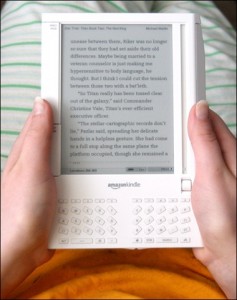
Amazon Kindle ebook readerWe’ve been mentioning ebooks a lot lately here at Futurismic, as the big publishing companies have suddenly woken up to the fact that the 21st Century has well and truly arrived… and isn’t going to go away.

One can look at the ebook as a way for the publishers to move away from the increasingly expensive and wasteful dead-tree model and reinvigorate themselves in the process. But there is a flipside, of course, as pointed out by The Guardian‘s Naomi Alderman:

if ebook readers took off, big-name authors such as [Stephen] King may be able to move to self-publishing. And that could mean the end of our current publishing system. Because of the way the publishing business is structured, big-name authors who sell millions of books are, in effect, supporting the industry. I’ve heard various estimates of the percentage of books that actually turn a profit. One agent I spoke to said 95% of published books make a loss. Others have put the figure lower. Either way, everyone agrees that a large majority of profits come from a small minority of authors.

If King, Dan Brown, JK Rowling and Patricia Cornwell were all to decide to move to selling their books online themselves, rather than going through a publisher, they’d certainly benefit financially. Typically, an author only receives about £1 for every copy of their book sold. Rather than relying on a publisher, big-name authors could afford to simply employ an editor, a PR person, a typesetter and a designer. They could price their books at only £2 or £3 and still make much more money than under the current system.

There’s obviously a few flaws in Alderman’s reasoning here: first of all she’s discounting the nurturing aspect of the publishing industry, its ability to bring the next generation of Kings, Cornwells and (universe forfend) Browns up through the ranks; secondly, a shift to ebooks should see the loss margins on a title by a smaller author drop considerably, as there’ll be no massive pile of unsold books to pulp (not to mention much smaller distribution costs).

But what is plain is that book publishing needs to learn in adavance from the messy lessons that the record companies are still struggling with now. A look at the music industry blogs will show you that Alderman’s speculation above is an almost perfect mirror of what’s already happening with middle-band musicians as they (and their fanbase) realise the labels are primarily concerned with wringing the last few drops of profit out of a dead business model, and decide to leave them behind.

As has been pointed out before, the principle difference between the publishers and the record labels is that publishers haven’t yet been forced to innovate by the pressures of piracy. It looks as if they’d be wise to jump ship and start swimming for shore right now, rather than waiting to be made to walk the plank. [Image coutesy Wikimedia Commons]

Nick Gevers surveys the sf short fiction scene at Locus Online

Just arrived in my inbox is a note from Nick Gevers informing me that starting today, Locus Online will be running a series of interviews titled SF Quintessential.

The column will see Gevers quizzing the creators and publishers of science fiction short stories in an attempt to map the current state of play:

I intend that the series will help promote valuable short fiction publications and provide a forum for discussion of trends in the short form: creative movements and the rather troubled state of the market. There’s a huge amount to talk about; I hope “SF Quintessential” can supplement and augment existing debate, at a vital time in the history of genre literature.

The first instalment of SF Quintessential features an interview with Australia-based anthologist extraordinaire Jonathan Strahan, and Pyr’s Lou Anders is also in the pipeline. This promises to be a fascinating (if potentially grim) read for anyone writing short stories for publication.

[Full disclosure: Nick Gevers is part of the editorial team at PS Publishing, who are clients of mine.]

Luc Reid suggests a type of ebook DRM that actually might not suck

The eBook future looks pretty bright for consumers, with devices improving and dropping in price, and a wealth of material to read thereon. But writers are worried, with some justification – after all, if the Kindle does for publishing what the iPod has done for the record labels, no one’s going to get much money for writing short stories any more.

Writer Luc Reid has been scratching his head over the Digital Rights Management question in an attempt to satisfy his requirements as both a writer and a reader, starting from the premise that DRM is necessary to enable authors to be paid for their work:

In general, the biggest argument against DRM seems to be that it provides positive things for the seller but only negative things to the buyer. Here’s a DRM proposal that actually helps the buyer, while taking away some of the biggest nuisances. I’m sure I’m not the first one to come up with it. It’s account-based DRM.

What I mean by “account-based” is that when a person buys a book, that person gets a permanent license to read that book on any eReader device they own, from a smart phone to a dedicated eReader to, who knows, their wide-screen TV with a little black box attachment. Computers might or might not be included; that would be mainly a technical issue.

This “account-based” idea is different from what’s usually talked about when people talk about eReader DRM, which is “device-based.” That is, much of the thinking about DRM has been that when I buy a book, I get to read it on the particular device I bought it for and nowhere else.

It’s a well-thought out set of ideas, and Reid has worked hard at including the flaws and objections. Unfortunately, I suspect it’s predicated on too many ‘ifs’ for it to be viable. An industry-wide standard retail structure complete with hardware and software that supports the system may sound easy on paper, but the real world is a little more messy, and getting competing companies to work together is like herding cats.

That said, Reid’s piece is one of the most honest defences of DRM I’ve ever read; maybe the publishing houses should get a think-tank of smart writers and readers together to boil up new ideas instead of leaving it to the beancounters and engineers?