Tag Archives: publishing

Would you ever use ePaper?

New corporate spinoff Liquavista are beginning work to develop practical epaper:

The technology is based on a process called electrowetting, which uses electricity to manipulate a thin layer of liquid so that it changes colour. It uses far less power than a traditional liquid crystal display (LCD) and, crucially, the individual cells change fast enough to run video.

Newspaper editors, grappling with declining circulation and the migration of advertising spending to the internet, have been hoping for years that e-paper will move beyond the drawing board into reality. The dream is for a device allowing readers to upload the newspaper in the morning, then update editorial content and ads as the day goes on, perhaps using a mobile phone or wireless connection.

I wonder if epaper-newspapers will be one of those technologies, like videophones or vitamin-pill-meals, that become technically feasible but never really take off commercially?

Think about it: you get a free paper-paper on the bus every morning and free news content on the web at work or on your laptop.

Also if devices like Microsoft’s Surface (corporate video) become ubiquitous then why bother carrying around a sheet of plasticky stuff when every table, wall, and counter has an interactive Internet-linked display?

I think it will be around as a technology, but I don’t think it will “save the newspaper” any more than wireless laptops or mobile phones will.

The issue is how you monetise content creation – rather than how it is displayed and delivered to the consumer.
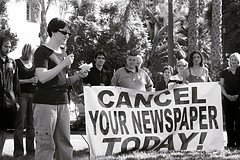
[story in Guardian Unlimited][image from eriwst on flickr]

Investigative journalism 2.0

newspaper_journalismSelf-described new media whore Paul Carr has an interesting take on the future of investigative journalism and publishing – the problem:

Talk to a random sample of journalists and they’ll tell you the same thing – no one commissions investigative journalism any more.

Talk to any editor and they’ll tell you why; it costs a fortune to produce and rarely adds anything in terms of circulation or bottom line.

In an era of plummeting circulation and competition from free online news sources, as far as a cost-benefits analysis of newspaper investigations goes, it’s all cost and no benefit.

Basically another example of the problem of monetizing content that costs a lot to produce but little to reproduce. After dismissing one Web 2.0 business that attempts to address the problems of investigative journalism called Spot Us Mr Carr proffers his own solution:

I’d kill it. Take it out to the shed and put a bullet through its brain. Its been sick since the mid-80s and watching it try to struggle for twenty more years is embarrassing at best and cruel at worst.

Walk in to any bookshop and go to the politics, culture, biography or current affairs section. Now tell me investigative reporting is dead.

Of course these are the big stories – what of the smaller, more immediate ones? TV news. It’s there first, it has money and access and it has a 24 hour cycle to fill, meaning that every lead gets followed and reported no matter how apparently inconsequential.

Online news sources have their part to play too, although, frankly, they can be divided into two camps – brand extension for established media companies or total horseshit. Blogs have a role – but it’s confined to fact checking and uninformed gadflyery.

This gadfly likes Carr’s idea of idea of a cheap, subscription book-service, slightly more in-depth than a typical article in The Economist but less heavy than (for example) the 464 pages of Blackwater: The Rise of the World’s Most Powerful Mercenary Army and you would also get a tighter, more focused, and original piece of reporting:

I’d approach an established publishing house with a business plan – a new imprint that publishes short (40,000 words maybe), low cover price (£4.99 tops) books, each written by a recognised investigative reporter and each dealing with a single investigative subject.

Also recommended is Paul Carr’s recently published book Bringing Nothing to the Party: True Confessions of a New Media Whore. It combines hilarious gonzo journalism with genuine insight from Paul Carr’s experience as a wannabe Web 2.0 entrepreneur.

[story from Paul Carr’s blog][image from dsearls on flickr]

Pay attention, J K Rowling – fan-created content can work in your favour

J K Rowling might be interested to see that suing people who make derivative works based on your own creations isn’t necessarily the best option. YA author Stephanie Myers Meyer took the opposite approach by encouraging her fans to produce a Lexicon of her Twilight Vampire books, and as a result has engendered a hard core of people who evangelise the books on her behalf. [via TechDirt]

Word-of-mouth is the best form of marketing there is, so they say – and getting someone else to do the hard work for you seems like a smart move in a networked world. As I’ve mentioned before, I think the importance of fan-fic in building an author’s career is set to increase over time, and it is in author attitudes to fan-created works that we’ll start seeing the split between writers who have embraced the internet and those who cling to the old paradigms of print.

Watch the Skies – Tor.com goes live beta

Tor.com logo

This week’s big genre fiction news is undoubtedly the long-promised launch of the new-look Tor.com – a publisher’s website that is also a social network, free fiction repository, group-blog and webzine all in one. Go take a look around and see what you can find.

As Charlie Stross points out, it’s been a long time coming – not just for Tor but for big publishing houses in general, who have been slow to adapt to the post-print internet paradigm.

Of course, not everyone is all positive. Genre fiction’s gadfly-in-chief, Futurismic columnist Jonathan McCalmont, wonders if Tor.com is too little (or rather too much) too late:

“I put it to you that this community (which has been admirably quick in adapting to new technologies) is as connected as it can possibly get and that this connection is (aside from a few existing forums) nicely decentralised and organic.

In fact, I put it to you that [the genre fiction] community is getting dangerously close to the saturation point.

Do free ebooks actually affect the sales of paper books?

We’ve had a good few years of activists like Cory Doctorow advocating the free digital book as a loss leader against the physical product, and in the last twelve months or so we’ve seen a distinct rise in the number of authors and publishers getting on board with the idea. The question is – is Doctorow right? Does giving it away make people more willing to pay?

Simon “Bloggasm” Owens has evidently been wondering the same thing, so he thought he’d chase up some of the authors who’ve recently had free versions of their novels released via Tor‘s mailing list. Tobias Buckell and John Scalzi both reported noticeable upticks in sales following their freebies, though fantasy author Daniel Abraham saw no change at all – neither up nor down.

Scalzi points out that it’s risky to make the results into science:

“… I don’t think that ‘scientifically’ is the standard required here; I think ‘heuristically’ is probably better. If you consistently see a rise in sales of an author’s work after the release of a free e-book, then heuristically you have a good idea it’s beneficial.

But the telling thing is this:

Every Tor author [Owens] spoke to for this article said they hoped the publisher would continue offering the ebooks even after the new site debut. When [he] asked them whether they would be willing to offer another book of theirs to the giveaway list there wasn’t a moment’s hesitation with their answers.”

So, we can’t be sure that giving away ebooks is a good thing, but we can say that few who’ve tried it think it’s a bad thing.