Tag Archives: publishing

Can shorter books save fiction?

small-stack-of-books A blogger at The Guardian wonders whether the decline of interest in reading could be slowed by reversing the trend for bigger longer books. [Via SF Signal] [image from stock.xchng]

“Readable in a couple of hours, a novella demands far less time than a full-length novel: you can get through them in the same amount of time it takes to watch a film or two reality television programmes. If you read one in bed you can actually finish it in one go, as opposed to reading the same few chapters repeatedly because you keep forgetting what you covered the night before.”

Perhaps she has a point; she also mentions that writing novellas forces the writer to be more concise and economical with words in much the same way as the short story form.

I guess this is a reiteration of the “burst culture” argument – the idea that as our culture speeds up, we only have the attention span to deal with shorter works. But will a change of format reverse the trend, or is the reading decline a generational phenomenon with more complex roots than simple attention span?

How would you “save the novel”? Does the novel need saving?
How to be a successful science fiction writer

Besides actually sitting down and, you know, writing (which is the bit I always struggle with), there’s no precise science to getting science fiction stories published. over at Orson Scott Card’s Intergalactic Medicine Show, Carol Pinchefsky asks how much value networking has in the tight-knit international community of sf writers and editors.

Meanwhile, Jeff VanderMeer has the inside dope – all the successful genre writers are on drugs!*

[* In case it isn’t absolutely clear, both Mr VanderMeer and I are joking, OK? Joking. No lawsuits required. KTHXBAI.]

[tags]science fiction, writing, publishing, humour[/tags]

Contest to design a new e-reader

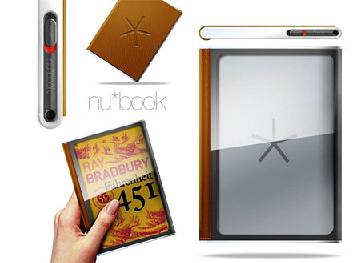
Michael DiTullo’s ‘Nubook’ designAmazon’s Kindle ereader received a rather lukewarm reception. Although some of the concerns related to the high price of both the gadget and the ebooks ($299 for the Kindle plus prices for books not much cheaper than the hard copies they replaced), a lot of vitriol was directed towards the rather clunky design, which resembled something out of the 70s version of Battlestar Galactica.

Over at ‘Industrial Design Supersite’ Core77, they are having a competition to design sketches of e-readers that might live up to the kind of design standard mp3 players have led us to expect. The competition is open to both computer and hand-drawn designs and is open until Tuesday. If you are interested in an ebook revolution, maybe you should enter your own idea. If not, you can still check out some of the interesting sketches so far.

[via Treehugger, image from the contest]

Some statistics about the publishing industry

Hands on a keyboardFreelancingBlog has collected some statistics that should be of interest to any aspiring writers, of fiction or otherwise. It’s kind of a mixed bag – some of them are quite heartening, like this one:

“Book sales account for 25-30 billion dollars in annual revenue?”

While others make you realise that there’s a lot more to getting published than simply bashing out a manuscript:

“Out of every 10,000 children’s books [written], 3 get published.”

As the post says, you’ve got to have guts and perseverance if you want to make it through.

Any writers among Futurismic’s readers who’d care to share their experiences? [Image by dbdbrobot]

[tags]writing, publishing, statistics, career[/tags]

Online publishing: how can we do it right?

Clarkesworld produces regular quality online fictionAs you may have noticed, Paul has been putting lots of links to other online fiction markets over the last week or so – we hope to encourage people to read the stories from all over the interweb. The topic of internet vs traditional publishing has been sweeping the sf blogosphere recently and there are some superb opinions on the subject. Some notable contributions include Erin Hoffman at Homeless Moon, the editor of Clarkesworld, Tobias Buckell, Booksquare on the viability of the iphone as a ebook reader, Paolo Bacigalupi’s superb 5-part critique of the state of the current print mags. Heavyweights John Scalzi, Cory Doctorow and Warren Ellis all helped start the debate.

The print medium hasn’t had such a quick transition into the internet world of the twentieth century, giving it the advantage of seeing how badly its brethren in the music and film industry have dealt with change. By stubbornly trying to hold on to old business models and suing many of those uptaking new technology, music and film executives alienated large quantities of their target audience and only recently has there been movement towards a sensible model. As digital paper and ebook readers get closer to producing an enjoyable reading experience, editors and authors will have to adapt to the digital age too.

The print digital revolution has the advantage of hindsight – we’ve seen how badly avoiding the idea is and have some element of time to start thinking about alternatives. Whether by email weekly story subscriptions, ebook purchases, tipjars for individual stories or community collection before posting, the internet is offering alternatives. I’d be interested to know what Futurismic readers feel about the debate. Of course, we can’t move to a new writing paradigm if people aren’t reading – so travel to some of the links on the side and read some of the great SF out there on the internet already!

[via Tobias Buckell, image from the latest cover of Clarkesworld magazine]