Tag Archives: robotics

Our new cyborg insect overlords

livesilkmothContinuing the robotic insect theme: researchers in Japan are developing the means to recreate the brains of insects in electronic circuits and thus modify existing insect brains to perform useful tasks, like finding narcotics, and earthquake victims:

In an example of ‘rewriting’ insect brain circuits, Kanzaki’s team has succeeded in genetically modifying a male silkmoth so that it reacts to light instead of odour, or to the odour of a different kind of moth.

Such modifications could pave the way to creating a robo-bug which could in future sense illegal drugs several kilometres away, as well as landmines, people buried under rubble, or toxic gas, the professor said.

Kanzaki also observes how remarkably adaptable biological organisms are:

“Humans walk only at some five kilometres per hour but can drive a car that travels at 100 kilometres per hour. It’s amazing that we can accelerate, brake and avoid obstacles in what originally seem like impossible conditions,” he said.

Our brain turns the car into an extension of our body,” he said, adding that “an insect brain may be able to drive a car like we can. I think they have the potential.

It certainly raises interesting questions about how to achieve intelligent machinery: why reinvent the wheel creating strong AI? We can reverse engineer animals that fly or hunt then adapt them to our purposes.
[from Physorg][image from Physorg]

Psikharpax: the robot rat

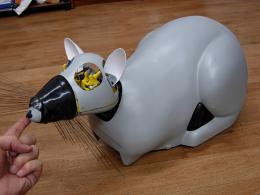
Psikharpax the robot ratDespite some freaky-looking androids coming out of Japan, we have yet to develop robots that can reproduce complex autonomous human behaviours. Perhaps the problem is that we’re aiming too high?
That’s the theory held at the Paris-based Institute for Intelligent Systems and Robotics, at least, who’re looking to the rodent world for inspiration:

Rather than try to replicate human intelligence, in all its furious complexities and higher levels of language and reasoning, it would be better to start at the bottom and figure out simpler abilities that humans share with other animals, they say.

These include navigating, seeking food and avoiding dangers.

And, for this job, there can be no better inspiration than the rat, which has lived cheek-by-whisker with humans since Homo sapiens took his first steps.

The rat is the animal that scientists know best, and the structure of its brain is similar to that of humans,” says Steve Nguyen, a doctoral student at ISIR, who helped show off Psikharpax at a research and innovation fair in Paris last week.

The goal is to get Psikharpax to be able to “survive” in new environments. It would be able to spot and move around things in its way, detect when it is in danger from collision with a human in its vicinity and spot an opportunity for “feeding” — recharging its battery at power points placed around the lab.

“We want to make robots that are able to look after themselves and depend on humans as least as possible,” said Guillot.

Seems like a good idea… provided they don’t build in the natural rodent propensity for rapid reproduction. [via GlobalGuerillas; image borrowed from linked PhysOrg article]

Cube a breakthrough in smart matter

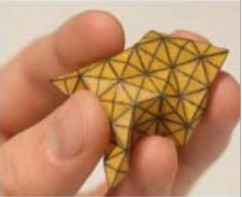
darpa_origami2DARPA are still at it busily inventing the all the science-fictional goodness we expect and deserve. Now they’re going in for programmable matter, of a similar flavour to that found in Fire upon the Deep by Vernor Vinge, Accelerando by Charles Stross, and Dune: The Butlerian Jihad by Brian Herbert and Kevin J. Anderson. The goal of the project is to create matter that can “self-assemble or alter their shape, perform a function and then disassemble themselves.”:

One day, that could lead to “morphing aircraft and ground vehicles, uniforms that can alter themselves to be comfortable in any climate, and ’soft’ robots that flow like mercury through small openings to enter caves and bunker complexes.” A soldier could even reach into a can of unformed goop, and order up a custom-made tool or a “universal spare part.”

One team from Harvard is working on a kind of “generalized Rubik’s Cube” that can fold into all kinds of shapes. Another is trying to order large strands of synthetic DNA to bind together in a “molecular Velcro.” An MIT group is building “’self-folding origami’ machines that use specialized sheets of material with built-in actuators and data. These machines use cutting-edge mathematical theorems to fold themselves into virtually any three-dimensional object.

Very powerful and potentially gamechanging. Presumably if and when these become available to the general public they will have various restrictions built into them that will promptly be overcome and hacked origami-tools will become the ultimate criminal penknife.

On a more cheerful not this have wonderful applications in art and performance.

[from Danger Room]

Is a Terminator scenario possible?

metropolis h+ Magazine conducted a poll of “roboticists, AI workers, SF writers, and other techie types” (the SF writers were David Brin and Vernor Vinge) to see if they thought a “Terminator-like scenario” was possible, and if so, how likely it was. (Via KurzweilAI.net.)

Boiling it down (read the whole thing here), the consensus seems to be 1) forget about the time travel; 2) don’t expect a super-intelligent Skynet to spontaneously awaken and start wiping us out (though rather alarmingly, it was generally thought that was just “highly unlikely,” not flat-out impossible); but 3) do expect a future full of robots, both beneficial and warlike–though in the latter case, the intelligence directing them is likely to be humans of a destructive bent, rather than an AI with its own designs on the planet.

Knowing what humans are capable of, this is not much comfort.

Even though I am by nature optimistic.

(Image: 1935 tobacco card of Fritz Lang’s movie Metropolis, from Film Virtual History.)

[tags]robots, Terminator, artificial intelligence, science fiction, robotics, predictions[/tags]

Garden on the moon

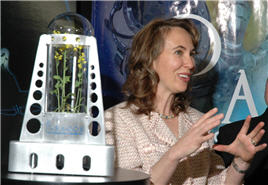
grand-lunar“The Selene Gardening Society,” anybody? Two corporations want to grow vegetables and flowers in a bell jar-like miniature laboratory greenhouse on the moon.

The “Lunar Oasis” has a certain poetry going for it.  “Imagine a bright flower or a plant in a crystal clear growth chamber on the surface of the Moon, with the full Earth rising above the Moonscape behind it...” says Paragon Space Development founder and Biosphere 2 veteran Jane Poynter. Plants have never been grown in a fraction of Earth’s gravity.

Candidates for the experiment besides flowers include aquatic plants and also the unpoetic brassica family (which includes cabbage, broccoli, brussels sprouts).  The garden could be sprouting as early as 2012.The project is a contender for the Google’s $30 million lunar robotics prize.

H.G. Wells, Pierre Boulle, Steve Erikson, and presumably Busby Berkeley must be smiling.

[Image: Grand Lunar (OK, U.S. Rep.) Gabrielle Giffords with lunar greenhouse prototype, Paragon Space Development]