Tag Archives: robots

Rise of the giggling robots: toddlers accept robot as a peer

gigglingrobot Researchers at the University of California San Diego have discovered that it doesn’t take much to get toddlers to accept a robot as just another kid. (Via New Scientist.)

They put a 60 cm-tall robot called QRIO (pronounced “curio”) into a classroom with a dozen toddlers (video here) and programmed it to giggle when its head was touched, to occasionally sit down, and to lie down when its batteries dies. A human operator could also make it look at a child, or wave as one went away. Over several weeks, the toddlers began interacting with QRIO pretty much the same way they did with other toddlers. They’d even help it up when it fell, and when its batteries died and it lay down,  they’d cover it with a blanket and say “night, night.” (Awwww….)

There’s been a lot of recent research on trying to make the robot-human interaction better. Researchers have also taught a robot to dance to a beat, or to a partner’s movement, and are working on giving robots a sense of humor. Add in the martial-arts robots of a few years ago and that robot that conducted a Beethoven symphony, and you’ve got to think a true pass-for-human android a la Blade Runner may not be all that far away.

Whether you think that’s a good idea may depend on how much you took Terminator to heart.

(By the way, this is also the topic of my newspaper science column this week.) (Photo: J. Movellan et al., UCSD.)

[tags]robots, androids, artificial intelligence[/tags]

Robot and human surgeons compare micro-gravity operating skills

Robot surgeon at work in Aquarius underwater habitat

Good news for future space travelers: the world’s first demonstration of robotic surgery in a simulated micro-gravity environment takes place this week, in a collaborative effort between SRI International and the University of Cincinnati.

On four parabolic flights September 25 to 28 aboard a NASA C-9 aircraft (nicknamed the "Weightless Wonder"), a human surgeon will match suturing and similar skills with a robot surgeon tele-operated from thousands of miles away. The robot surgeon is equipped with special software that is designed to help it compensate for "errors in movement" (what you might call those pesky "oops!" moments that surgeons–and patients–just hate) due to turbulence or lack of gravity. The human surgeon is equipped with an airsickness bag.

The remote-surgery robot has already been tested on the Aquarius Underwater Laboratory, 60 feet under the water off the coast of Key Largo, where SRI demonstrated the robot could operate successfully even with a two-second latency, similar to that an Earth-based surgeon would experience if operating such a robot on the moon. Future beneficiaries of such tele-operated surgery could include not only astronauts and military casualties but anyone who needs attention by a surgeon when the hospital is a long way away.

Those who believe they’ve been abducted by aliens and subjected to medical testing, however, might wish to ask for a sedative or a blindfold before a knife-wielding robot is positioned above them.

(Via MedGadget.)

(Photo from NASA via SRI International.)

[tags]robots, medicine, space travel, surgery[/tags]

Mechanical mole robots to the rescue!

The Urban Search And Rescue (USAR) robot design settled on by the Manchester Robotics group after extensive research into the problems of negotiating debris fields

Inspired by the European mole, Robin Scott and Robert Richardson of the University of Manchester hope to develop a digging robot that could "swim" through debris to rescue people trapped under rubble after a disaster. Here’s a video of their new digging mechanism undergoing tests with a range of materials, and here’s an animation that shows how the mechanism works. A search-and-rescue robot based on the design could be ready in as little as two years.

That’s probably longer than you want to wait if you’re trapped under rubble right now, but if you’re planning on being trapped in the future, it’s good to know improved options are on the way.

Other researchers are experimenting with rescue robots that roll, walk or slither.

And then there’s the human-eating firefighter rescue robot. You have to admit, a mechanical mole sounds downright friendly next to that one.

(Via NewScientistTech.)

(Image from Newsline 36, Engineering and Physical Sciences Research Council)

[tags]robots, search and rescue, engineering [/tags]

Robot rock and roll

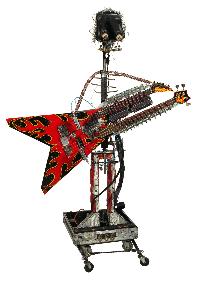
GTRBOT666I love my rock music, and I love robots, and I’ve been heard to remark once or twice that the two spheres of interest simply don’t converge often enough. I need never do so again, however, for thanks to Wired I have now discovered Captured! By Robots – a band that consists of one human guy in a gimp mask and a stage-full of freaky foul-mouthed automatons. Be warned – the video clips beyond the link feature synthesized swear-words and the sort of music that doesn’t make it onto daytime radio. Amen to that.