Tag Archives: satellite

Streamlined satellite

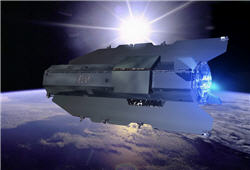
goceThe European Space Agency’s satellite GOCE (Gravity Field and Steady-State Ocean Circulation Explorer ) has been called the most beautiful satellite to be launched (Monday from Plesetsk Cosmodrome in north-west Russia, if all goes well).

GOCE needs a low orbit to accomplish its mission, which is to map “fantasically small” variations in the Earth’s gravity.

The arrow shape and fins are necessary to keep the spacecraft stable as it flies through the wisps of air still present at an altitude just under 270km. This orbit is much lower than for most Earth observation missions but will be essential if Goce is to sense the very subtle gravity anomalies that exist across the planet.

The satellite will also fine-tune its altitude with an ion engine, which accelerates charged xenon atoms through nozzles at the rear of the craft.

The data will inform a multitude of science disciplines:

  • understanding how the mass of ocean waters circulate, moving heat around the planet, will assist climate prediction
  • a better knowledge of the way mass is distributed inside the Earth will be useful to those who study geo-hazards such as volcanoes and earthquakes
  • and because gravity defines what is meant by “up”, “down” and “level”, the new data can underpin a truly universal system to compare heights the world over

This first of at least six projected  missions is being launched by a modified ICBM. Glad to see one of those things get put to good use.

[Image: NASA]

US and Russian satellites collide

satellite_dieOn Tuesday a satellite owned by the US company Iridium collided with an inoperative Russian satellite nearly 780 km above the Earth:

The risk to the International Space Station and a shuttle launch planned for later this month is said to be low.

The impact produced massive clouds of debris, and the magnitude of the crash is not expected to be clear for weeks.

There are thousands of man-made objects orbiting the earth, but this is thought to be the first time two intact spacecraft have hit each other, the BBC’s Andy Gallacher in Miami says.

Unfortunately as Earth orbit becomes more and more crowded (the number of orbiting objects larger than 10 cm reached 10, 000 in 2007 and is still increasing) it increases the risk of a cascade effect, where one collision results in a cloud of debris that go on to cause more collisions resulting in millions of tiny fragments resulting in a major and ongoing hazard to space exploration.

Given the risk of hindering future space exploration – is it worth pushing for an Earth orbit cleanup (and is such an idea even feasible)?

[from the BBC][image from Joe Hastings on flickr]

The Internet will go interplanetary

NASA finished first tests on a system that

could one day be used to automatically relay information between Earth, spacecraft, and astronauts, without the need for humans to schedule transmissions at each point. …

For the test, dozens of images of Mars and its moon Phobos were transmitted back and forth between computers on Earth and NASA’s Deep Impact spacecraft. The craft, which sent an impactor into Comet Tempel 1 in 2005, has been renamed “Epoxi” now that it its mission has been extended to search for extrasolar planets.

Further tests will begin on the International Space Station next year.

[Story: New Scientist; picture: NASA/JPL]

Danes hope to launch rocket man

Danish researchers at the Copenhagen Suborbitals project seek to launch a one-man rocket projectile into space, from their mission statement:

This is a privately funded suborbital space endeavor.
Our mission is to launch a human being into space.

We are currently developing a series of suborbital space vehicles – designed to pave the way for manned space flight on a micro size spacecraft.

Two rocket vehicles are under development. A small unmanned sounding rocket, named Hybrid Atmospheric Test Vehicle or HATV and a larger booster rocket named Hybrid Exo Atmospheric Transporter or HEAT, designed to carry a micro spacecraft into a suborbital trajectory in space.

What fun! The thought of riding into the sky inside a rocket!

Apparently the idea is for the astronaut to be situated in a standing position beneath the transparent, polymer-plexiglass nose-cap!

Their candour is to be saluted, as is the bravery of the prospective astronaut. I wonder if the project will ever come to fruition?

[via Boing Boing][image from the Copenhagen Suborbital website]

Shooting the moon

An artist's impression of MoonliteSpace scientists have come up with a novel way of studying the moon (and possibly later other satellites like Europa). Scientist Sir Martin Sweeting’s Moonlite experiment plans to launch a satellite to orbit the moon. Once in orbit, the satellite would fire four dart-like missiles at the moon’s surface, penetrating three or four metres to study the composition beneath the ground.

Planned for a launch in 2013, the project has had recent tests of the high powered darts in South Wales prove very successful. The subterranean probes are hoped to provide details on the heat flow, seismic activity and water components of our closest astronomical friend.

Meanwhile, the most recent astronomical mission is having problems with its own studies of extraterrestrial soil. The Phoenix lander is struggling to sift the clumpy Martian soil to small enough pieces to study in its compact detectors. The robotic lander is resorting to shaking and sprinkling soil samples with its robotic arm to get material small enough to study.

[picture by SSTL and story via BBC]