Tag Archives: science fiction

NEW FICTION: A PROGRAMMATIC APPROACH TO PERFECT HAPPINESS by Tim Pratt

I can’t tell you how proud I am to be introducing a story by Tim Pratt at Futurismic. Seriously; this isn’t a man short of professional venues for his wide-ranging fictional output, but he tells us he’s been keen to sell us a story for some time now, and “A Programmatic Approach to Perfect Happiness” rang Chris’s editorial bell in just the right way. It’s something a little different to our usual house style: a little Gonzo, a little retro, but all Tim Pratt. I hope you enjoy it!

A Programmatic Approach to Perfect Happiness

by Tim Pratt

My step-daughter Wynter, who is regrettably prejudiced against robots and those who love us, comes floating through the door in a metaphorical cloud of glitter instead of her customary figurative cloud of gloom. She enters the kitchen, rises up on the toes of her black spike-heeled boots, wraps her leather-braceleted arms around my neck, and places a kiss on my cheek, leaving behind a smear of black lipstick on my artificial skin and a whiff of white make-up in my artificial nose. “Hi Kirby,” she says, voice all bubbles and light, when normally she would never deign to utter my personal designation. “Is Moms around? Haven’t talked to her in a million.”

I know right away that Wynter has been infected.

I carefully lay my spatula aside. “Your mother is… indisposed.”

She rolls her eyes. “Whatever makes you two happy.” She flounces off toward her bedroom, the black-painted shadowy forbidden portion of our home that my wife April calls “the tumor.”

I go to our bedroom door, push it open gently, and say, “Darling, your post-coital brunch is ready, and I believe Wynter has been infected by the H7P4 strain.”

A groan emerges from the pile of blankets, straps, and oddly-angled cushions that constitutes our bed. “Oh, god. Which one is that again?”

“The one that makes you happy,” I say, and close the door on April’s sardonic laughter. Continue reading NEW FICTION: A PROGRAMMATIC APPROACH TO PERFECT HAPPINESS by Tim Pratt

Friday Free Fiction for 27th March

I knew it was too good to last; a solid week of sunny weather, and now it seems we’re back to grey skies and low temperatures. But hey, the sun always shines on the internet (provided you’re searching the right tags on Flickr), and there’s always free science fiction stories at Futurismic on a Friday afternoon…

***

Via Jonathan Strahan, we discover that Night Shade Books have made Ted Chiang’s Hugo-nominated short story “Exhalation” available for free in a variety of formats: PDF, HTML, RTF and Mobipocket

***

Mary Robinette Kowal is a Hugo nominee, too; go check out her “Evil Robot Monkey

***

Lou Anders of Pyr reveals that the short story “A Book of Silences” by James Enge is now gracing their free samples page; looks to be more in the fantasy line than we’re usually interested in here at Futurismic, but hey, nothing says you can’t read other stuff too, right?

***

We’re up to chapter 4.1 with Jason Stoddard‘s Eternal Franchise

***

A message from Lee Gimenez:

My science fiction story “The Wellness Center” was just published in the March edition of Aphelion Magazine.

Congratulations, Lee, and thanks for the tip-off!

***

As we’ve thrown some fantasy into the mix, why not a soupcon of horror, too? Tim Lebbon announces an excerpt from his new novel Bar None:

It’s a novel of  ‘chilling suspense, apocalyptic beauty, and fine ales’.   So as a pre-weekend treat, the first ever extract is now available at Dread Central for your perusal and delectation. It reads with a soft fruity aromas, a smooth mouthfeel, and finishes with a dark and complex aftertaste.

Knowing Lebbon, he was probably half-cut when he wrote it, too…

[ Disclosure – Tim Lebbon is one of my clients, and is not really a heavy drinker. Or so he claims. ]

***

The DVD Extras are coming thick and fast for Season 2 of Shadow Unit; this one’s called “Ice

***

Strange Horizons presents “The Spider in You” by Sean E Markey

***

HUB Magazine presents “Hush a Bye” by Beverley Allen

***

Mary Robinette Kowal pops up again, this time at BoingBoing in her capacity as editor of Shimmer Magazine:

“For Shimmer magazine’s 10th issue, we’ve got twelve fantastic new stories and an interview with none other than Cory Doctorow. In honor of Cory’s work with Creative Commons, we are giving away the pdf of issue ten as a free download.”

***

Jayme Lynn Blaschke‘s Memory rolls onwards with its thirty-fifth chapter.

***

The SF Signal crew have been gathering free fiction links like gangbusters this week, so it appears. There are two massive roundup posts as well as the following tidbits:

***

And finally, a fistful of Friday Flash Fiction:

***

That should keep your eyeballs busy for a few hours… don’t forget to keep us informed if theres anything you think deserves a plug here at friday Free Fiction, and have a great weekend!

Design and SF: an essay on intersection

spiral_designJulian Bleecker has written a fascinating essay on the intersection of science fiction and design and how they cross-pollinate, and how SF design (mostly movie-oriented) influence actual design, go read:
Design Fiction is making things that tell stories. It’s like science-fiction in that the stories bring into focus certain matters-of-concern, such as how life is lived, questioning how technology is used and its implications, speculating bout the course of events; all of the unique abilities of science-fiction to incite imagination-filling conversations about alternative futures.

It’s about reading P.K. Dick as a systems administrator, or Bruce Sterling as a software design manual. It’s meant to encourage truly undisciplined approaches to making and circulating culture by ignoring disciplines that have invested so much in erecting boundaries between pragmatics and imagination.

[via Boing Boing][image from stage88 on flickr]

David Brin guestblogging at Sentient Developments this week

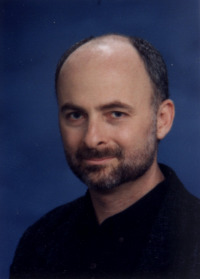
David BrinThis week, transhumanist blogger George Dvorsky’s site Sentient Developments plays host to no less a science fiction luminary than David Brin as guest blogger. Says Dvorsky:

David will be writing about biological uplift, the Singularity, Active SETI (messages to extraterrestrial intelligences), and how a transparent society might work to help us mitigate catastrophic risks.

Topics that should be of some interest to Futurismic regulars, then; I file David Brin among the group of authors and thinkers with whom I don’t always agree, but who never fail to challenge my thinking.

Dvorsky has taken the time to provide a reading list around Brin’s first topic, namely biological uplift, and that first post is ready to read as I type. Here’s a snippet:

1. Can we replicate – in other creatures or in AI – the stunning way that Homo sapiens outstripped the needs of mere hunter-gathering, to reach levels of mentation that can take us to other planets and invent symphonies and possibly destroy the world? That was one hell of a leap! In Earth I speculated about half a dozen quirky things that might explain that vast overshoot in ability. In my next novel Existence I speculate on a dozen more.

In truth, we just don’t know. I frankly think it may be harder than it looks.

Go read. [Brin portrait from Wikimedia Commons]

Self-publish and be damned? The modern writer’s dilemma

Damien G Walter has been thinking about self-publishing, reassessing the established wisdom that self-publication is de facto a bad thing.

To date, self publishing has been a bad idea. People without the necessary skills and experience full prey to vanity publishers. Writers with some talent but who are still learning can expose their work too soon. Excellent writing can find itself swamped among the dross that is self published every year and no one bothers to go looking for it. The general wisdom on self publishing for anyone who aspires to become a professional author has been… don’t.

Walter goes on to point out that the landscape has changed somewhat in recent years, with rising stars such as John Scalzi and Kelly Link owing some portion of their success to self-publication of one stripe or another, and with the publishing industry suffering at the hands of market forces.

The main argument against self-publication is that it usually results in work that will harm the author’s reputation: rip-off vanity press jobs, or simply work that isn’t ready for publication which would have benefited from more revision and/or editorial input. These problems apply more to the beginning author, though; the point has been made before that an author with the stature of Stephen King could probably self-publish with a great deal of success (not to mention a bigger profit margin). But the principle appeal of self-publishing for a new author with genuine skill is the opportunity to start building an audience and having readers engage with the work… and that’s not so easy a benefit to dismiss.

Walter concludes:

If the general wisdom about self publishing has been ‘don’t’, its likely that wisdom may change to ‘do – but with great caution’. There has always been a role for self publishing, but as that role grows, the provisos that accompany self publishing will grow all the more important. Authors will need to be aware that self publishing means more than just having a book printed. It means being an editor, a distributor and a marketer of your own work. It means investing in yourself in exactly the way a good publisher invests in their authors, whilst taking the risks a good publisher also takes. It means understanding the arc of your own career as a writer in the same depth that good editors and agents do. And most of all it means having an honest and accurate understanding of the quality of your own writing, maybe the hardest thing of all.

For most self publishing will continue to be a mistake, but for writers with enough talent and determination it is already becoming an important part of building a readership, one that for many writers it will be a mistake to simply dismiss.

For what it’s worth, my work as a music reviewer has exposed me to a similar evolution in the music business; it’s easier than it has ever been for a band or soloist to record their work and make it available to anyone. As with writing, many of them jump the gun and release before their work is up to a standard where it can survive against product recorded and promoted by the established labels… but there are the occasional success stories, be they out-of-nowhere newcomers or established acts turning their backs on an exploitative  system.

This contrasts with our recent post on comics self-publishing, where Jim Munroe pointed out that the stigma against self-published works in the comics field is minimal by comparison to the literary field, and suggests that it may be because it’s easier to discern the quality of comics ‘at a glance’.

Will we see a change in attitude toward self-publishing in years to come? I think it’s inevitable, though it will take time… and the sheer mass of terrible self-published work (much of which Futurismic receives email about on a daily basis, I might add) will do much to slow it.

But economics may provide an accelerating force; all bets are off on how things will look in five years’ time. So, writers in the audience – published or otherwise – have you self-published, or considered doing so? And what factors influenced your decision?