Tag Archives: science fiction

2007 Nebula Award longlist announced

The preliminary list of nominees for the 2007 Nebula Awards have been announced. Below are the novel selections, with the novella, novelette, short story and film selections available at the SFWA site. Some of the novels have free links as listed below, although some require you to be a SFWA member. My favourite of those I’ve read is Chabon’s excellent alternate history. What do people think of the list?

NOVELS:

Ragamuffin, by Tobias Buckell

(Tor, Jun07)    First Third available on his website for free

The Yiddish Policemen’s Union, by Michael Chabon
(HarperCollins, May07)

Species Imperative #3: Regeneration, by Julie E. Czerneda (full PDF on Private Edition)
(DAW, May06)

Vellum: The Book of All Hours, by Hal Duncan
(Del Rey, Apr06 (Macmillan hardcover Nov05 (UK)))

The Accidental Time Machine, by Joe Haldeman
(Ace, Aug07)

The New Moon’s Arms, by Nalo Hopkinson
(Warner Books, Feb07)

Mainspring, by Jay Lake
(Tor, Jun07)

Odyssey, by Jack McDevitt (full PDF on Private Edition)
(Ace, Nov06)

The Outback Stars, by Sandra McDonald
(Tor, May07)

Strange Robby, by Selina Rosen (full PDF and hardcopy offer on Private Edition)
(Meisha Merlin Publishing Jul06)

Harry Potter and the Deathly Hallows, by J.K. Rowling
(Scholastic Press, Jul07)

Rollback, by Robert J. Sawyer
(Analog, Feb07 (serialized in Oct06 through Jan/Feb07 issues; Tor book, Apr07))

Blindsight, by Peter Watts (free Creative Commons versions)
(Tor, Oct06)

[links from the SFWA page, via numerous editors and authors]

How to be a successful science fiction writer

Besides actually sitting down and, you know, writing (which is the bit I always struggle with), there’s no precise science to getting science fiction stories published. over at Orson Scott Card’s Intergalactic Medicine Show, Carol Pinchefsky asks how much value networking has in the tight-knit international community of sf writers and editors.

Meanwhile, Jeff VanderMeer has the inside dope – all the successful genre writers are on drugs!*

[* In case it isn’t absolutely clear, both Mr VanderMeer and I are joking, OK? Joking. No lawsuits required. KTHXBAI.]

[tags]science fiction, writing, publishing, humour[/tags]

New blog on the block: Gawker’s io9

io9addict Doubtless after realising that the Futurismic team, as awesome as we are, just don’t have the resources to cover everything, the folk at Gawker Media have started a new science fiction blog, io9, headed up by none other than Annalee Newlitz. [Image lifted from i09 introductory post]

From the looks of it so far, they’re going to be covering all sorts of funky science fictional stuff, and not just the written fiction and plausible technogeekery we try to stick to here – so I’m guessing there’s room in your RSS reader for both. 🙂 And as Scalzi points out, fandom will not be slighted lightly … still, they’re off to a good start from my point of view, with a post that faces the rotting elephant carcass in the room and points out six reasons that Star Trek should stay dead. Amen, brothers and sisters.

[tags]science fiction, blog, io9[/tags]

A New Year’s look at 2007’s science fiction

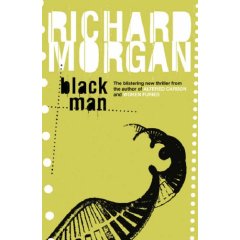
I preferred the US title but the UK cover to Richard Morgan’s excellent bookAs the year draws to a close I thought I’d highlight some of the delights I’ve read in the SF genre this year.

Two of the best books I’ve read this year are Spook Country by William Gibson and The Yiddish Policeman’s Union by Michael Chabon but as they are generally considered mainstream rather than SF, I’ve left them out of my top five. Gibson in particular brings the boundaries between the present and the future closer together than ever before.

Top Five for 2007:

5. Joel Shepherd – Breakaway/Killswitch (books 2 + 3 of the Casssandra Kresnov trilogy) – Pyr have brought over this extremely good trilogy from Australia and the combination of insightful interstellar politics, kickass action and Battlestar Galactica-esque discussion of what it means to be human make these books following android Cassandra Kresnov a real hit.

4. Alastair Reynolds – The Prefect A real step up for Reynolds comapred to his previous work, with a much more sympathetic protagonist and a racy police-thriller plot. The worldbuilding in each of the space stations along the Glitter Band and the crisis that develops are intriguing and engaging.
3. Ian McDonald – Brasyl Three plotlines across three times in Brazil’s past, present and future interconnect with dizzying vision and skill. In addition to some incredibly cool future tech and scientific ideas, McDonald continues his trend of highlighting a country less explored in SF, really giving the reader a feel for the wonderfully different world of South America.

2. Charles Stross – Halting State Stross has many pans in the fire but this is easily my favourite of his novels so far. The extrapolation of today’s MMOs and online games into a complex near future of virtual realities and spy networks is breathtaking and the humour helps the thriller aspects tick along nicely. This year’s Rudy Rucker in the ‘most likely to happen’ category.
1. Richard Morgan – Thirteen (or Black Man in Europe) Morgan really stepped it up a notch with his fifth novel. The near-future Earth is brilliantly done and the moral ambiguities of the genetically altered hero and the world’s politics resonate strongly with current events. The action is frenetic and the plotline zips along but the worldbuilding of 90 years from now is what made me love this novel.

A special mention to the anthology edited by Lou Anders – Fast Forward #1. It’s really encouraging to see a broad remit anthology featuring superb new stories from big authors, rather than reprints and best of the year collections. John Joseph Adams’ Wastelands is also excellent. I’m sure I’ve missed a few books – what were your highlights of 2007?

Kim Stanley Robinson interviewed

Kim_Stanley_Robinson BLDGBLOG has an excellent in-depth interview with Kim Stanley Robinson, in which he discusses his attempts to redefine utopias, the ideological bankruptcy of primitivism, how rational design in architecture and technology is one of the crucial keys to surmounting the problems presented by our changing environment, and much more.

A brilliant interview with a brilliant thinker … and hosted on a brilliant blog. You may think you’re not really interested in architecture, but I think an exploration of BLDGBLOG‘s archive would prove you wrong. Go read. [Image from Wikipedia]

[tags]Kim Stanley Robinson, climate change, science fiction, interview[/tags]