Tag Archives: SF

Best SF Movies Ever?

Over at AMC, John Scalzi points out that AFI has released a top ten list of films from the SF and Fantasy genre, and he’s written a new Top Ten List featuring films made since 1991:

“One interesting thing about the list, however, is that it stops 17 years ago; the latest film to be included on the list is Terminator 2: Judgment Day, which hit screens in 1991. On one hand, this makes perfect sense, because it really does take time to find out which films are influential and which ones aren’t…On the other hand, there have been a fair number of genuinely excellent science fiction films since Arnold had his Terminator self dipped in hot metal, and it seems a shame to not give a shout out to them.”

Fifth Element seems to have a lot of the popular vote, as does the Matrix, but what do Futurismic readers think? Which movies would you add to or remove from that list?

One of the interesting aspects of written word SF is its ability to take up social problems in an SFnal context.  But the same ideas don’t translate well to the big screen, and what we end up with are inaccurate disaster thrillers like The Day After Tomorrow.  Are there any SF movies that take up ideas and social problems without forsaking the spectacle and CGI that run amok in a lot of SF?  

How to define a genre … and why not to bother

Blasphemous Geometries returns, ready to bask in your merciless indifference.

Blasphemous Geometries by Jonathan McCalmont

This month Jonathan McCalmont has been thinking about that perennial discussion that is mathematically certain to arise in any situation where three or more sf fans or critics are gathered – how do we define science fiction? Jonathan has decided that we should stop trying. Continue reading How to define a genre … and why not to bother

Time is A One Way Street…

TimeThe June 2008 issue of Scientific American sets out to answer a very perplexing question:

Why does time only move forward?

To find the answer, according to Sci-Am and Mr. Sean M. Carroll, we have to start looking at a very unlikely place:

To account for it, we have to delve into the prehistory of the universe, to a time before the big bang. Our universe may be part of a much larger multiverse, which as a whole is time-symmetric. Time may run backward in other universes.

The article is filled with high-end physics and a bit of science jargon, but Mr. Caroll puts uses neat little analogies to explain difficult concepts:

The asymmetry of time, the arrow that points from past to future, plays an unmistakable role in our everyday lives: it accounts for why we cannot turn an omelet into an egg, why ice cubes never spontaneously unmelt in a glass of water, and why we remember the past but not the future. And the origin of the asymmetry we experience can be traced…back to the orderliness of the universe near the big bang. Every time you break an egg, you are doing observational cosmology.

All in all, it’s a very interesting article and well worth a read. Some of the concepts used in the article are highly science fictional and are prime idea fodder for stories about multiverses and time travel. In fact, for those who’ve read River of Gods, may recognize the inspiration for ideas in that novel presented in this article. [image by gadl]

Open Source SF

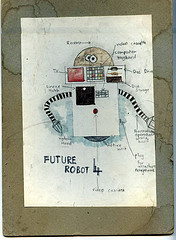
Open Source RobotOver at SF Signal, several writers and editors were asked the following question:

Which medium is driving [SF] … books or Film/TV?

There were interesting responses all around I thought, but the most thought proving answer, IMHO, came from io9 editor Charlie Jane Anders, who said:

“The future of science fiction is probably online, in a blend of written material, video and other media. The best science fiction of the future will be open source and collaborative, blurring the distinction between “creators” and “fans” to an increasing degree… there will be obvious advantages in opening things up to collaboration. One major difference between [SF] and most other genres is worldbuilding. And the more people you have involved in your worldbuilding, the bigger and more realistic your world can be. So the most compelling science fictional worlds online will be ones that are, at least to some extent, open-source…”

I can’t point to any examples of open source SF in online print and video venues directly yet, but consider what video games like Neverwinter Nights, Starcraft, et al. are/were doing for RP-style games with level builders or what Second Life is doing for massive online communities, and we may see what Ms. Anders is getting at. [image by Salim]

A virus with space-shoes – SF, YA and all that

Welcome back to Blasphemous Geometries – science fiction criticism that goes where sex ed. teachers fear to tread.

Blasphemous Geometries by Jonathan McCalmont

This month Jonathan McCalmont looks at the entanglement of science fiction with Young Adult literature, and wonders whether YA is the latest victim of science fiction’s aggressive expansionist tendencies. Continue reading A virus with space-shoes – SF, YA and all that