Tag Archives: simulation

Dune roleplayers in Second Life squelched by IP takedown notice

The big brands may have all but abandoned Second Life, but the still-growing (yet still somewhat troubled) metaverse platform remains a haven for niche-interest communities… like roleplayers re-enacting locations and events from intellectual properties such as films and novels, for example.
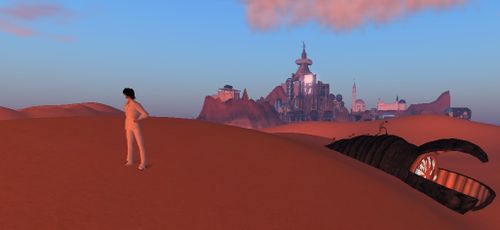
Second Life Dune simulation (with sandworm)

One such small community is based around Frank Herbert’s famous Dune series, acting out conflicts between the Fremen and House Harkonnen, riding sandworms and so forth. Or at least they were until very recently, when the estate of Frank Herbert issued a legal notice for the group to discontinue their reappropriation of controlled intellectual property. [image by Wagner James Au, borrowed from linked article]

In his write-up, Wagner James Au makes the point that there are other unofficial RPG sims in Second Life that make use of controlled IP (from franchises like Star Wars and Star Trek, for example) but who have been allowed to continue by the legal types – whether that be because they consider it to be not worth the hassle to shut them down, or that they can see value in fans propagating their memes without being paid to do so, remains uncertain.

Au also claims the Dune take-down notice to be the first such official occurance in SL; I’m not so sure about that, as a friend of mine from The Wastelands claimed to have been stomped by Bethesda Software for selling Fallout-themed items from a shack to cover his land tier payments. It may have been an exaggeration, but his bitterness about it suggested otherwise.

But the question remains: how effective is this sort of take-down at preserving the image of a brand or property? Sure, you may prevent people from making a little pocket-money off the back of your copyrights, but the PR value of letting them be (or, heaven forfend, encouraging them) could be pretty significant… as could the inverse.

That Dune sim has been running for a good year and a half; I remember visiting it when it first opened. Now, if it’s taken Herbert’s estate that long to catch on to a genuinely tiny community of roleplayers, things are only going to get harder. After all, there’s only one Second Life at the moment, but in a decade or so there’ll be hundreds of them.

Will big brands hire researchers to trek through digital realities in search of reappropriated brands, characters and memes, like IP bountyhunters? Will kill-filed private sims harbour markets where you can buy cheap and unofficial avatars based on properties owned by Disney, Pixar and all the rest?

Who knows. One thing can said for certain, however: if the lawyers wanted to protect the sanctity of Dune as a much-loved brand, the first thing they should have done was kept Kevin J Anderson well away from it…

Travel to Mars… without ever leaving the parking lot

MarsSo, do you think you could cope with the cramped conditions and prison psychology that would be an inevitable part of a manned mission to Mars and back?

Well, here’s the test – we’ll lock you in a fake space capsule that’s sitting in a parking lot somewhere outside of Moscow for about a hundred days with five other people and watch you through cameras to see how you get on.

The idea is for the 550 cubic-metre “ground exploration complex” (GEC) to recreate as closely as possible the atmosphere of a spacecraft racing through the solar system, bombarded by cosmic radiation. Any return flight to Mars – at least 34 million miles from our planet – would take between 18 months and three years, including landing and exploration.

The volunteers – four Russians, a French airline pilot and a German army engineer – will be kept under constant camera surveillance to record the physical and psychological impact of their time in the isolation chamber.

Isn’t this lifted wholesale from a J G Ballard story? You’re surely going to get some industrial-grade cabin fever going on…

Mark Belokovksy of the IMBP admitted the psychological pressure of living in close quarters with five other human beings could crack even the toughest guinea pigs.

“Tension is inevitable,” he said candidly. The fact the 105-day “flight” will be a single-sex trip on this occasion may be a blessing. During a similar experiment in 1999 the participants were given vodka to celebrate New Year’s Eve: two members then got in a fist fight after one tried to kiss a female volunteer from Canada.

Yeesh; the green-eyed monster in outer space, no less. I wonder where I can find details about that Canadian experiment – I’m curious to know whether the women fared any better at the isolation than the men did. Would an all-female crew be more stable, or less? How about a crew of eunuchs?

But if you’ll permit me a brief flight of fancy, mashing up this story with that half-remembered Ballard piece and the Moon hoax conspiracy theories: I wonder if it would be possible for a government with sufficient space capability to run an entirely faked CGI Mars mission that fooled everyone, even the cosmonauts themselves? [image by jasonb42882]

The silicon brain

neural networkMost attempts to simulate the function of organic brains using computers have been software simulations – models built with code, if you like. An international team of computer scientists have been trying the other approach, however: building computer hardware that mimics the dense interconnection of brain cells.
The hope is that recreating the structure of the brain in computer form may help to further our understanding of how to develop massively parallel, powerful new computers, says Meier.

This is not the first time someone has tried to recreate the workings of the brain. One effort called the Blue Brain project, run by Henry Markram at the Ecole Polytechnique Fédérale de Lausanne, in Switzerland, has been using vast databases of biological data recorded by neurologists to create a hugely complex and realistic simulation of the brain on an IBM supercomputer.

[snip]

The advantage of this hardwired approach, as opposed to a simulation, Karlheinz continues, is that it allows researchers to recreate the brain-like structure in a way that is truly parallel. Getting simulations to run in real time requires huge amounts of computing power. Plus, physical models are able to run much faster and are more scalable. In fact, the current prototype can operate about 100,000 times faster than a real human brain. “We can simulate a day in a second,” says Karlheinz.

A day in a second, huh? That’s straight out of your favourite Singularity sf story, right there. [image by neurollero]

Transhumanists talk a great deal about the inevitability of human-equivalent artificial intelligence in the very near future, and it’s easy to dismiss them as dreamers until you read an article like this. I’m not saying that silicon brainware means the Singularity is inevitable, or even likely… but I think I’ll start learning to speak in machine code. Y’know, just in case.

Immersive 3D: ‘Please touch’ coming soon?

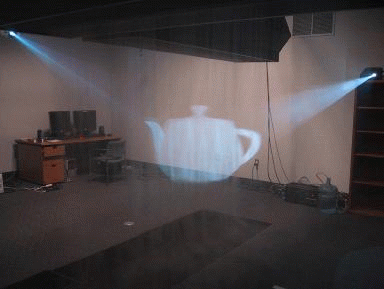
immaterialteapotThe ability to touch and manipulate 3D images is key to the future of interactive entertainment, not to mention every other episode of Star Trek: The Next Generation. Now two UC-Santa Barbara researchers say they’ve built a prototype room-sized 3D display using projectors, a user-tracking system, and two FogScreens, which produce 2D images using microscopic water droplets and ultrasound.

To achieve the 3D effect, the same image is rendered on two overlapping screens at different depths. Users’ head positions are tracked since the 2D images on each screen depend on the user’s viewing direction. The system computes the image alignment in real time, and users see a single, fused 3D image where the screens overlap.

But a room-sized DFD [depth-fused 3D] still presents technical challenges for researchers. For instance, the fog from two FogScreens can bleed through and disrupt each other, air conditioners and open doors can cause turbulence that interferes with the image quality, and alignment and tracking errors can occur because people view the 3D images with two separate eyes.

Possible future applications include virtual museums, surgery, and offices, not to mention virtual catch or Frisbee.

[Image: 3D teapot by Cha Lee, UCSD, IEEE]

The Army’s Iraq Simulator

robotmannequinLast November, Public Radio International’s Here and Now broadcast a news story about the U.S. Army’s 1,000-square-mile National Training Center at Fort Irwin, in California’s Mohave Desert — an urban warfare simulator now being used to train soldiers bound for the real Iraq. Now a documentary film about the site, Full Battle Rattle, follows an Army battalion and role-playing insurgents “as they attempt to quell an insurgency and prevent Medina Wasl, a mock Iraqi village, from slipping into civil war.” Fake body parts, robot mannequins, costumed American and Iraqi actors, and Killed In Action cards are all part of the mix.