 If you thought we were all done with millennial panics and numerically significant dates for another thousand years or so, think again. Mac Tonnies looks a short way ahead to December 2012, the much-touted end of the Fifth Sun of the Mayan calendar, and wonders whether we’re doomed as a species to perpetually rebuild such temporal milestones. Continue reading Why I’m looking forward to 2012
Tag Archives: Singularity
And I, for one, welcome our new robot scientists
 Robots are ideal for doing human tasks that are repetitive, like screwing lids on cosmetic bottles, welding car panels… and now making scientific discoveries. Columbia University’s “Adam” machine is “the first automated system to complete the cycle from hypothesis, to experiment, to reformulated hypothesis without human intervention”.
The demonstration of autonomous science breaks major ground. Researchers have been automating portions of the scientific process for decades, using robotic laboratory instruments to screen for drugs and sequence genomes, but humans are usually responsible for forming the hypotheses and designing the experiments themselves. After the experiments are complete, the humans must exert themselves again to draw conclusions.
[snip]
They armed Adam with a model of yeast metabolism and a database of genes and proteins involved in metabolism in other species. Then they set the mechanical beast loose, only intervening to remove waste or replace consumed solutions. […]
Adam sought out gaps in the metabolism model, specifically orphan enzymes, which scientists think exist, but which haven’t been linked to any parent genes. After selecting a desirable orphan, Adam scoured the database for similar enzymes in other organisms, along with the corresponding genes. Using this information, it hypothesized that similar genes in the yeast genome may code for the orphan enzyme.
The process might sound simple — and indeed, similar “scientific discovery” algorithms already exist — but Adam was only getting started. Still chugging along on its own, it designed experiments to test its hypotheses, and performed them using a fully automated array of centrifuges, incubators, pipettes, and growth analyzers.
After analyzing the data and running follow-up experiments — it can design and initiate over a thousand new experiments each day — Adam had uncovered three genes that together coded for an orphan enzyme. King’s group confirmed the novel findings by hand.
Score one for the Singularitarians – autonomous systems that can follow the scientific method without supervision would surely be a component of an emergent self-improving artificial intelligence, if I understand the theory correctly. [image by jurvetson]
And why not outsource our more tedious scientific tasks to robot underlings? After all, we’ve been fairly unhesitating in our rush to do the same with warfare… no matter how ethically blurred an idea that may be:
Seeking Solace in the Abyss
Mac’s back, and he’s been thinking bleak thoughts about a post-climate-change planet. How much of a part does our certainty of apocalypse play in ensuring it comes to pass – and can an agnostic approach to our ultimate fate help us prevent it happening? Continue reading Seeking Solace in the Abyss
David Marusek on posthumanism and a soft singularity
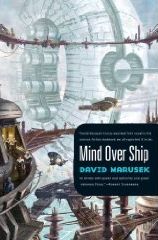 We’ve had it straight from the horse’s mouth that Charlie Stross isn’t an ideologue for the a posthuman future, but it appears (allowing for a little authorial hyperbole) that David Marusek is a little more bullish on the matter, due to his own reconception of what a singularity might really mean:
I sincerely believe that our near future includes the existence of posthumans. That is, if secular civilization survives and science advances, our subspecies Homo sapiens sapiens will branch out. Whether through purely biological means or in combination with some sort of inheritable machinery or machine interface, a new subspecies of human will coexist alongside us. Nothing like this has occurred for 30,000 years when our hominid cousin, the Neanderthal, was still around, or 200,000 years when we shared the planet with possibly three other human species. But this time we’ll be the obsolete species.
The idea of humans creating their own successors has been around for a long time and provides rich material for storytelling. The thing is, in most sf tales, you have to go through a Vingean Singularity to get to the Posthuman Future. We old model humans do poorly in singularities; by definition we are the past. Thus posthuman stories tend to be about trying to fight off the posthumans, especially if they’re machines. Brave humans strive to prevent their rise and maintain our biological supremacy. And this is where I try to break new trail in Mind Over Ship. I’m proposing a singularity that does not deny the importance of the human body but instead relies upon it.
The loathing of the body is one of the many detractions used against Singularitarian thinkers, and it’s easy enough to understand why (although, on some mornings, I’d gladly upload myself out of this damage-prone meat-machine). Perhaps Marusek’s new take on the trope will inspire another schism in post-human philosophy – a ‘soft’ singularity, perhaps?
And while we’re on the subject, Marusek’s new novel Mind Over Ship is a brilliant read, and comes heartily recommended to anyone who likes their sf to come packed to the brim with brain-bending ideas and complex plotting. Go buy it.
Bruce Sterling sideswipes AI evangelism
Bruce Sterling’s keynote speech at the Webstock conference in New Zealand last month contained the usual high concentration of non-fic eyeball kicks, and is well worth a read if you’re at all interested in the culture of the web, modern economics and the near future.
As usual, there are loads of provocative little asides nestled in the narrative, and I was particularly taken by this backhander to the face of artificial intelligence advocates:
I really think it’s the original sin of geekdom, a kind of geek thought-crime, to think that just because you yourself can think algorithmically, and impose some of that on a machine, that this is “intelligence.” That is not intelligence. That is rules-based machine behavior. It’s code being executed. It’s a powerful thing, it’s a beautiful thing, but to call that “intelligence” is dehumanizing. You should stop that. It does not make you look high-tech, advanced, and cool. It makes you look delusionary.
There’s something sad and pathetic about it, like a lonely old woman whose only friends are her cats. “I had to leave my 14 million dollars to Fluffy because he loves me more than all those poor kids down at the hospital.”
This stuff we call “collective intelligence” has tremendous potential, but it’s not our friend — any more than the invisible hand of the narcotics market is our friend.
Zing! I think we can be certain that Sterling doesn’t subscribe to any of the three schools of Singularitarianism.