Tag Archives: social networks

Facebook as your alibi

We’ve surely heard enough stories about how posting status updates on social networks can give away more information about you than you intended, so here’s the positive flipside of that: Rodney Bradford was a suspect in a Brooklyn mugging case, and it’s partly thanks to a Facebook status update made from his father’s apartment that the charges against him were dropped. [via TechDirt]

Of course, such alibis could be faked, if you had the time and intelligence to plan it all out and the help of a close-lipped accomplice… expect a lot more mystery and crime plots involving status updates, IP addresses and server timestamps to crop up in the next couple of years.

But perhaps this means that lifelogging is the ultimate way to protect yourself from accidentally being accused of something you didn’t do – if every second of your life is open to public scrutiny, you’re not going to commit a mugging and get away with it, after all.

But what happens when we’re all lifelogging, in some almost unimaginable combination of the participatory panopticon and David Brin’s transparent society? When every moment, when every minor indiscretion is a matter of public record, will we simply cease to sin? Or will we develop a kind of social blindness to the sort of unethical actions that we all take every now and again?
The Facebook graveyard

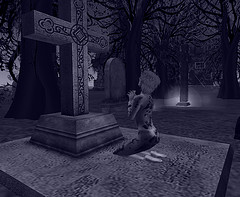
metaverse tombstoneThis week’s big social network story is Facebook’s announcement that they now allow the user profiles of people who’ve died to be “memorialised” – frozen in perpetuity (one presumes) so that you can still visit them, like some digital tombstone or memorial bench. [image by moggs oceanlane]

As that blog post makes clear, Facebook are obviously reacting to a genuine human need, though it would be easy (if highly cynical) to suggest that they’d like a slice of the growing traffic for online memorial sites, as mentioned earlier this month. But questions remain – who will maintain these profiles, and for how long? Will they drop out of the system when their last friend connection is severed (assuming, of course, that any social network platform lasts long enough for that to happen)? Will those memorial profiles be any more or less transferrable to new networks than those of the living? Will the memorials still have adverts surrounding them, like a normal Facebook page, and is that a morally acceptable price for their maintenance?

The biggest question is obviously “how much checking will Facebook do to ensure that the person really is dead?” Internet “pseuicides” aren’t a new phenomenon, and it’s not clear whether the Facebook crew have a procedure in mind to prevent a group of friends faking a death, be it in collusion with the owner of the profile in question or otherwise. Given how easy it is to hack many people’s public email accounts (poor password choices, easily reverse-engineered ‘secret questions’, etc.), unless they demand some sort of legal confirmation from the state that the owner has indeed passed away it could be a relatively simple scam to declare a living person to be deceased. Indeed, that might even become a popular black economy service, alongside fake IDs and new identities.

A more honest and open society?

networkPaul Carr hits the nail on the head concerning the ongoing hysteria amongst many mainstream journos as to the relevance of Twitter, social networking et al to political culture:
…every time a scandal emerges involving the technology – be it McBride’s email or American teenagers ‘sexting‘ naked photos to each other, we hear the same crap from journalists – that the web, and email and mobile phones are making everyone behave in scandalous ways they never did before. If that’s true then I have some amazing YouTube footage of a bear shitting in the woods, which I found next to a damning video of the Pope taking communion.

The only difference between the way humans have been behaving badly for years, and how they behave badly in the internet age is the fact that now there’s always someone else watching.

And that seems to be the key point that politicians and more traditional media sources seem to have yet to properly absorb.

As networked recording devices become ubiquitous we’re going to have to learn to deal with a reduction in personal privacy. Further Carr adds:

…as a generation grows up that has never known true privacy, things will start to change. And they’ll change for the better.

This is something that’s been bothering me recently: like many people I’ve always had the vague idea I can be one person online and another in real life. This idea, however, is false. My generation and every generation hence will go through life leaving a sticky trail of hyperlinks, tweets, and FaceBook photos; an online miasma that everyone will possess and everyone will have to accept.

As privacy is reduced maybe prurient voyeurism and hypocrisy will also diminish. Part of the enjoyment of gossip is the secretive aspect of it: but if everything about everyone is out in the open then there will be no need to fear slur and innuendo.

So maybe the rise of ubiquitous recording and surveillance will lead to a more caring, more honest, and less hypocritical society?

[Paul Carr in The Guardian][image from jonbell has no h on flickr]

Living la vida geo-loca

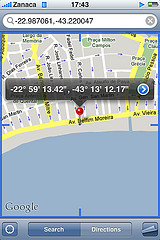
iPhone geo-locational software screenshotOver at Wired last week, they ran a piece by Matthew Honan about his experiences with the new wave of geolocational software for the iPhone and Google’s G1. He starts off by asking fellow users in his locality what they use the systems for:

My first response came from someone named Bridget, who, according to her profile, at least, was a 25 year-old woman with a proclivity for scarves. “To find sex, asshole,” she wrote.

“I’m sorry? You mean it’s for finding people to have sex with?” I zapped back.

“Yes, I use it for that,” she wrote. “It’s my birthday,” she added.

“Happy birthday,” I offered.

“Send me a nude pic for my birthday,” she replied.

A friendly offer, but I demurred. Anonymous geoshagging is not what I had in mind when I imagined what the GPS revolution could mean to me.

I don’t think anyone who has looked at the adoption curve for new networking technology will be particularly surprised by Bridget’s response… [image by zanaca]

Honan goes on to look at the pros and cons of what is admittedly still a technology in its applicational infancy, which he finds fun and intriguing at the same time that it seems creepy and intrusive – the latter response being one that I’d attribute to his age. When these apps have matured in a few years, however, the Facebook generation will have no qualms or fears about them whatsoever.

Whether they should have qualms is another question, of course. If nothing else, geolocational apps are a reminder that the tin-foil hat brigade’s warnings about The Feds being able to follow your cell phone weren’t entirely fictional; the potential for stalking someone is obvious.

But would stalking be as big a risk in a society where many people’s locations were public knowledge? If lifelogging catches on at the same time, we might all become one big happy globally geolocative panopticon…

Kevin Kelly: omni-access is the new ownership

Thanks to organisations like Creative Commons, we’ve been hearing a fair bit of rhetoric about goods and services ‘held in common’. The notion of the commons is far from new, but the way the web facilitates sharing has brought it back to a new prominence.

Naysayers against the commons are, er, common enough, but they seem to me to always be arguing from an economic standpoint that can’t conceive of the commons in the way its supporters describe it – for example, they ask ‘who will build and maintain these goods and services?’ Kevin Kelly’s latest essay on the matter covers that question quite neatly:

As creations become digital they tend to become shared, ownerless goods. We can turn this around and say that in this realm of bits, property itself becomes a more social endeavor. Property may be less about title and more about usage and control. An idea can’t be owned in the way gold can; in fact an idea has little value unless it is shared or used to some extent. Its value paradoxically can increase the less it is owned privately. But if no one owns it, who gains the benefit of that increase in value? In the new regime users will often assume many of the chores that owners once had to do. And so in a way, usage becomes ownership.

Kelly’s big on ‘social’ as an ideal, but given the way the recession is cutting into the soc-net startups, ‘social’ might not be as strong a paradigm in another few years. But then again, if it’s the inevitable matter of social necessity that Kelly describes, perhaps it will… if work remains scarce, will people do more things for the common good as a result, or less?