Tag Archives: solar

Combining computing servers with alternative energy

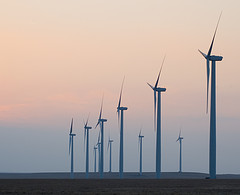
Could servers only be used when the wind blows nearbyThe Guardian has this interesting snippet of an article that makes sense to me on so many levels. Professor Andy Hopper of the University of Cambridge has been looking at the power usage of computers and made an astute suggestion: locate large processing servers near sources of alternative energy like solar or wind farms. When the power is flowing through the turbine or photovoltaic, computers all around the world can tap into the processors of the server farm. When there’s no wind or sun in one location, the network can call on the processors of somewhere there is.

This kind of synergy is fascinating and I think it’ll be a major feature in our future working lives. Flash drives getting bigger, faster and cheaper all the time and programs like Portable Firefox run straight off a portable drive. I’m writing this post on my portable usb, using only the processor and screen of the laptop I’m borrowing time on. Sooner or later all our computers will be a usb-style stick with all our programs, data and settings stored on it. Plug it into a nearby screen (or project your own), whack out your laser keyboard and dial into any heavy processing power from an external server. Who needs a big computer tower in your room when you can fit it in your pocket?

[story via the Guardian, image by Brent Danley]

Using nanotechnology for brighter lights and better solar power

Some examples of quantum dots, mere nanometres in sizeTwo good examples of nanotechnology in action today from Science Daily. The first comes in the field of solar technology. There are two main forms of solar nanotech: thin films of nanoparticles like titanium oxide doped with nitrogen, and so-called ‘quantum dots’, tiny semiconducting crystals that absorb the energy from light to release conducting electrons. Scientists from California, Mexico and China have shown that both methods can be combined into one material that performs better together than either method alone!

The second article discusses LED lights, which use far less energy than even energy-saving flourescent bulbs. However, whilst LEDs work great for smaller uses like book-lights, computers or mobile phones, they aren’t bright enough to light a room. The method to improve this is to make thousands of tiny holes on the bulb itself, allowing more light to escape the LED. Whilst before this process has been extremely time and money intensive, using nanotechnology lithography to imprint the holes makes the process far cheaper – which could lead to a massive growth in usage of LEDs in our homes and gadgets.

EDIT: As Larry mentions in the comments, there’s also been great progress making solar antennas using nanoscale spirals imprinted onto the material. This method could be printed on flexible materials and potentially is as much as 80% Efficient. Thanks for the heads up Larry!

[via Science Daily, image via NIST]

Emergent technology for 2008

Cars like the Tesla Roadster will be run on electric batteriesGlen Hiemstra of Futurist.com has a video on his home page called ‘Outlook 2008′ in which he discusses his five big stories for the coming year, plus a wild card. He talks about oil prices, the economy and the political changes (or non changes with the presidential elections so close to the end of the year) of 2008. Two more technological comments caught my eye.

He mentioned both Solar and Nano technologies as big movers in the coming year. In particular he highlighted NanoSolar, whose thin-film solar cells have just started reaching commercial grade at potentially cheaper prices than coal. The other company on his watch list was Altairnano, which uses ceramic nanomaterials to create long-living batteries that should see the market in a number of forms in 2008, including in electric cars such as the pictured Tesla Roadster.

His most interesting comment was in the ‘population’ section, talking about young entrepreneurs:

“The leading edge of the digital native generation is now 18-25 or so. The first generation to grow up in the personal computing and internet age is now at work. The venture capital world increasingly focuses on this generation, the very young creatives, for the breakthrough ideas. Thus 2008 marks a change-over to the next generation for innovation leadership.”

It will be interesting to see if these predictions come true. Other turn of the year predictions include a pessimistic James Kunstler and an optimistic 50-year prediction by Climate Progress.

[via Futurist.com, image by Jurvetson]

North African Solar project could provide a sixth of Europe’s electricity

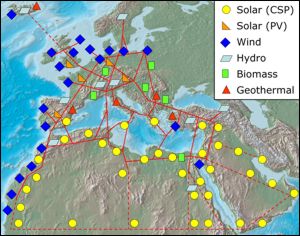
A grid such as this sketch could supply Europe’s power even when the wind doesn’t blow and the sun doesn’t shine where you areNow this is very positive. Last week there was talk of a giant ‘supergrid’ connecting much of Europe to wind turbines across the continent, to take advantage of whenever the wind was blowing.

Now the Guardian reports on Desertec, the plans to put hundreds of solar concentrating plants on the North African coasts and in the Middle East. Two thirds of the estimated 100 Billion Watts would stay in the countries producing the energy, with another 30 Billion Watts (around of all of Europe’s use) being pumped via underwater cables to the EU, which would provide a chunk of the funding for the project. With the Bali talks now underway to find a new version of the Kyoto treaty, projects like this could be a major facet of reducing carbon emissions. German energy expert Gregor Czeich reckons with new higher efficiency power lines a 100% renewable powered Europe could be possible in the near future without costing much more than the current fossil fuel system.

[via the guardian, picture by TREC]

Solar pessimism

Lots of advances have been made in solar energy, as we’ve reported recently.  But solar energy may not be all dandelions and sunflowers, and there are worries not just about efficiency.  Simple production capacity dictates that even if we wanted to, we couldn’t produce nearly enough to meet our current energy needs.  A post by scienceblogger James Hrynyshyn over at the aptly named The Island of Doubt has some more information of solar pessimism.

Just like at that business seminar you attended, constructive criticism is best.  These add a dose of realism and keep us from wondering in five years why we’re still being told we’re just around the corner from a breakthrough.  As Mr. Hrynyshyn said, "Don’t get discouraged guys. Just keep plugging away…."

(image from Rob!)