Tag Archives: space

Project Icarus: an eye in the sky for just $150

The popped Project Icarus balloon on its way back to EarthIf the $8000 TubeSat kits we mentioned last month are still to pricey for your pocketbook, never fear – you can still muck about on the edge of space, provided you can scrape up a few hundred bucks. A group of MIT students under the aegis of the Icarus Project have managed to take digital photographs from 17.5 miles above the surface of the Earth using nothing but off-the-shelf components… for a mere $150. [via Hack A Day]

The GPS receiver was a Motorola i290 “Boost Mobile” prepaid phone with internet and GPS capability (set up with Accutracking to constantly report its GPS location).

We bought a AA-battery cell phone charger to sustain the phone’s power over the duration of the flight, and we used Energizer lithium batteries (rated to operate at temperatures are low as -40F) to power both this charger as well as our camera.

As a further safeguard against electronic/battery failure due to low temperature, we utilitzed Coleman disposable hand warmers (placed near our electronics) to help keep our equipment warm in the cold of the stratosphere.

We loaded a Canon A470 camera (bought used on Amazon) with CHDK open source software to enable a feature which allowed the camera to take pictures continuously (intervalometer). Using this feature, we set the camera to take a picture every 5 seconds at a 1/800 second shutter speed. With an 8GB card, the camera was able to chronicle the whole journey of the balloon from launch to retrieval. (~5 hours)

OK, so it’s not exactly the most complex payload ever sent aloft, but it’s a clear demonstration that ingenuity gets things done… as is the example of Armadillo Aerospace, who’ve just taken the Level 2 prize of $1million for the Northrop Grumman Lunar Lander Challenge with their Scorpius vehicle.

And given that NASA has been warned that it needs to constrain its goals unless it can increase its budget, that’s good to know; I’m more convinced than ever that the next big steps in space will not be achieved by government agencies, though they may retain a political space on the game-board by commissioning more prize challenges.

One-way ticket to Mars, redux

Earth-Mars montageThe one-way mission to Mars is becoming one of those hardy perennial stories, earning a mention here back in the spring of 2008 when former NASA engineer Jim McLane spoke out in favour of the idea.
Now it’s the turn of Lawrence Krauss, who sums up his attitude to Mars missions with the phrase “to boldly go where no one has gone before does not require coming home again”.

The most challenging impediment to human travel to Mars does not seem to involve the complicated launching, propulsion, guidance or landing technologies but something far more mundane: the radiation emanating from the Sun’s cosmic rays. The shielding necessary to ensure the astronauts do not get a lethal dose of solar radiation on a round trip to Mars may very well make the spacecraft so heavy that the amount of fuel needed becomes prohibitive.

There is, however, a way to surmount this problem while reducing the cost and technical requirements, but it demands that we ask this vexing question: Why are we so interested in bringing the Mars astronauts home again?

His arguments focus on finance (a one-way mission is far cheaper and more logistically simple) and anthropological pragmatism (the journey might well reduce the astronauts’ lifespans considerably, so why waste the remainder of their lives dying in an Earth hospital when they could be doing useful stuff on Mars?). It’s a very cold set of equations, of course… but as has been pointed out before, there’d probably be no shortage of volunteers, be they elderly scientists or younger bold adventurers. Hell knows I’d love to go.

Furthermore, Krauss is probably correct in suggesting that Congress and NASA would never take the political risk of a mission that could be seen as signing a definite death warrant for American citizens, even if they chose to go. So perhaps that one-way ticket will be supplied by a private company… if it’s ever supplied at all. [via SlashDot; image by Bluedharma]

Japanese plan space-based solar power

714px-Space_solar_powerThe Japanese government has taken another step towards actually building a space based solar power plant. Mitsubishi Electric Corp and industrial design company IHI Corp are to develop a design for a SBSP plant to be up and running at some point in the next three decades:

By 2015, the Japanese government hopes to test a small satellite decked out with solar panels that beams power through space and back to Earth.

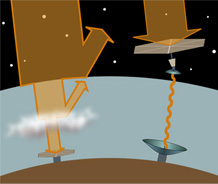
There are still a number of hurdles to work through before space-based solar power becomes a reality though. Transportation of the solar panels into space is too expensive at the moment to be commercially viable, so Japan has to figure out a way to lower costs. Even if costs are lowered, solar stations will have to worry about damage from micrometeoroids and other flying objects. Still, space-based solar operates perfectly under all weather conditions, unlike Earth-based panels that are at the mercy of the clouds.

It makes sense to start moving in this direction, but will practical implementation arrive fast enough to help reduce global warming emissions?

[from Inhabitat, via Slashdot][image from Wikimedia]

Thrown off course by relativity

Cosmos1-2006-2A preview of space-flight issues of the future: how do you account for the effects of relativity when travelling long distances? A solar sail launched from close to the Sun would have to account for relativistic effects when navigating to the edges of the solar system:

And even though those effects are relatively minor to start with, they have a significant effect over long distances.

The calculations carried out by Kezerashvili and Vazquez-Poritz show that the effects of general relativity could push a solar sail off course by as much as a million kilometers by the time it reaches the Oort Cloud

The promise of solar sails as a propulsion mechanism is impressive:

By one calculation, a solar sail with a radius of about a kilometer and a mass of 300 kg (including 150 kg of payload) would have a peak acceleration of about 0.6 g if released on a parabolic trajectory about 0.1 astronomical unit (AU) from the sun (where the radiation pressure is higher).

That kind of acceleration would take it beyond the Kuiper belt to the heliopause, the boundary between the solar system and interstellar space (and a distance of 200 AU), in only 2.5 years.

In 30 years, a solar sail could travel 2,500 AU, far enough to explore the Oort Cloud.

Of course we need to actually build one of these things first.

[from Technology Review, via Technovelgy][image from Wikimedia]

Earth and other unlikely worlds

Apologies to Paul Mcauley for pinching the name of his blog for a post title, but it felt appropriate!

In addition to raking over our old friends the Drake Equation and the Fermi Paradox, COSMOS Magazine looks at the possibilty of the sort of planets found in classic space opera actually existing… you know the sort, solid globes of diamond or iron or ice or whatever else.

THE EARTH FORMED in a region of the Solar System’s protoplanetary disc that was relatively rich in the element oxygen. So on top of an iron-rich core, our planet is mostly built out of oxygen-containing silicate rocks. But further out in the protoplanetary disc, the ratio of the elements carbon and oxygen was probably different.

A class of meteorites found on Earth, called enstatite chondrites, may have formed in this region – they have a ratio of carbon to oxygen that is a thousand times larger than the ratio found on Earth.

“If an entire planet were to have condensed from this kind of raw material, it would have ended up enormously different from the Earth,” says Marc Kuchner, an expert on exoplanets at NASA’s Goddard Space Flight Centre near Washington DC.

Built out of relatively more carbon than oxygen, such a planet would still have a metallic iron core, but the outer layers could be composed of ceramics – silicon and titanium carbides – with a shell of pure carbon on top.

These ceramics and graphite would make the entire planet extremely hard and heat-resistant, and it could survive much closer to its star. Even more bizarre is that the high pressure beneath the surface would convert the bottom of the graphite layer into an entire shell of diamond that would be many kilometres thick.

That’s your sensawunda fix for the day, I reckon. And if you’re a fan of the OMG-we’re-so-insignificant angle, try this for size: Earth’s habitable period may nearly be over, at least on a cosmological time-scale [via SlashDot].

“The Sun does not seem like the perfect star for a system where life might arise. Although it is hard to argue with the Sun’s ‘success’ as it so far is the only star known to host a planet with life, our studies indicate that the ideal stars to support planets suitable for life for tens of billions of years may be a smaller slower burning ‘orange dwarf’ with a longer lifetime than the Sun ― about 20-40 billion years. These stars, also called K stars, are stable stars with a habitable zone that remains in the same place for tens of billions of years. They are 10 times more numerous than the Sun, and may provide the best potential habitat for life in the long run.”

Take that, Rare Earth Theory! Turns out we’re not so special after all… though whether that’s reassuring or depressing is a matter for debate.