Tag Archives: space

Black Holes in the sky, Black Holes in the internet

Three black holes interact in complex waysA mix of two stories about completely different types of Black Holes today. First, researchers at the Rochester Institute of Technology found that interactions between three black holes should produce gravitational waves that detectors like LISA or LIGO could detect within the next ten years. Gravitational Waves are ‘ripples’ in Space-Time caused by massive objects and events and could tell us a great deal about the big bang.

Another kind of black hole in the news is the ‘internet black hole’. Researchers for the Hubble internet project found distinct pathways on the internet where data was lost for unexplainable reasons. The project, which you can see the results of at their website, was intentionally named after the famous astronomer and telescope. The researchers say they are performing ‘internet astronomy’, looking for events in the cosmos of data that is the internet.

[image by M Campanelli/L Carlos/Y Zlochower/H-P Bischof, that plus space story via New Scientist, internet story via TG Daily]

Moving the Earth

450825428_b0ef55b12e_m_d The typical ending of our lovely planet will come in several billion years when the Sun swells up and engulfs all of the inner planets.  But it’s never too early to start thinking of how to rescue our beloved cradle.

According to an article in the NYTimes, the Earth faces an unknown future because it will move further out in orbit as the Sun expends its mass and the gravitational forces become weaker.

One solution is to lasso comets and asteroids, swinging them near the Earth and using their slight gravity to boost the Earth to a higher orbit, where it could escape the Sun’s expansion.  Because, y’know, what could go wrong with that?

(image from NASA website)

Sins of A Solar Empire game developer talks piracy

Sins of a Solar Empire has an impressive scaling of graphics to suit your machine

Sins of A Solar Empire by small independent game company Stardock (and their developers Ironclad) is the biggest selling pc game of 2008 so far, despite a tiny budget and much less coverage by the gaming press.  Stardock owner Brad Wardell posted an excellent analysis of why their games are having success. (last year’s Galactic Civilisations II was another underground hit.)

He talks a lot about the bad policies taken by much of the PC game industry. For example, why bother targeting the Chinese market when piracy is so rife many people won’t purchase your game? His main point, and it’s a very good one, is that very few people upgrade their computer often so targeting the graphics of your game to only work for the ‘hardcore’ pc gamers is limiting your market. Rather than trying to break the latest processor if you just make a game that’s fun and works on most computers people will play it.

Sins is a fun game that combines the 4X ideas of ‘eXplore, eXpand, eXploit and eXterminate’ of games like Civilisation with Real Time Strategy elements of space games like Homeworld. I’ve enjoyed myself whenever I’ve played it but what’s even more impressive is the attitude of the people behind it – updates are frequent, there’s no DRM, the developers comment frequently on the game’s forum and they listen to requests from players about bugs and new features. In an industry full of high budget Hollywood games, it’s comforting to see that small companies can be a big success if they just concentrate on pleasing their audience.

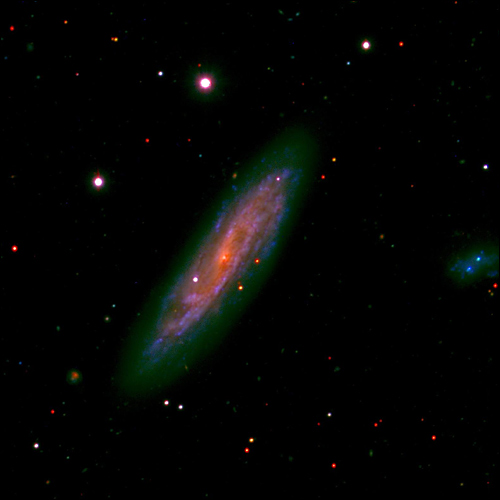
First images from the Large Binocular Telescope

The first of many images by the new telescope

The Large Binocular Telescope in Arizona has ‘opened its eyes’ for the first time, marking one of the first in a new wave of high-tech astronomical devices to come online. The LBT combines two 8m mirrors working in tandem to take pictures of the sky in a wide range of wavelengths at resolutions higher than that of Hubble.

Another couple of new telescopes, Herschel and Planck, will come online this year following their launch into space in April. Laser Interferometer LISA, which measures the bending of space time, has been given the go ahead but won’t be ready for a decade. A spate of advanced telescopes are in planning and construction, taking advantage of the computer advances of the last decade to give more accurate and detailed pictures of the sky than ever before.

[story and image via BBC]

Jules Verne – the first cargo ship in space

The ATV Jules Verne will be the first unmanned European spacecraftThis Saturday marks the launch of the biggest vessel in European space history – the Automated Transport Vehicle (ATV), Jules Verne. Named for the classic SF writer, the 21-ton spacecraft is the first unmanned ship launched by Europe to transport goods through space. Russia has some unmanned vehicles, the Progress spaceships. The US Space Shuttle and Russian Soyuz craft also visit the International Space Station but Jules Verne is the first new type of craft in 9 years.

“The ATV, as a logistics vehicle, carries almost three times the hardware, fuel, water and oxygen that a Russian Progress carries,” said NASA’s ISS program manager Mike Suffredini. “It is a major contribution to the program.”

The Jules Verne will travel for a week catching up with the International Space Station before docking. The astronauts will remove the fuel and equipment within and send the ATv back to Earth in six months time, filled with waste material. Jules Verne will burn up in the atmosphere although in the future reentry-proof canisters may be included.

[story and image via Space.com]