Tag Archives: space

Rogue black holes wander the galaxy, seeking whom they may devour

blackhole There’s a science fiction tale or two to be dug out of this little science item, I’m thinking:

If the latest simulation of what happens when black holes merge is correct, there could be hundreds of rogue black holes, each weighing several thousand times the mass of the sun, roaming around the Milky Way galaxy.

The simulation in question is focused on “intermediate mass” black holes, and there isn’t really even any strong evidence that such things, weighing a few thousand solar masses, exist. (Via PhysOrg.)

Still, if they exist, and two of them of different sizes and rotating at different speeds combine, the simulation indicates resulting merged black hole gets a kick in the pants that can hurl it away in an arbitrary direction at a velocity that averages 200 kilometres per second but in some instances can be as high as 4,000 kilometres per second–enough in either case to allow the black hole to escape the globular cluster where these intermediate black holes (if they exist) are predicted to form.

The researchers are reassuring:

“These rogue black holes are extremely unlikely to do any damage to us in the lifetime of the universe,” Holley-Bockelmann stresses. “Their danger zone, the Schwarzschild radius, is really tiny, only a few hundred kilometers. There are far more dangerous things in our neighborhood!”

Of course, anything with a mass of a few thousands suns wandering close to the solar system is going to play havoc with planetary orbits…but fortunately, space is very, very big.

It’s probably nothing to worry about.

(Image: Ute Kraus, Max-Planck-Institut für Gravitationsphysik, Golm, and Theoretische Astrophysik, Universität Tübingen, www.spacetimetravel.org)

[tags]astronomy, space, black holes[/tags]

Another barrier to space colonization: the common cold

With the US, Japan and China all actively talking about permanent settlements on the Moon and Mars, not to mention the prolonged stays of astronauts on the International Space Station, attention is being focused on a well-known but little understood fact: the human immune system actually degrades in weightlessness.

The human immune system, which [is] as complex as the central nervous system, includes an arsenal of responses to invading bacteria, viruses and other pathogens – ranging from first responders such as neutrophils and microphages to more sophisticated T-cells and B-cells that act on a molecular level. Although research into the workings of these infection-fighters during space missions remains limited – because of technical problems with collecting samples in space, very limited crew time and, more recently, deep funding cuts – [many] key infection-fighting molecules appear to be less available to people in space.

Not only are people more susceptible to sickness inducing microbes in zero gravity, but it also appears that some microbes, such as salmonella, become significantly more virulent in weightlessness.

New supernova changes the way astronomers think about star explosions

supernovas are one of the most incredible sights in the universeEarlier in the year a gigantic explosion lit up the sky. Supernova SN 2006gy, around 100 times brighter than a typical example, created a real puzzle to astronomers – how did such a big event occur? Currently there are two main models for Supernovae – type I occur when a white dwarf accretes too much material from another partner star and crosses the unstable Chandrasekhar limit, forcing nuclear fusion in the core. The second principle type, type II has a larger older star running out of hydrogen in its core to burn, leaving the outer layers cooling and falling inward. When the pressure from the infalling layers gets high enough, the helium ignites – a type II supernova.

The sheer brightness of SN 2006gy doesn’t fit any current theories, and has left astronomers baffled. A new model suggests that the star exploded not once but twice or as much as SIX time, with the outward material from later novas hitting earlier remnants to create the bright lights in the sky. A somewhat similar star, Eta Carina, is not too far off exploding in our own galaxy, which should provide an amazing night show.

[story and image via Science Daily]

Living in Space

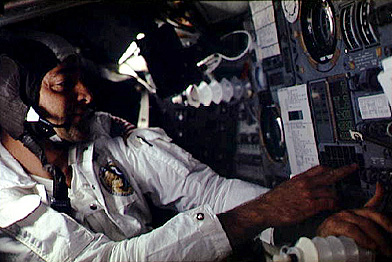
35mm pictures taken by Schmitt on the Apollo 17 missions
Space tourism is the big thing right now
, if you’re a multimillionaire looking to do something no-one else has done. Or alternatively it takes years to train to be an astronaut – if you qualify. Much of science fiction is dedicated to the thought of life outside Earth’s gravity well. Yet how easy would that be? Discover magazine lists 20 things you probably don’t know about Living In Space. It offers some handy tips to surviving in a vacuum (don’t hold your breath!) as well as some interesting facts about existing astronauts, who grow around two inches on average due to less pressure on their spines. It makes you wonder how many people will want to spend their holidays in zero-g.

[via Discover Magazine, image from Apollo 17 mission via Eric Hartwell’s Infodabble]

Potentially life-supporting planet found

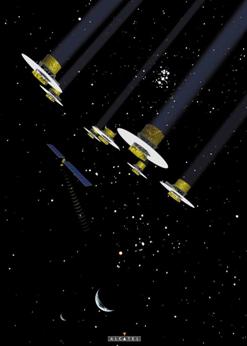
The four space-based 3 metre telescopes of DARWIN will work together to find other planetsAstronomers have discovered a planet in the 55 Cancri system that orbits constantly in what is know as the ‘habitable zone’ of the solar system. Although the planet is a gas giant some 45 times the size of Earth, there’s a good chance one of its moons might have liquid water and hence encourage the development of earth-like life. Planets are found by studying their transits across the light of a star. By studying the amount the star dims when the planet crosses, the size of the planet can be estimated. This is limited to larger planets currently but future missions like the Kepler and Darwin projects may be able to find rocky planets like our own.

The search for ‘exoplanets’ outside our solar system is hitting its stride and regularly more are found. Whilst the planets found to date are all ‘Jupiters’ like the gas giants further out in our home system, we know that Jupiter, Saturn, Neptune and Uranus all have large satellites. If any of these were in the habitable region where Earth is, the possibility of liquid water and hence bacterial life would be likely. If 55 Cancri did support life on one of its moons it would resemble the world of Coyote in Allen Steele’s excellent series.

[via the guardian, image of Darwin project via Astronomy Online]