Antimatter has powered countless science fictional starships, but has yet to be used as a propulsion method in reality. Reasons are manifold: firstly, it’s very difficult and expensive to make even the tiniest amount of it; and second, we’re still not entirely sure what it is or how it works. Centauri Dreams reports on the state of antimatter research, and hopes that someday we’ll be able to use it to move between the stars.
That said, successful Space Shuttle launches aside, we’re still short of a simple and affordable route to orbit, let alone our nearest stellar neighbours. JP Aerospace reckons it has an answer to getting us at least half-way there – namely making lighter-than-air flyers to ascend to a sub-orbital space station, from which super-light orbiters could be launched. It’s a low-budget lo-fi approach, but if it works, why not?
Still hungry for space-related stuff? Carnival of Space #14 is live at Universe Today.
Transient Lunar Phenomena (aka TLP) are bursts of light on the lunar surface whose origins have been a mystery for nearly four centuries since their discovery. But now an astronomer reckons he has the answer – these optical flashes could be the result of gas eruptions on the Moon. [SlashDot]
 Some dissent in the ranks at NASA; the man who led the development of the Apollo lunar module has come out in vocal opposition to plans to use explorations of the Moon as a test-bed for eventual manned missions to Mars; instead, he argues for full exploitation of the ISS and further robotic missions to the Red Planet.
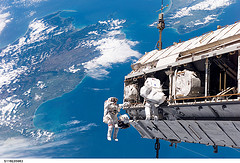
Arguments of this type are ten a penny in space politics, which is a landscape of conflicting ideologies; Moon versus Mars, robotic missions versus human missions, and so on. An essay at The Space Review argues that these conflicts are “zero-sum games”, and a waste of energy and resources that could be better expended by the different groups working together toward common goals. Human nature being fundamentally factional, I’m not going to hold my breath just yet. [Image by jurvetson]
Presenting the fact and fiction of tomorrow since 2001
 I think I’m largely preaching to the choir when I plug the benefits of space exploration here at Futurismic, but I’m not going to let that stop me. And we’re not alone in our beliefs –