Tag Archives: surveillance

Innocence-Sensitive Spy Cams

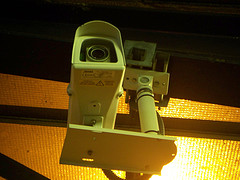
security cameraSince 9/11, the government’s use of video surveillance on the public has increased dramatically (this opens a new window with a .pdf). While the vast majority of this surveillance has been implemented to “protect the country from another 9/11-style attack”, it has been used in other arenas as well, namely in attempts to catch wanted criminals. It’s effectiveness in such a capacity is questionable at times, and the effects of such surveillance on society is noteworthy [photo courtesy of kafka4prez].

However, companies like 3VR – one of the largest surveillance software and video-analysis producers in the world – have begun development of increased-privacy software that would seek to protect innocent people from being falsely targeted by authorities. Their software is hoping to visible blur every face in video surveillance unless an investigation requires that the people in the video be identified. It seems like a small step in the right direction to counter the immense violations by the NSA not too long ago, but at least it’s something.

Robotic Dragonflies

Fans of one of Terry Pratchett’s early comic science-fiction novels The Dark Side of the Sun, will be familiar with the idea of robotic versions of insects being used as “bugs” to spy on people.

This is an idea that is being enthusiastically embraced by the US military, with many small UAVs in development for surveillance purposes.

And there is even more insect-themed biomimicry on it’s way from the labs: the dragonfly is of particular interest, according to researchers:

Dragonflies are one of few creatures that utilize four independently controlled wings to fly,dragonfly allowing them to hover, dart, glide, move backward, and change directions rapidly. Looking to understand such abilities, scientists at the Royal Veterinary College, in England, and the University of Ulm, in Germany, have developed a robotic dragonfly to measure the current flows over and under the wings at different flap cycles. While most of the dragonfly hovering scenarios were not efficient, the team found that if the lower wings are beating slightly ahead of the top wings, the double set of wings proves more efficient at generating lift, employing 22 percent less power to lift the same weight as a single pair.

Well good luck to them. Fortunately for privacy-lovers/paranoids it seems that practical fabrication of these insect spies is still some way in the future.

[story from Technology Review][image by Lori Greig]

Frikkin’ LASERs

Another wonderful development in the world of LIDAR – LIght Detection And Ranging – has lead to the possibility of mapping the surface and geophysical properties of other planets with with “differences [in height] down to one centimeter“. Pixel resolution has also greatly increased, “from kilometers square to a few feet by a few feet.

LIDAR works on a similar principle to radar, but through the use of lasers rather than radio waves. The laser is shot at an object, and the time delay between the pulse and the reflection is measured in order to accurately gauge the distance. The advantages of LIDAR over radar are twofold: LIDAR can be used to measure smaller objects, and it works on a greater variety of materials.

Of course project leader Professor Donald Figer is keen to promote his system’s anti-terrorism credentials:cctv

“Imagine,” he says, “that you have this 3-D, 180-degree fish-eye system . . . in every city scanning continuously for biohazards.”

I know it’s meant to be scanning for biohazards, but presumably the system could also be used to create real-time, centimetre-resolution maps of cities, including the relative positions of every individual. Combine this with currently existing surveillance systems and we could have ourselves a nice panopticon by the middle of the century.

[original story from Technology Review][image by Mike Licht]

RFID and the future of social networking

RFID tagResearchers at the University of Washington are curious to see what effects RFID technology could have on social networking. To see what happens when the tags become ubiquitous, they installed two hundred antennae in and around a campus building and gave tags to twelve researchers. The results? Their every move is recorded by computer. [image by akaalias]
If that sounds sinister, that’s the entire point. The experiment is designed to see if the negative implications for privacy can be balanced by the more positive functions. [via Roland Piquepaille]

It’s good to see these sort of implications being considered in public … maybe we’ve started to learn from our mistakes and keep an eye on the road ahead?

Charles Stross on transport surveillance

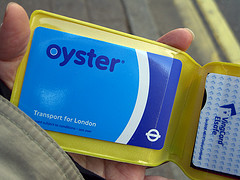
Will your next trip on the tube be tracked by the spooks?The ever-illuminating Charles Stross talks about plans for MI5 to have access to the databases for Oyster, the wireless card that regular users of the London Underground swipe instead of paper tickets. He discusses the possible ramifications of intelligence agencies being able to track your movements across the capital.

The news stories about Oyster pose good questions about the future of RFID: with cracks in the encryption beginning to be found, what are the risks of having everything wirelessly connected? Is the added convenience going to expose us to a new breed of hackers? Expect this to appear in the next series of Spooks, for sure.

[via Charles Stross, image by Mirka23]