Tag Archives: sustainability

The internet is a major feature of reducing carbon emissions

Will we all be connected and working through low power laptops like this one?A lot of the plans for sustainability try to provide the energy for what we already do using new sources of power. Whether you subscribe to the peak oil camp or you fear global warming or even if you want to prudent ahead of a possible recession caused by sub-prime mortgages, each problem has the same solution: use less. Buying less consumables, reducing food miles, rebuilding soils and producing electricity from renewables can only do so much.

Transport is a huge part of the energy (and money) we spend. A future coming to terms with the ‘Peak Century’ will need to travel much less distance for work, play and neccessity. The 50 mile commute seems illogical now at close to $100 dollar a barrel of oil. If oil gets harder to extract and prices rise, that commute won’t just be an annoying expense, it’ll mean bankruptcy. Fortunately new technology has arrived, seemingly perfect timed to coincide with reducing our carbon footprint and energy consumption.

A geologist recently said “My hopeful view is that we’ll be living like we did at the turn of the 20th century, but with computers.” I like the analogy. The internet and low-energy computers offer us a real potential of making a low carbon economy yet still providing jobs and a worldwide community. As Worldchanging puts it, the ‘High bandwidth, Low Carbon future’ could be both sustainable and more personally fulfilling. Google is investing $100Million in Green computing and the Asus EEE laptop uses 11 watts. All this talk of choose your own price music, online markets for fiction and e-readers is important because it’s a first step to creating an entertainment economy that could work in the low-energy world that’s coming, sooner or later.

[picture by jaaron]

Thermoelectrics – conduct electricity well but heat badly

Today thermoelectrics let you keep your car seat at the right temperature. In the future they might make everything more efficient.Usually, heat and electric conductivity go hand in hand. Now, thanks to the emerging nanostructure technology movement, scientists think they can separate these two.

“Thermoelectric devices are based on the fact that when certain materials are heated, they generate a significant electrical voltage. Conversely, when a voltage is applied to them, they become hotter on one side, and colder on the other. The process works with a variety of materials, and especially well with semiconductors — the materials from which computer chips are made.”

Previously thermoelectric devices were far too inefficient to be of use. But by adding nanoscale structures a few billionths of a metre across, the heat conductivity of a material can be disrupted whilst the electricity passes through fine, ramping the efficiency up massively. Imagine a computer chip that doesn’t get heated as it works, or a solar cell that uses heat as well as light to generate electricity. Thermo electrics are already starting to get efficient enough to cool your car seathow soon before they start to be used in the growing low energy pc market?

[via ScienceDaily, image from Amazon.com ]

Scalable Renewables in Berkeley, California

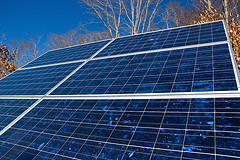
Are clever governments going to encourage more of these in our homes?Microgeneration is the often mentioned as a great way to reduce energy use and dependence on fossil fuels. But looking at the prices of enough solar panels to provide 2-3kW of power is a little bit scary. A loan is possible – but the amount you’d pay back in interest would be frontloaded, whereas the savings in electricity would be paid back in a longer period, say 15-20 years. Wouldn’t it be good if you could offset the cost of the PV panels against future savings on your electricity?

The community of Berkeley is already beginning to offer such a scheme. They offer loans for Solar Electricity with repayments guaranteed to be less than the cost of electricity saved by the panels. Not only does this scheme make Berkeley more attractive to live in, it also encourages manufacturers, installers and testers of the technology to setup in the area. Hopefully this trend will continue in more governments and with more types of microgeneration.

[via Daily Kos, image by roddh]

An oil production plateau could be with us by 2012

Those derricks may start to pump slower than we might likePeak Oil is a worrying topic but one that is complicated and based on many factors. Even if Hubbert’s predicted peak of oil isn’t close to happening and there are lots of barrels left in the earth, a plateau of oil production, which a lot of oil companies are saying looks likely around 2012, is likely to have a similarly heavy impact on economic growth and prosperity.

The oil taken so far has been mostly the easiest to extract. Whilst large swathes of oil lie locked away in places like the Venezuela Orinoco Belt and the Canadian Oil Sands, they are harder (and more expensive) to get. Added to the slowing of many major crude sources, these facts have led a lot of oil experts to predict the production of oil will slow and plateau, probably never reaching 100mbpd. With China and India increasing demand, we’ll be needing more than that in ten years time. What happens if the supply can’t keep up?

[via wired, image by jGregor]

Plane to fly around the world entirely via solar

The sustainable plane that wants to fly around the worldBertrand Piccard was the first person to fly around the world in a balloon, the longest flight ever. His new endeavour, the Solar Impulse, is even more ambitious. To highlight the need for sustainability, the project has a lofty goal:

“In a world depending on fossil energies, the Solar Impulse project is a paradox, almost a provocation: it aims to have an airplane take off and fly autonomously, day and night, propelled uniquely by solar energy, right round the world without fuel or pollution. An unachievable goal without pushing back the current technological limits in all fields…”

If we’re to make the targets that Gordon Brown set yesterday, we’ll be looking to projects like this for inspiration.
[via European Tribune, image by Bertrand Piccard]