Tag Archives: technology

Fake blood

red blood cellsNo, not the Halloween dress-like-a-zombie fake blood – we’re talking entirely artificial polymer replacements for red blood cells, which could potentially be used for transfusions in the absence of donated blood [image by Andrew Mason]:

They start out as spherical cells which then collapse into mature red blood cells following exposure to various substances. Similarly, Mitragotri’s team found that if they added small balls made of a polymer called PLGA to a particular solvent, the spheres would collapse into a biconcave shape.

The researchers coated these 7-micrometre across, tyre-shaped particles, in a layer of protein. When they dissolved away the polymer core, a soft biodegradable protein shell was left behind with the same mechanical properties as red blood cells.

The fake cells also seem to share red blood cells’ ability to transport substances. One of the proteins Mitragotri added to the surface of the imitation blood cells was haemoglobin, the molecule that binds to oxygen in the lungs, later releasing it elsewhere in the body.

In test tube experiments, the researchers found that their haemoglobin-coated particles picked up oxygen when there was a lot around and released it later when the concentration was lower. If the squishy particles do the same thing when injected in animals, they could be given to people instead of a blood transfusion.

To see if the protein shells could also carry drugs, Mitrogotri’s team exposed them to the anti-clotting drug heparin. Sure enough, the particles soaked up the heparin and then released it later on when they were moved to an area of lower concentration.
Merry Christmas; I got you a panopticon

Two quick links; I’ll leave you to do the math yourself. First up – ‘smart’ CCTV system learns to spot suspicious behaviour with a little help from its human operators:

… a next-generation CCTV system, called Samurai, which is capable of identifying and tracking individuals that act suspiciously in crowded public spaces. It uses algorithms to profile people’s behaviour, learning about how people usually behave in the environments where it is deployed. It can also take changes in lighting conditions into account, enabling it to track people as they move from one camera’s viewing field to another.

[…]

Samurai is designed to issue alerts when it detects behaviour that differs from the norm, and adjusts its reasoning based on feedback. So an operator might reassure the system that the person with a mop appearing to loiter in a busy thoroughfare is no threat. When another person with a mop exhibits similar behaviour, it will remember that this is not a situation that needs flagging up.

And secondly – a facial recognition door lock system retailing for under UK£300.

… can store and register up to 500 faces thanks to an internal dual sensor and two cameras. This, claims the manufacturer, “allows it to establish an incredible facial recognition algorithm in a fraction of a second”. Importantly, the system also works at night. A 3.5 inch screen and touch keypad are also included.

The system can also be used to record attendance in an office. There’s a USB and Ethernet port so that managers can download or keep track of who arrives and leaves the office when.

I have the sudden urge to talk at length to people about the findings of the Stanford Prison Experiment.

Bionic limb pr0n

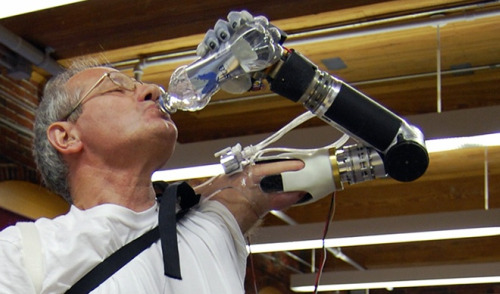
If you’re fascinated by bionic limbs and other prosthetic technologies, you’ll want to be checking out Wired‘s gallery of photos showcasing the current state of the art – we’re still a good distance from the uncanny valley in this field, but the actual utility and ergonomics of the designs are reaching a point where their usefulness balances out their clunky appearance. Borrowed from the gallery in question, this here is the “Luke” arm, developed by a company owned by the guy who invented the Segway:

The 'Luke' bionic arm

Go check ’em out… and bear in mind that an Italian car accident victim spent a month last year testing an entirely thought-controlled prosthetic replacement for his lost limb. Interesting times.

The Surprising Range of Robots

I’ve been invited to join a panel on robotics at the upcoming Orycon Science Fiction Convention, so I decided to write about them here, too.  I also have a story coming out soon in Analog, called “The Robots’ Girl,” which started when I read an article complaining about robots being developed to help with childcare in Japan.

We were promised undersea cities and jet packs and household robots.  The robots are here, and the next decade is pretty clearly a breakout time for them. Continue reading The Surprising Range of Robots

Microfluidic diagnostic chips are (almost) child’s play

Pity us poor Brits and our ox-bow lake of eighties pop-culture – until today I had no idea what Shrinky Dinks were. But now I know… and I also know that code 6 polystyrene sheets (which is what Shrinky Dinks are made of) can be used to make single-run prototypes of microfluidic diagnostic chips, thanks to the innovative thinking of one Michelle Kine:

she whipped up a channel design in AutoCAD, printed it out on Shrinky Dink material using a laser printer, and stuck the result in a toaster oven. As the plastic shrank, the ink particles on its surface clumped together, forming tiny ridges. That was exactly the effect Khine wanted. When she poured a flexible polymer known as PDMS onto the surface of the cooled Shrinky Dink, the ink ridges created tiny channels in the surface of the polymer as it hardened. She pulled the PDMS away from the Shrinky Dink mold, and voilà: a finished microfluidic device that cost less than a fast-food meal.

[…]

She hastens to point out that Shrinky Dink microfluidics isn’t perfect–minute ink splatters from the printer, for instance, can give rise to slight irregularities in the finished channels.

Still, glitches like these don’t pose a problem for most applications. And Khine has already found a way around a more serious difficulty: PDMS can absorb proteins, throwing off the results of sensitive tests. She has begun to make chips directly out of the Shrinky Dinks by etching the design into the plastic using syringe tips. As the plastic shrinks, the channels become narrower and deeper–perfect for microfluidics. She can even make three-dimensional chips by melting several etched Shrinky Dinks together. The whole process, from design to finished chip, takes only minutes.

Kudos, Miss Kine. Even if you’re not a microfluidics researcher, this is an impressive example of finding cheap methods for making high-tech devices – the sort of favela-budget hack that takes a technology from university laboratories to the potting sheds of the globe. I wonder what the garage biohacker crowd will make of Kine’s innovation? And what might be the next lab-grade technology to be reproduced at a fragment of the normal price using off-the-shelf stuff from the supermarket? [via BoingBoing]