Tag Archives: technology

Robot hop

military-robotIn the latest of your monthly dose of robot drones coming to a theatre of war hopefully-some-distance-from-you we have news that DARPA have developed a remote military robot with the capability to jump over walls:

Most of the time, the shoebox-sized robot – which is being developed for the US military – uses its four wheels to get around.

But the Precision Urban Hopper can use a piston-actuated “leg” to launch it over obstacles such as walls or fences.

The robot could boost the capabilities of troops and special forces engaged in urban warfare, say researchers.

It occurs to me that in a couple of decades this kind of robot could have developed into a truly terrifying war machine. Imagine thousands of tank-sized versions of these, each containing a really pissed-off synthetic cat brain programmed to zap humans with a tactical high-energy laser.

/DrEvil

[from the BBC, via h+ Magazine][image from h+ Magazine]

Solar roadways

solarroadwaysOne of those brilliant ideas that I wish I had thought of first: paving roadways with electricity-generating solar cells. Idaho-based startup Solar Roadways have been awarded $100 000 to develop their road-based solar panel technology:

The 12- x 12-foot panels, which each cost $6,900, are designed to be embedded into roads. When shined upon, each panel generates an estimated 7.6 kilowatt hours of power each day. If this electricity could be pumped into the grid, the company predicts that a four-lane, one-mile stretch of road with panels could generate enough power for 500 homes. Although it would be expensive, covering the entire US interstate highway system with the panels could theoretically fulfill the country’s total energy needs.

Furthermore the panels would create road markings with embedded LEDs.

It occurs to me that roads are the perfect media for ground-source heat pumps as the constant passage of cars heats up the road surface, even on cold days. When a new road is laid down (or an existing road is resurfaced) you fill it with the necessary pipework and plug it into the heating systems of nearby houses. Heat pumps would be more useful in urban areas of more northern, colder countries than solar panels due to shorter days in the winter.

[via Physorg][image from Physorg]

Exoskeletons now available to rent

Cyberdyne HAL exoskeletonIf you’ve got some protracted heavy lifting to do in your garden, or if you just fancy indulging that long-running fantasy of re-enacting the cargo-lifter vs. alien queen deathmatch from the last bit of Aliens, then boy do I have some good news for you. Remember the ‘HAL’ agricultural exoskeletons we mentioned early last year? Well, they’re now available to rent to the public, according to an article in H+ Magazine:

The HAL exoskeleton […] has robotic limbs that strap to your arms and legs — providing much fuller mobility than a wheelchair. The suit’s backpack contains a battery and computer controller. When a HAL-assisted person attempts to move, nerve signals are sent from the brain to the muscles, and very weak traces of these signals can be detected on the surface of the skin. The HAL exoskeleton identifies these signals using a sensor, and a signal is sent to the suit’s power unit telling the suit to move in synch with the wearer’s own limbs.

HAL comes in three sizes — small, medium and large and weighs in at 23kg (50.7 lbs). A single leg version rents for 150,000 yen ($1,570) a month, while a two-leg unit goes for 220,000 yen ($2,300) a month. Cyberdyne has yet to announce when HAL will go on sale to the public or what the price tag will be.

When you consider that these are the first publically-available examples of this technology, those rental prices don’t actually seem that large in real terms – though still a bit much for the casual gardener or DIY homebuilder. Even so, Futurismic‘s own Tom James said just a little over a year ago that “it’ll be about 10 years before [exoskeletons] are available to consumers: and will probably be expensive, heavily regulated and licensed when they are“; it looks like they’ve arrived sooner, cheaper and more freely available than we expected. Though I’d have thought (or maybe just hoped) they’d look a little less like a Buck Rogers prop… [image courtesy Cyberdyne]

But in the spirit of making science-fictional predictions, I reckon it’ll be about five years before we see some sort of competitive extreme-sport deployment of the same technology… maybe the pro-wrestling scene will see exoskeletal combat as the next level in sports entertainment?

By the way, the linked article is from the web-based version of the just-published fall issue of H+ Magazine, which is always full of stuff with a distinctly Futurismic flavour – go check it out.

Singularity lacking in motivation

motivationMIT neuroengineer Edward Boyden has been speculating as to whether the singularity requires the machine-equivalent of what humans call “motivation”:

I think that focusing solely on intelligence augmentation as the driver of the future is leaving out a critical part of the analysis–namely, the changes in motivation that might arise as intelligence amplifies. Call it the need for “machine leadership skills” or “machine philosophy”–without it, such a feedback loop might quickly sputter out.

We all know that intelligence, as commonly defined, isn’t enough to impact the world all by itself. The ability to pursue a goal doggedly against obstacles, ignoring the grimness of reality (sometimes even to the point of delusion–i.e., against intelligence), is also important.

This brings us back to another Larry Niven trope. In the Known Space series the Pak Protector species (sans spoilers) is superintelligent, but utterly dedicated to the goal of protecting their young. As such Protectors are incapable of long-term co-operation because individual protectors will always seek advantage only for their own gene-line. As such the Pak homeworld is in a state of permanent warfare.

This ties in with artificial intelligence: what good is being superintelligent if you aren’t motivated to do anything, or if you are motivated solely to one, specific task? This highlights one of the basic problems with rationality itself: Humean intrumental rationality implies that our intellect is always the slave of the passions, meaning that we use our intelligence to achieve our desires, which are predetermined and beyond our control.

But as economist Chris Dillow points out in this review of the book Animal Spirits, irrational behaviour can be valuable. Artists, inventors, entrepreneurs, and writers may create things with little rational hope of reward but – thankfully for the rest of society – they do it anyway.

And what if it turns out that any prospective superintelligent AIs wake up and work out that it isn’t worth ever trying to do anything, ever?

[via Slashdot, from Technology Review][image from spaceshipbeebe on flickr]

Japanese plan space-based solar power

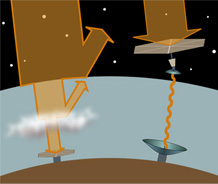
714px-Space_solar_powerThe Japanese government has taken another step towards actually building a space based solar power plant. Mitsubishi Electric Corp and industrial design company IHI Corp are to develop a design for a SBSP plant to be up and running at some point in the next three decades:

By 2015, the Japanese government hopes to test a small satellite decked out with solar panels that beams power through space and back to Earth.

There are still a number of hurdles to work through before space-based solar power becomes a reality though. Transportation of the solar panels into space is too expensive at the moment to be commercially viable, so Japan has to figure out a way to lower costs. Even if costs are lowered, solar stations will have to worry about damage from micrometeoroids and other flying objects. Still, space-based solar operates perfectly under all weather conditions, unlike Earth-based panels that are at the mercy of the clouds.

It makes sense to start moving in this direction, but will practical implementation arrive fast enough to help reduce global warming emissions?

[from Inhabitat, via Slashdot][image from Wikimedia]