Tag Archives: technology

Urban mining – there’s gold in that there techno-junk

printed circuit board and electronic componentsDesperate times call for desperate measures, and as the economic crunch digs in across the Western world we’ll probably see a rise in habits like urban mining. [image by HeyPaul]

Urban mining is a hip term grafted onto an un-hip task that’s been a major source of employment (and illness) in places like China for quite some time. It hinges on the idea that certain consumer electronic devices that are perceived to have no value as a working item thanks to obsolescence (hello, old cell-phone!) contain residual value in the form of the metals used in their construction. Urban mining is the process of digging the value out of dead technology.

If you’ve read some of my flash fiction pieces you’ll know that this is a subject that fascinates me, and I believe it will become a big component of any future economy, especially in developing nations.

What I find saddest of all is that the fancy “urban mining” moniker is a way of covering up the contempt we feel for a process that we already pay lip-service to – it’s just recycling, after all. The only difference is that the world’s poor can’t afford to not do it. [Via Posthuman Blues – cheers, Mac!]
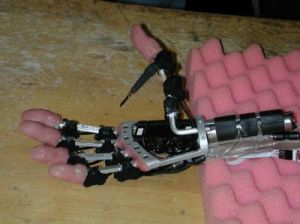
Prosthetic “fluidhand” raises the bar

Fluidhand - prosthesis prototypeVia Warren Ellis’s grinders, I present to you: the Fluidhand!

The flexible drives are located directly in the movable finger joints and operate on the biological principle of the spider leg – to flex the joints, elastic chambers are pumped up by miniature hydraulics. In this way, index finger, middle finger and thumb can be moved independently. The prosthetic hand gives the stump feedback, enabling the amputee to sense the strength of the grip.”

Prosthetics and exoskeletal tech are really making strides (arf!) at the moment. I don’t think it’s science fictional to suggest that we’ll be seeing prosthetic limbs that equal the functionality of the organic originals within a decade. [image borrowed from linked Physorg article]

But there’ll still be a stigma attached to having one, because of the aesthetic issues; it’ll be longer than a decade before there’s a false limb that would pass for a real one.

Maybe they’d become a badge of pride in certain industries or regions – among veterans of ideological conflicts, perhaps? And what about the possibility of elective prosthetics – people choosing to replace limbs that had nothing wrong with them?

Six-story tall giant robot? Yes, please

433545945_a040aa5016_m My roommate’s an interesting guy.  He’s into Gundam.  Like, room-filled-with-models into Gundam.  And he’s dragged me into his robot otaku world.  So I had to mention this project when it came up.  A roboticist from the Future Robotics Technology Center in Japan, Takayuki Furuta, has done cost-estimates of what it would take to build a full-size, functional Gundam robot.  Some impossible parts, namely the alloy Gundanium and solar furnaces, would be replaced by modern analogues, aluminum alloy and 7 Apache gas turbines, respectively.  The whole thing will cost roughly US$742 million, a small price for a giant robot, I suppose.  Furuta hopes to have a 4-meter version up and running by 2011, if I’m still nearby in 3 years, I might have to make a pilgrimage.

(via Matt Yglesias) (image from moogs)

The Pros and Cons of Resource Collapse

Coal-fired power stationWe’ve all heard about Peak Oil, but mineral hydrocarbons aren’t the only thing that could run out on us sooner than we think. The world is a complex place full of interrelated dependencies (a bit like a Linux install, come to think of it), and there are lots of other essential resources that, with a bit of bad luck, could dwindle or vanish very quickly. [image by The Tardigrade]

Jamais Cascio points out that resource collapse will be one of the most important driving forces of the near future – not just technologically but geopolitically, too:

“Resource collapse isn’t the cause of the rise of the post-hegemonic world, but it’s an important driver. It weakens the powerful, and opens up new niches of influence. It triggers conflict, setting the mighty against the mighty. It reveals vulnerabilities.

Most importantly, it sets up the conditions for the emergence of new models of power, as ultimately the most effective responses to resource collapse will come from revolutions in technology and socio-economic behavior. Those actors adopting the new successful models will find themselves disproportionately powerful.”

Adapt or die, basically. But what will Nation-States2.0 look like?

Microsoft creates an algorithmic accompanist

Neon sign of musical notes coming from singer Me, I sings a bit, and it ain’t always easy to find an accompanist when I need one. ‘Sides that, them piano players cost money. (And no, I got no explanation for why I’ve suddenly started bloggin’ in the voice of a hillbilly, ‘cept to point out I did go to school in Arkansas…)

Anyhoo…er, anyway, some new music technology invented by the folks at Microsoft could obviate the need for an accompanist, at least in some instances. Called MySong (follow that link to see a video of it in action and hear some samples) it can take a sung vocal melody and generate appropriate chords to accompany it, offering a singer a variety of accompaniments to choose from, depending on how he or she varies the “happy factor” and “jazz factor.” (Via NewScientistTech.)

Here’s how it works:

Since people rarely sing at precise frequencies, MySong compares a sung melody to the 12 standard musical notes. It then feeds an approximate sequence of notes to the system’s chord probability computation algorithm. This algorithm has been trained, through analysis of 300 rock, pop, country and jazz songs, to recognise fragments of melody and chords that work well together, as well as chords that compliment each another.

MySong isn’t on the market yet, but it’s already got me concerned, because apparently the computing power required is so slight that it will run on a cellphone–which means we may soon have to listen, not only to people talking too loud into their cellphones, but singing too loud into their cellphones.

Shudder.

(Image: Wikimedia Commons.)

[tags]music, singing, Microsoft, technology[/tags]