Tag Archives: water

Better living through chemistry – lithium, for a saner society

water tapsI like to think I’m mostly over my twenty-something’s obsession with conspiracy theories and government-as-competent-ubiquitous-control-system paranoia… but stories like this still hold the power to make me start thinking about where I left the tin-foil. You see, it turns out that populations who drink tap water that contains lithium are statistically less inclined to suicide; so, why don’t we engineer a happier society by giving everyone lithium?

High doses of lithium are already used to treat serious mood disorders.

But the team from the universities of Oita and Hiroshima found that even relatively low levels appeared to have a positive impact of suicide rates.

Levels ranged from 0.7 to 59 micrograms per litre. The researchers speculated that while these levels were low, there may be a cumulative protective effect on the brain from years of drinking this tap water.

At least one previous study has suggested an association between lithium in tap water and suicide. That research on data collected from the 1980s also found a significantly lower rate of suicide in areas with relatively high lithium levels.

A spokesperson from a mental health charity points out that:

“… lithium also has significant and an unpleasant side effects in higher doses, and can be toxic. Any suggestion that it should be added, even in tiny amounts, to drinking water should be treated with caution and researched very thoroughly.”

Or perhaps simply deployed on the quiet for the good of the nation; after all, if you wait until after the lithium has been soaking into the population to tell them about, they’re less likely to get upset about it. It’s all for their own good, poor lambs; best to shelter them from the miseries of reality as completely as possible. Think of it as a method of extending governance beyond its traditional border – the oh-so-intransigent skull.

Yeah, I know, there’s probably no Western government that could get away with it… but you can’t try to tell me there aren’t certain elements in the halls of power who’d find it a very appealing prospect nonetheless. [via Jamais Cascio on Twitter; image by koshyk]
The first watery exoplanet?

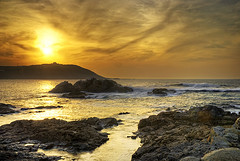
An alien coastline?I’ll wager you’ve caught at least a hint of this story already: astronomers reckon they’ve located the first serious candidate for a water-bearing exoplanet:

… new calculations – made possible by the discovery of “[Gliese 581] e” – show that the larger planet is squarely within the so-called “habitable zone,” neither too far nor too close to the star around which it orbits to support life.

“Gliese 581 d is probably too massive to be made only of rocky material, but we can speculate that it is an icy planet that has migrated closer to its star,” said co-author Stephane Udry, a professor at Geneva University, in Switzerland.

“It could even be covered by a large and deep ocean – it is the first serious ‘waterworld’ candidate,” he said.

A waterworld, eh? As Gareth L Powell put it, maybe we should dispatch Kevin Costner immediately

More seriously, a wet Gliese 581 d is only a possibility as yet, but it’s a possibility that shifts the odds on there being life elsewhere in the universe. When (or perhaps I should say “if”) we manage to confirm the presence of liquid-phase water on other planets, we’ll have to concede that the likelihood of life evolving elsewhere is not as remote as was once thought… which will doubtless be immensely upsetting to some people, but makes me feel pretty good. [image by Paulo Brandão]

NASA gets serious about recycling water

When you make that long trip to the planetary system of Fomalhaut, what are you going to drink? New York Times reporter and all-around brave person John Schwartz reports:

How does distilled urine and sweat taste? Not bad, actually…

Your intrepid reporter opened one of the bottles of “Purified Recycled Water” that Mr. [Robert] Bagdigian [leader of the project to recycle stuff on the International Space Station] brought with him. The wryly worded label was a little intimidating: “We use only the finest ingredients! Urine, Perspiration, Food Vapors, Bath Water, Simulated Animal Waste, and a touch of Iodine. No Carbs or Calories Added.”

With that as my verbal drum roll, I took a sip. Aside from a slight tang of iodine, it tasted like, well, water. I’ve had tap water that tasted much more like things I don’t want to think about.

The $250 million water recovery system is on its way to the station, “preparing our home in space for a larger international family,” as NASA’s spokesperson couches it. The system will recycle about 90 percent of the water used aboard the station and could pay for itself in a couple of years. Astronauts don’t seem worried; one of the first customers for the system, Sandra H. Magnus, says: “We drink recycled water every day, on a little bit longer time scale.”

[Apparently my water is OK for space by tom.glanz]

First ‘synthetic tree’ created

metal tree sculpture“I think that I shall never see / a poem as lovely as a tree.

Indeed, if they were all this small / we’d never see no trees at all… “

Proving a long-held theory that transpiration in trees is a physical process rather than a biological one, the world’s first synthetic tree isn’t much to look at… hell, you’d need a microscope to really make out the detail.

What use is a synthetic tree, anyhow? Well, it:

… should also be a useful platform for the study the properties of metastable liquids and a starting point from which to design new technologies for the management of water in chemical processes, heat transfer, and environmental engineering.

Water management, eh? Euphemistically speaking, I think that may be a fairly big business in a few decades. [image by SweetOne]

Ohio earthworks: Not a fort but a 2,000-year-old water project

ohio-riverThings aren’t always what they seem. More than 200 years ago, General (and future U.S. President) William Henry Harrison decided that a structure at the confluence of the Ohio and Miami Rivers was a fort. Now University of Cincinnati archaeologists and anthropologists say it’s really an irrigation system built by the Shawnee to deal with long-term drought.

Two points stand out: one is that the engineering expertise required to conceive of such a massive irrigation system must have been far greater than what history has traditionally assigned to Native American groups from that time in history, and the second is that the cultural priority of engaging in such a massive undertaking as building these earthworks by hand was done by this culture not because of military motivations but for a more civil cause.

The builders were probably women, too.

[Photo: Ohio River, Chris Breeze]