Tag Archives: writing

Stross: how I ended up as a science fiction writer

lifeCharles Stross is recounting the long journey to his current position has one of the stars of British science fiction, beginning with his first steps into education during the years of Thatcher:

I already knew (from an early age — 12 or so) that I wanted to be an SF writer. But there was a fly in the ointment — a fly called Margaret Thatcher. I turned 15 in 1979, the year the conservatives won an election and the Thatcherite revolution swung into action.

Unemployment soared from around one million to over three million in twelve months as the UK experienced the worst industrial recession since the end of the second world war (largely caused by Thatcher’s dramatic decision to cut most of the state-owned industries off at their knees, on the assumption that the workers would find new and more productive jobs sooner rather than later — a misplaced assumption, as it turned out).

I come from a middle-class background; I could expect to go to university, but not to rely indefinitely on parental hand-outs. “You’ll need some kind of way to earn a living while you’re trying to write,” the careers guidance teachers told me.

A familiar story, as this happy university dropout will affirm (except it was Blair instead of Thatcher and the economic collapse only really started after I left).
[image from The Wandering Angel]

Post-postmodern fiction? Dear Esther, and game engines as narrative engines

We were talking just a few days ago about the narrowing gap between traditional storytelling and computer games. Well, here’s something that seems to have bridged the two to create a hybrid artform: Dear Esther is a Half-Life mod that’s a sort of first-person virtuality narrative with a degree of interaction but no ‘traditional’ gameplay goals.

Dear Esther screenshot

Lewis Denby guests at Rock Paper Shotgun, and explains the potential of level modding for new expressions of creativity:

In a way, that it would be this sort of amateur creation to have such an effect makes sense. The mod scene has the potential to be a land of limitless creative opportunity. You’re not restricted by publishers’ requests, or the demands of your perceived audience, or your own barely competent technology. You’ve an enormous blank canvas to paint on, and all that holds you back is your imagination.

The real big deal here, though, is that 3D game engines can theoretically produce experiences that film, audio and the written word combined still fall short of; the interactive element is the key, producing a sense of emotional engagement that a ‘static’ work cannot replicate. Back to Denby, who suspects it’s the untapped potential for producing a negative emotional response that’s important:

I love my Marios and what-have-you as much as the next person, but I still feel games have an incredible untapped potential for negative emotions. Some have tried – Braid stands out for having a bloody good go – but we’re still a little too comfortable with enjoying everything we play. Any stretches of sadness in this medium tend to be restricted to self-indulgence or vapid tearjerker fare, and even they invariably make way for happy endings and bunny fluff.

Dear Esther rejects pretty much every notion of what videogames should do, and instead presents a profound look at what they could be doing. They could be telling stories that, while unforgiving and upsetting, exist within a format that no novel or film could ever reproduce. Stories that take clever audiovisual amalgamation for granted and go the extra mile, allowing the player to explore a tangible world that they would never otherwise be able to visit. In a sense, Dear Esther is pretty much non-interactive: nothing you do changes the course of the fiction, and there’s no element of challenge to speak of. But in another, far more accurate sense, the interaction is totally key. It’s your journey – whoever “you” are – and the intimacy heightens every emotion censor in your poor, overloaded brain. After watching me finish Dear Esther, my girlfriend asked me what it was I’d been playing. I turned to answer her, only to find I couldn’t speak. No words arrived. None mattered.

Of course, not everyone will want a harrowing immersive experience – think of the number of people who bemoan the lack of happy endings in modern novels – but there’s nothing to say that the form has to be negative in character. But it’s that potential, that opportunity to produce and manipulate both ends of the emotional spectrum, that demonstrates we have yet to see even the infancy of this hybrid artform.

I rather suspect that this could provide a great way for powerful fiction writers to reach a massive new audience that traditionally ignores dead-tree media. Who knows – it might even usher in a return of the writer as something more than a small-font credit line at the end of a movie or TV show. [via BoingBoing; Dear Esther screensot borrowed from Rock Paper Shotgun under Fair Use terms, please contact for immediate takedown if required]

PR advice for writers from Jeff VanderMeer

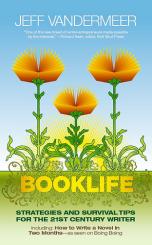
Booklife by Jeff VanderMeerHyperprolific author and anthologist Jeff VanderMeer recently completed and submitted Booklife, a non-fiction book about the writing life that promises to be full of insight, harsh truths, good ideas and (knowing VanderMeer) dark humour.

He’s been posting a few excerpts from it in various places, including a chunk of tips on PR and self-publicity for writers which are well worth reading even if you’re not a writer – they say a lot about the art of publicity in a world where everyone is already their own PR firm (whether they realise it or not).

That advice includes a warning on the dangers of listening to advice from those who aren’t as qualified to give it as they might like to think:

How did some of these people arrive at bad places? Horrible advice. Always keep in mind that advice, especially advice on promoting yourself, is often anecdotal or a Received Idea–received from a time machine from the Distant Past. Sincerely-given but idiotic career advice can be a shiv in the side, an icepick through the eye. Worse, it can result in a slow malarial fever from which you never recover, performing actions you later have no good rationale for doing. The worst career advice attempts to separate you from your work, you a shucked oyster wondering what happened, and why.

Five lies writers believe about editors

Hey, fiction writers – ever wonder what really makes editors tick? Sure you do; you’d love to know what really happens to your story when you wing it off for consideration at a favourite magazine or website.

Well, you’re in luck – Jeremiah Tolbert, himself a writer but also currently submissions editor at Escape Pod, explodes five myths about the editorial process. Here’s the first:

  • LIE #1: Editors give every story fair consideration. OR: Editors reject stories without reading them at all.

The truth is, the slush is deep, and it’s rarely an editor’s favorite part of the job. Why do you think so many places have slush readers?

Every story doesn’t get fair consideration. Not every story deserves it. If you can’t be bothered to read the submission guidelines and follow them, it’s an easy rejection. If you have five grammar and spelling mistakes in the first two paragraphs, it’s an easy rejection. If it’s a story about vampires, and I hate vampire stories, it’s mostly an easy rejection.

Most stories get at least a page out of me. Then I skip to the last 3 paragraphs, if I’m feeling generous. Some get less. Some work is so obviously bad that it’s startlingly easy to know it’s not going to work. But every story gets looked at. Nothing ever gets rejected without being partially read. Honest.

All five are honest, pertinent, and pretty funny. Go read.

Writing the mega-corporation realistically

corporate headquartersJason Stoddard has gotten tired of stories and novels featuring shadowy and nefarious mega-corporations seeking to enslave the globe, and with good reason – it’s just not a realistic or logical thing for a corporation to do, and it’s becoming a modern iteration of the moustache-twirling Snidely Whiplash villain cliché. [image by victoriapeckham]

A corporation doesn’t care if you’re living in a 300 square foot studio apartment or a 6000 square foot McMansion. They don’t want to wipe out the McMansion dwellers, or elevate the studio apartment owners. They only care about one thing: that you buy their stuff.

For everything they do, they’ll have justification. There’s no hidden business plan with a top-line mission statement of “Destroying Civilization As We Know It.”

But there will be hundreds or thousands of decisions, all based on maximizing profit. Substituting cheaper ingredients: maximize profit. Use low-income countries for labor: maximizing profit. Driving smaller competitors out of business: ensuring growth, which maximizes profit. Extending credit to anyone: maximizes profit.

If they can make a bigger profit selling you a “green” condo and a Prius rather than a McMansion and an Escalade, that’s exactly what they’ll do. If they think they’ll make an even larger profit renting you an apartment and leasing you a bike, that’s what they’ll do.

While we’re on the subject of capitalist economics, ethics and prosperity, here’s Matt Ridley at Wired UK explaining why robber barons always end up on top – it’s because they find ways to make things cheaper for you, the consumer:

It’s still happening today. Wal-Mart, Aldi and Ryanair won their market shares by ruthlessly charging us viciously lower prices. And here lies a cause for optimism in the midst of this recession. Even though jobs are being lost, houses repossessed and firms bankrupted, the underlying deflation caused by innovation is still going on – indeed, on the web, it’s accelerating. All over the internet, people are dreaming up ways of making things available to you more cheaply, more conveniently, more copiously and more quickly. That is what will cause prosperity to return one day.

That’s a brave op-ed, given the current econo-political climate, but I suspect he’s at least half right. However, I was somewhat amused to note that Ridley’s masthead note says he was a non-executive chairman for Northern Rock for three years; make of that what you will. 😉