Help us out: which two Futurismic stories should we nominate for the Phoenix Pick Award?

Readers of Futurismic fiction, your assistance would be appreciated: Phoenix Pick are running a competition for original science fiction stories published online between July 2009 and June 2010, and we need your help to decide which two stories we should send in.

A bit of background, here: the Phoenix Pick Award is a new prize, exclusively for sf published online, and is unique in that the stories for consideration have to be submitted by the editors who originally published them, rather than by the authors themselves. The prize money for the winning story – guaranteed at a minimum of $US650, no less! – will be split between the story’s author and its publishing venue.

Now, each publishing venue can submit two stories from the eligibility period for consideration, and that’s where we need your help.

We obviously think all eleven stories we published between July 2009 and June 2010 are awesome, or we wouldn’t have published them (d’uh!), and picking favourites would be no fun at all. So I figure we call on you lot, the readers, and crowdsource the choices – what could be fairer than that?

So, here are all the eligible stories, so you can refresh your familiarity with them:

To nominate your two choices, please list them in order of preference (i.e. favourite, second favourite) in a comment below this post*. You’ve got until Sunday 10th October to make your choice; on that day, I’ll lock the comments, count ’em all up, and announce the two leading candidates to be put forward for the Award.

[ * I looked into using an embedded poll gizmo, but none of them really worked the way I wanted them to, and at least with comments made here I can check by IP address to be sure no one’s stuffing the ballot! ]

The in-jokes from way out

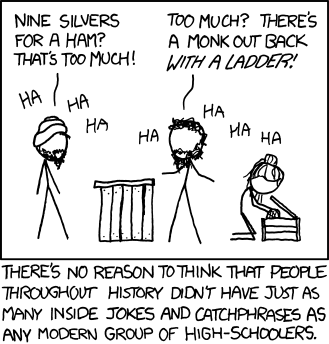
Today’s XKCD may not be one of the funniest ever, but as is often the way, it’s the not-so-funny ones that tend to get me thinking:

Inside joke - XKCD

And as always, it’s the mouseover text that gets to the real point:

I’ve looked through a few annotated versions of classic books, and it’s shocking how much of what’s in there is basically pop-culture references totally lost on us now.

Now, that’s a pretty ubiquitous aspect of popular culture he’s on about, but I think we can suggest that sf will suffer more strongly than regular mimetic novels from this problem when appraised by the readers of the future. Making sense of, say, Jane Austen’s work demands an understanding of the sociopolitical milieu in which it was written, but imagine trying to read Paolo Bacigalupi’s The Windup Girl a century from now (assuming, of course, that there’s still someone capable of reading it at that point). To fully grok the story and its commentary, the reader would need to understand not just the historical situation of the Noughties, but also the way the Noughties looked at the future, and (to a perhaps lesser extent) the way in which a work of sf tends to engage in a dialogue with its antecedents and contemporaries.

Of course, that’s partly true of almost any cultural sub-genre. And this here blog will read rather strangely in a century’s time, but (again assuming it’s still around to read, stuffed into a corner of a diamondite teracube in 2110’s equivalent of the Wayback Machine) there’d at least be the links there for context. But that assumes that the links aren’t dead either, of course… and that the reader would be bothered about checking that context. Hmmm. I seem to have just argued my way out of my own hypothesis; maybe Noughties sf in retrospect won’t look any weirder than any of its contemporary media. In fact, thinking about the music videos I’ve seen recently, it might get off quite lightly…

Even so, I quite fancy the job of knocking up hypertext Cliff’s Study Notes-style annotated versions of modern sf novels for the benefit of the cultural anthropologists of the near future… would anyone like to pay me to do that, please?

Related: Douglas Coupland pops in to the New York Times to coin some much-needed neologisms for the near future. I wonder if he has one for marginal book critics who portray popular post-modern authors as self-indulgent cynics?

Remember to spray on your deodorant first, yeah?

A brief “hey, look, tech!” post, simply because it seems to be everywhere at the moment, and I’d totally jump off a cliff if all my friends were doing it too*: spray-on clothing!

The spray consists of short fibres that are mixed into a solvent, allowing it to be sprayed from a can or high-pressure spray gun. The fibres are mixed with polymers that bind them together to form a fabric. The texture of the fabric can be varied by using wool, linen or acrylic fibres.

The fabric, which dries when it meets the skin, is very cold when it is sprayed on, a limitation that may frustrate hopes for spray-on trousers and other garments.

“I really wanted to make a futuristic, seamless, quick and comfortable material,” said Torres. “In my quest to produce this kind of fabric, I ended up returning to the principles of the earliest textiles such as felt, which were also produced by taking fibres and finding a way of binding them together without having to weave or stitch them.”

Apparently it takes fifteen minutes to spray a T-shirt onto a model, which (for now at least) pretty much ruins the only practical selling point of spray-on clothing, namely convenience. But sensibly Torres has other (more sensible but less headline-worthy) applications in mind, e.g. medical. The cynic in me wonders if he didn’t think of the medical apps first and come up with the clothing thing as an effective marketing gambit… whether he did or not, it seems to have worked.

And your sf-nal pat-ourselves-on-the-back-for-prescience moment: Technovelgy points out that good ol’ Stanislav Lem wrote about spray-on clothes back in 1961. I dare say it’s been mentioned in fiction a few times since.

[ * That particular parental rejoinder has always bothered me. I remember responding to it once with something along the lines of “if I saw a trampoline at the bottom, then yes”. I think I may have been sent to my room afterwards. ]

Oil Spill Fundraiser Anthology from Book View Cafe

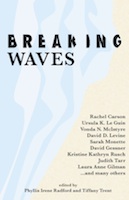
Breaking Waves anthology coverWhat’s better than good quality reading material? Good quality reading material that supports a good cause, of course!

So whether you’re a fan of genre fiction and poetry, concerned about the environmental impact of the Deep Horizon oilspill or both, you should take a look at Book View Cafe’s Breaking Waves anthology:

Edited by Phyllis Irene Radford and Tiffany Trent, Breaking Waves offers up glimpses of maritime splendor, poignancy, and humor through the works of poets, essayists, and Hugo and Nebula-award winning authors like Ursula K. Le Guin, Vonda N. McIntyre, David D. Levine, and more.  All proceeds from the sale of this anthology will go to the Gulf Coast Oil Spill Fund of the Greater New Orleans.

Available in four DRM-free formats – epub, mobi, pdf, prc – and just US$4.99… sounds like a bargain to me!

(Thanks to Nancy Jane Moore for the tip-off.)