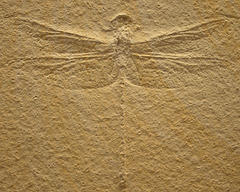
 Can you imagine what the extinct birds of millions of years ago looked like? How big were they? Do they look like the birds of today? What colors were they? The first two questions are easily answerable by fossil records, but the third one is a bit more difficult, unless you have a time machine handy. But US researchers believe they’ve come a bit closer to solving the problem:
Writing in the journal Biology Letters, US researchers reveal how ancient feathers found in Brazil displayed “striking” bands of black and white. Previously, fossil experts could only guess at the range of hues exhibited by ancient birds and some dinosaurs.
To find an answer they had to look at behavioural and genetic clues:
There are particular cells that cluster into the dark areas of modern birds called melanosomes. Somehow the melanosomes are retained and replaced during the preservation process and hence you preserve a very life like representation of the colour banding in the fossils.
And also:
The Yale team believe they could identify brown, red, buff and even iridescent colours. The technique may be applied to other creatures to reveal the colour of fur or even eyes, the team believes.
This news reminds me of an SF story called The Color of A Brontosaurus, which speculates somewhat on the same subject matter.

 Everything can and will be hacked; once you have the motivation sussed, the exploits will be close behind.
 As science fiction writers and readers, we tend to think a lot in technologies, and
  What do science fiction writers think of global conflict? What happens when the world falls into chaos after environmental collapse? Where will the world be if we eradicate ourselves with biological warfare? There’s no grand technological breakthrough that lies at the heart of these types of stories. No, there stories that have been told many times, but they’re present, and they’re modern, and they’re pertinent: they are human, and that is what makes them so profound. Socially conscious writing is important, in my opinion, because it begins to bring back to science fiction what it began as: a way of questioning that which is potentially dangerous. [Photo courtesy of