‘Ghost’ Photos through Quantum Physics

toysoldierScientists funded by the Air Force have used quantum entanglement — in which pairs of particles continue to interact even after they are spatially separated — to snap this picture of a tin solider without aiming a camera directly at the object.  The technique, called “ghost imaging,” has potential military or space applications, such as using aerial drones to survey of battlefields obscured by clouds, or the smoke that follows airstrikes.  Yanhua Shih, who has been experimenting with entangled photons since 1995, says:

“…[T]he image is not formed from light that hits the object and bounces back. The camera collects photons from the light sources that did not hit the object, but are paired through a quantum effect with others that did. An image of the toy begins to appear after approximately a thousand pairs of photons are recorded.”

These are exciting times on the frontiers of physics. Researchers in Copenhagen took a step towards producing a quantum bit. And scientists at Arizona State are trying to figure out how electrons interact. Both are necessary steps towards building superfast quantum computers.

[Image: University of Maryland]

Sarko in space

French President Nicolas SarkozyWith France assuming the (rotating) presidency of the European Union, the BBC reports on a potential shift in European space policy;

President Nicolas Sarkozy‘s well-known admiration for all things American now extends to space exploration. Speaking to the BBC, a senior official involved in French space policy said that it was time to shake up the European Space Agency and make it more like the US space agency (NASA) by giving it a new, politically-led direction

The official said that Europe was in danger of becoming redundant in global space terms and it needed an agency that followed a clear political agenda.

“The United States, Russia, China and Japan would not do what they do in space without a political motivation; Europe has only had a scientific motivation until now. So what we are saying is, let’s get the same chances as the others.

But while the BBC reads this shift in emphasis as from ‘scientific’ to ‘political’, the Financial Times focused on the small print – interpreting the announcement as a move towards a ‘military angle for space strategy’;

French ambitions range from setting up an EU spy satellite system to joining a manned US mission to Mars.

Paris wants to exploit synergies with existing civilian space projects. For example, Galileo, the €3.4bn ($5.4bn, £2.7bn) rival to the UScontrolled global positioning system, is classed as a transport project, although it could be used for military operations.

Hmm. The European Space Agency’s most recent press release on Gallileo mentions nothing of military applications, focusing instead on the five civilian services;

the Open Service, the Safety of Life Service, the Commercial Service, the Public Regulated Service, and the Search and Rescue Service.

Now, why does this make me uneasy?*

[image by thewritingzone]

– – – – –

[ * Only kidding – I’m a total Galileo fanboy. Of course, if Sarkozy were a Doctor Who / Bond villain, Bruce Sterling’s obsession with said Gallic premier could be explained as the result of some kind of sinister mind control laser… ]

Germans putting CO2 underground

Carbon sequestration or carbon capture and storage (CCS) is an enticing possibility for those who like their global CO2 levels below 390 ppm but aren’t too keen on nuclear power.

sa-megetThe basic idea is to carry on burning fossil fuels for energy, but instead of venting the waste CO2 into the atmosphere, bury it underground. Now CO2SINK, a European research project, have created the first underground carbon dioxide storage site at Ketzin, near Berlin:

It will pump up 60,000 tonnes of the greenhouse gas into porous, salt water-filled rock at depths of more than 600 metres (656 yards) over the next two years, the centre said.

This obviously won’t solve all the problems. After all it is probable that our fossil fuels will run out at some point. “Clean” fossil fuels might provide a useful stopgap before we decide on our long term energy mix.

[story via PhysOrg][image from Jacob Botter on flickr]

MAQUECH by Silvia Moreno-Garcia

First of the month means fiction time at Futurismic; this month’s offering is “Maquech” by Silvia Moreno-Garcia, a haunting and darkly beautiful tale of dreams and desperation set in a scarcity-riddled near-future Mexico City.

So get stuck in, and don’t forget to leave Silvia some feedback in the comments at the end!

Maquech

by Silvia Moreno-Garcia

The jewel encrusted beetle walked slowly across the table, dragging its golden chain behind. It was bigger than any other maquech he’d ever seen before and more richly decorated.

Gerardo put down the eyeglass.

“It’s not my usual purchase,” he said.

“It’s rare,” Mario replied. “This is the last one my grandfather made before he passed away.”

“Monkeys are the thing now. Everyone wants a monkey.”

“But it doesn’t need a lot of food or water,” Mario protested. “That’s a benefit.”

“Do you think my clients worry about things like food or water? Listen, I sold five ostriches two months ago. People want large animals now.”

It was a lie. He sold fish and birds and maybe a reptile or two. He could not afford extravagant purchases like ostriches.

“I need the money,” Mario confessed. “I want to go to Canada.”

“What for?”

“I want to see the polar bears before they disappear. Before all the ice melts away.” Continue reading MAQUECH by Silvia Moreno-Garcia

Smart mobs – more smart, less mob, says Rheingold

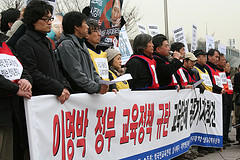
Korean political protestorsWeb anthropologist and elder statesman Howard Rheingold got invited to address South Korea’s citizen journalism website OhmyNews by video, in light of the protests currently ongoing there in opposition to the importation of US beef. The video and a transcript are available for everyone to see, and Rheingold has some sensible things to say about the Pandora’s Box of smart mobs:

A smart mob is not necessarily a wise mob.

The technology itself does not guarantee peace or democracy. It really requires a literacy. It requires an informed citizenry. Journalism plays a role in that. Journalism brings to the people news they need to know about the workings of the State. And it helps bring public opinion to the policy makers to know that they cannot make policy that goes against the majority of opinions of the citizens.

Wise words, for sure – but the inference is that Rheingold recognises that smart mobs are simply one emergent property of recent technological advances … and that the same technology, with a very slight adjustment of attitude or motive by its users, can be used for oppression just as easily as liberation. [image by hojusaram]

New technologies, same old problems.