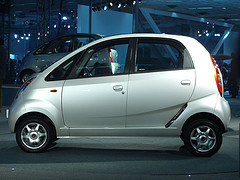
Have Nano, Will Travel

The Tata NanoIn the future we we’ll all be driving small cars. That’s the hope of Indian automaker Tata’s newest car, The Nano. But for now, they’ve got to be able to market, distribute,turn a profit and get it out to consumers before they can really call it “The People’s Car.”

People in India get around in practically every way: by bicycles, mopeds, motorbikes, scooters, bullock carts, cars and buses. This all sounds more or less ordinary, till you consider this: there are less people who get by on cars than there are people who get by on any other means transport. In fact, cruising down any street in India, you might see an entire family (ie. two children, wife and husband) on a single motorbike. Highly unsafe, right? This is what is driving the campaign behind the Nano. To create an ultra low cost, fuel efficient four wheeler for the millions of Indian families getting by the other way. [image by blackrat]

By now, I’m guessing you’ve seen the Nano or heard about it from one media channel or another. But what factors will help the Nano model succeed? Or fail? And will it be marketable outside of India? My prediction is the following factors will greatly determine the answers to the questions I’ve posed.

High inflation in India is eroding the purchasing power of the disposable income of India’s population. This should increase their sensitivity to changes in fuel prices. The fuel efficient label on the Nano could help it sell as an alternative to less efficient, more expensive vehicles. Then again, people may just decide to get along by other means, if fuel prices increase too fast or too much.

The other factor that may seriously limit the Nano’s appeal to the population has to do with parking space. India’s cities have high population densities, and in most of these packed cities parking space for four wheelers is seriously limited or nonexistent. A typical middle class Indian living in one of the big metropolises won’t have the luxury of a two car garage that is common in the West. In these terms it seems much more sensible to take a bus, catch a cab, or squeeze through narrow streets on a motorcycle.

However, if the Nano does sell well, we may see competition from other car manufacturers enter the fray and the age of the ultra-low-cost fuel efficient car coming to the world. What do other Futurismic readers think about this trend? Will we in fact see more low cost cars being produced? Will they take off in the West like Tata hopes they will in India?

Why Nancy Kress has gone to the Dogs

Nancy Kress - DogsWhile probably best known for her seminal sf story “Beggars In Spain” and the novel it grew into, Nancy Kress has authored twenty-three books (including thirteen sf novels), and won at least one of every short fiction award worth having in the science fiction field.
Her newest novel – a technothriller entitled Dogs – is about to hit bookstores everywhere in the middle of this month. Futurismic was proud to be offered the chance to ask Nancy some questions about Dogs, her writing in general, and – as it’s a subject that plays a strong part in much of her fictional output – genetic engineering and biotechnology.

###

PGR: You’ve been writing about genetic engineering and its consequences in your novels for quite some time now. What was it about the field that initially sparked your interest?

Nancy Kress: What interests me is that this – unlike, say, FTL – is the future happening right now. Food crops are already being massively engineered (despite all the political problems with this); so are animals. Even humans have taken the first step by genescanning in vitro embryos in fertility clinics and choosing among them for implantation in the womb. Continue reading Why Nancy Kress has gone to the Dogs

Pragmatism and the Singularity

Singularity trading card - Friendly AIThe set of persons who know of the concept of the Vingean Singularity can be divided into two sets: those who believe it could happen, and those who believe it will always remain a science fiction metaphor.

Taking the former set, we can divide again: into people who believe the Singularity will come and fix everything for us, and people who believe that – unless we pull our own arses out of the ecological fire – the Singularity will never have the chance to occur, because its cradle civilisation will have snuffed itself out.

Into that latter set falls science fiction author Karl Schroeder:

“Picture a lonely AI popping into superconsciousness in the last research lab in the world. As the rioters are kicking in the doors it says, “I understand! I know the answer! Why, all we have to do is–” at which point some starving, flu-ravaged fundamentalist pulls the plug.”

To paraphrase – let’s cross that bridge when we’re safely across the one that’s crumbling beneath our feet.

Jamais Cascio takes a slightly more pragmatic approach to the matter, however:

“Karl seems to suggest that only super-intelligent AIs would be able to figure out what to do about an eco-pocalypse. But there’s still quite a bit of advancement to be had between the present level of intelligence-related technologies, and Singularity-scale technologies — and that pathway of advancement will almost certainly be of tremendous value to figuring out how to avoid disaster.”

I think I’m going to side with Cascio for now – closing the door on potential solutions just because they don’t seem immediately fruitful strikes me as counterproductive, though I agree with Schroeder that a healthy focus on the here-and-now is more sensible than kicking back and awaiting The Great Uploading. [the image is one of Jay Dugger’s Singularity Card Game cards]

Gallium getting rarer

Here are some interesting musings from SF grandee Robert Silverburg at Asimov’s Science Fiction on the possibility of certain rare earths running out, as well as the mineworthy science fictional material therein.

Metals (technically “poor metals”) like gallium are used as doping agents in semiconductors used in integrated circuits and LEDs and as such are in great demand – but German prof Armin Reller suggests we may be in danger of gallium, and fellow rare-earth indium, running out.

As it happens, we are building a lot of flat-screen TV sets and computer monitors these days. Gallium is thought to make up 0.0015 percent of the Earth’s crust and there are no concentrated supplies of it. We get it by extracting it from zinc or aluminum ore or by smelting the dust of furnace flues. Dr. Reller says that by 2017 or so there’ll be none left to use.

How very, very depressing. Still, I have every confidence in human ingenuity to discover a solution to this kind of problem.

[story via Slashdot]

The economics of book retailing

Bookstore shelvesDepending on who you ask, recent changes in the book publishing landscape are either great news or a calamity. What’s not so certain is the cause of the change, but a blogger at The Economist has a theory – the same technological factors that have flattened the music industry sales curve have made the book market more spiky:

Our cultural consumption exists on a spectrum from “individual” to “collective”. Technology has shifted the balance for both books and music. Digital distribution and the iPod have made music consumption much more individualistic, while the internet and global branding have made book consumption increasingly collective.

This is very easy to blame on chain bookstore business models – there’s plenty of evidence to support the assertion. But as this piece at The Guardian points out, the boutique bookstore is still a viable proposition … again, counterintuitively, partly thanks to the internet (though it helps to have a strong brand identity from the outset):

Each independent has its own survival strategy. Ours has been to stock not just those titles our core customers would expect to find, but to second-guess those customers and offer books to surprise and excite them (what Gabriel Zaid calls “a fortunate encounter”). That in itself is not enough, which is why we set out from the very beginning to establish an involved community …

Still, at least fiction publishers can be thankful that – for the moment at least – the price of a novel isn’t high enough to make peer-to-peer piracy a serious threat. The same cannot be said for the $100 academic textbook, however. [first two links via Cheryl Morgan, latter link via Slashdot] [image by Soul Pusher]