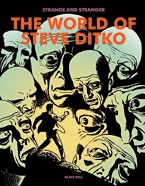
A new book about Steve Ditko

steveditkoThe New York Times has a review of Strange and Stranger: The World of Steve Ditko, a biography and critical study by Blake Bell (Fantagraphics). Stan Lee always knew how to promote himself, and the late Jack Kirby is getting the props he deserves. Ditko is less well known to the public, but of course every comics fan knows he was the original Spider-Man artist. (Tobey Maguire was such a great casting choice, capturing the antiheroic geekiness of the early Peter Parker.)

Ditko now seems now to be leading a strange, sad life, recounts Times reviewer Douglas Wolk:

He split with Lee and Marvel in 1966. By then, he’d fallen under the spell of Ayn Rand and Objectivism, and started producing an endless string of ham-fisted comics about how A is A and there is no gray area between good and evil and so on. “The Hawk and the Dove,” for instance, concerns two superhero brothers who … oh, you’ve already figured it out. Ditko could still devise brilliantly disturbing visuals — the Question, one of his many Objectivist mouthpieces, is a man in a jacket, tie and hat, with a blank expanse of flesh for a face — and his drawing style kept evolving, even as his stories tediously parroted “Atlas Shrugged” and “The Fountainhead” at the expense of character, plot and ultimately bearability.

He drew Transformer coloring books and Big Boy comic books, almost as if he followed John Galt on strike.

(Self-indulgent note: Rand is always good for starting an argument, in my experience…)

[Image: book cover from Fantagraphics]
Friday Free Fiction for 22nd August

Unless I’m very much mistaken, this is one of those rare occasions where the US and the UK get a long weekend at the same time – so let’s celebrate with some Friday free fiction, eh?

***

A trio from ManyBooks.net:

***

From Paul McAuley:

I’ve added a new short story, “A Brief Guide To Other Histories“, to my fiction archive. First published in Postscripts #15, it shares the same multiverse as [McAuley’s latest novel] Cowboy Angels.

***

The latest from Apex Online:

***

There’s some new stuff at Subterranean Online; I’m not entirely sure what’s newest, because either I’ve not been paying attention or their feed hasn’t been coming through to my reader properly of late. So, my apologies if I’ve posted any of these already, or missed any out:

***

From Jayme Lynn Blaschke, Memory #21:

Flavius recoiled from the creature, throwing up his arm between them. The thing stared at him briefly, nictating membranes sliding quickly across the eyes before its spindly arms abruptly produced a translucent, frosted dinner plate with crusted orange balls delicately arranged upon it. It deftly set the plate before Flavius as another arm deposited a tall flute of burgundy liquid on the table. It cocked its head without saying a word, then swiftly retreated straight up.

***

From Jay Lake:

The tarot issue of Behind the Wainscot has gone live. This includes my short-short “Heirophant Bridge“, along with a number of other short-shorts and flash pieces by a wide assortment of authors. Quick, interesting read.

***

The sixteenth (!) DVD extra from Shadow Unit is called “Mythology

***

Via SF Signal, we hear that Jeffrey Carver has released his novel Neptune Crossing as a free ebook in a variety of formats, which you can download from Starrigger.com; looks like there’s some stories as webpages there, too.

From the same tips list, a couple of titles at the curiously named Munseys:

***

And here’s a handful from the Friday Flashers:

***

That’s your lot – plenty to be going on with there, I think. In the meantime, keep your tip-offs and plugs coming through – this time only the deadline is 1800 GMT THURSDAY, because I’m out of town on Friday week and will need to pre-compile. Have a great weekend!

Arboreal structures: tree benches, streetlamps

A splendid concept is being pursued to manipulate the roots of trees to create useful structures:

Pilot projects now underway in the United States, Australia and Israel include park benches for hospitals, playground structures, streetlamps and gates. “The approach is a new application of the well-known botanical phenomenon of aerial root development,” says Prof. Eshel. “Instead of using plant branches, this patented approach takes malleable roots and shapes them into useful objects for indoors and out.”

A company called Plantware is developing these, and similar methods, to create a wide variety of tree-based items. In addition researchers from Tel Aviv University are developing other environmentally friendly ideas:

Prof. Eshel’s team is also working on a number of other projects to save the planet’s resources. They are currently investigating a latex-producing shrub, Euphoria tirucalii, which can be grown easily in the desert, as a source for biofuel; they are also genetically engineering plant roots to ensure “more crop per drop,” an innovative approach to irrigation.

[story via Physorg]

Nostalgia does science fiction a disservice

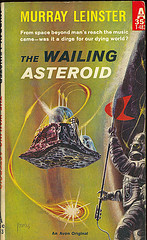
Old book jacket art for The Wailing Asteroid by Murray LeinsterNovelist Ian Sales makes an interesting point – a lot of the stories and novels held up as classics of the science fiction genre are actually very bad adverts for the modern form:

I’ve complained before about the undeserving admiration given to many science fiction novels and short stories of earlier decades. Such reverence frequently results in fans recommending these works to people wanting to try the genre. And that’s not a good thing. Readers new to the genre are not served well by recommendations to read Isaac Asimov, EE ‘Doc’ Smith, Robert Heinlein, or the like. Such fiction is no longer relevant, is often written with sensibilities offensive to modern readers, usually has painfully bad prose, and is mostly hard to find because it’s out of print. A better recommendation would be a current author – such as Richard Morgan, Alastair Reynolds, Iain M Banks, Ken MacLeod, Stephen Baxter, and so on.

I think Sales has a good point there. I came to science fiction through the authors publishing in the eighties, and as such I’ve found that a lot of the classics are, while interesting from a historical perspective, pretty unfulfilling reads. And hell knows being made to read some of Dickens’ more tedious works at school gave me a knee-jerk reaction to literary classics, too. [Murray Leinster cover scanned by J Levar]

Which authors would you recommend to a reader wanting to dip their toes into the genre, and why?

M.J. Engh to be honoured by SFWA as 2009 Author Emerita

We just got a press release from Jayme Lynn Blaschke of the SFWA:

Mary Jane Engh, author of Arslan and Wheel of the Winds among other works, will be honored as Author Emerita by the Science Fiction & Fantasy Writers of America for the 2009 Nebula Awards® Weekend in Los Angeles, California.

“Well, I hope ’emerita’ doesn’t mean ‘over the hill,’ but I’m truly honored — blown away, in fact,” Engh said. “It’s nice to know that somebody has noticed me.”

Under the pseudonym Jane Beauclerk, Engh published her first science fiction story, “We Serve the Star of Freedom,” in the July 1964 issue of the Magazine of Fantasy & Science Fiction. Over the next four decades, her short fiction appeared in a wide range of markets including Universe 1, Isaac Asimov’s Science Fiction Magazine and Arabesques.

Congratulations, Ms Engh! I’ll be entirely honest and say that I’ve never read anything she’s written, but I figure the SFWA don’t just give honours like that away for peanuts. If anyone knows where some of her fiction can be found on the web, do let us know, and we’ll stick the links up.