Why near-future science fiction is difficult

Here at Futurismic, our fiction guidelines state that we’re looking for near-future science fiction only. There’s no elitism involved – we just like to have a niche to focus on, one that (we hope) fits with our readers as well as it does with the editorial team.

But there is an argument to the effect that, in some ways, near-future science fiction is more challenging to write well than the out-and-out fabrication of, say, space opera. Few would know that better than Jetse de Vries, who has just finished a four and a half year stint as fiction co-editor for Interzone magazine. De Vries has been doing some thinking-out-loud about the problems of near-future sf from the writer’s perspective:

It’s what makes writing near-future SF such a daunting task, and a kind of catch-22 exercise: if it looks too believable it (most probably) won’t happen; if it looks too implausible it might very well happen.

So if you dive into the world of tomorrow, you need to find a balance between not being too conservative in your predicitions, but also not too ‘off-the-wall’, either. For example, back in 1997 the movie “Wag the Dog” satirised the Clinton/Lewinsky affair by fabricating a war to cover up a presidential sex scandal. Nowadays, one would not only wish it was only a sex scandal they were covering up, but — much more importantly — that the war was ‘fabricated’ instead of real.

[snip]

So what’s a poor SF writer to do? Well, dare to make mistakes, try to ride the fine line between extrapolating too straightforwardly or too crazily, and face complexity.

I hear that: the older I get, the more relevant the old aphorism seems to become – the truth really is stranger than fiction.

How do the writers among you approach plausibility in your near-future science fiction stories?

Tobias Buckell interviewed

Tobias Buckell meets Halo's Master ChiefWe like to keep an eye on the progress of members of the Futurismic gang who have moved on to bigger and brighter things, and there’s no one who fits the bill better than Tobias Buckell, the former Futurismic blogger who’s just finished writing his fourth novel at around the same time the third, Sly Mongoose, hits bookstore shelves. [image from Tobias’ blog]

Tobias is a great writer and a lovely bloke to work with, and also a poster-boy for the “work hard and earnestly and your dreams will come true” approach to life. There’s an interview with Tobias up at the Nebula Awards website that’ll give you an insight into his mindset:

From 15 to 25 I wrote during the time that everyone else played games or watched TV. The average American watches 20-30 hours of TV a week. That’s almost watching TV like a full time job. By swapping out writing, I worked at writing.

Of course, one can question the sanity of working a part time or near full time job for 10 years that hardly started paying anything until recently. I could have started a business on the side. But that’s where my hard work comes from, choosing to make a hard choice about how I spent my time. As a result, I never felt like I worked hard, just that I missed a lot of the stuff people around me seemed to be spending *their* time on. Do I regret not seeing 10 year old TV shows (what’s a ‘Buffy?’) and spending a lot of money on alcohol? In the big picture, not a bit.

Congratulations, Tobias – hope one or more of those awards comes through for you. Hell knows you’ll have deserved it. 🙂

Futurismic readers ate all Tom Doyle’s bandwidth!

It’s great for us to know that yesterday’s post sent lots of you off to listen to Tom Doyle’s audio readings of his stories… and great for Tom himself, too!

However, there really can be too much of a good thing – so many people downloaded that the bandwidth limits on the hosting site he was using has been exceeded. Never fear, though; Tom has moved the files to a new location. So if you didn’t manage to get them the first time, try the following links instead:

Enjoy!

Stephen Colbert’s DNA to back up the human race

geneUm. I can’t really add much to the title, churnalism be damned, this is good stuff:

Comedy Central announced Monday that the host of The Colbert Report will have his DNA digitized and sent to the International Space Station (ISS). According to the Associated Press, Stephen Colbert’s gene package will be carried there by famed video game designer Richard Garriott, who will travel to the station in October.

All in all, a great day for humanity. Also I wonder what a gene package looks like?

[story via KurzweilAI][image from Joe Madon flickr]

Google ponders offshore data center

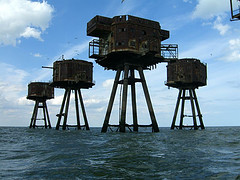
fortsIt sounds like something Bruce Sterling foresaw as long ago as Islands in the Net: Larry Dignan on ZDNet looks at a patent for a structure that would sit offshore like an oil rig:

Google is pondering a floating data center that could be powered and cooled by the ocean. These offshore data centers could sit 3 to 7 miles offshore and reside in about 50 to 70 meters of water.

….Now wild-cards abound. Jurisdiction issues will occur. Are states really going to allow Google or anyone else place these pontoons offshore without some tax hit?

And will Google take advantage of such a setup to bank your data like the Swiss bank money?

[Rusting sea forts in the Thames estuary photographed by phault; story tip: Gregory Frost]