 Mac Tonnies assures me that this is a true story; I’ve worked with him for a while now, and I’m inclined to believe him… though I suspect the truth in question may be more symbolic than literal. But you should make up your own mind after you read about Mac’s real-life alien encounter in this month’s Loving The Alien column. Continue reading My real-life alien encounter
Monthly Archives: September 2008
A new hope? Another call for positive science fiction
As an antidote to the previous doom-flavoured post, here’s recent Clarion alumni Damien G Walter suggesting that it’s time science fiction started taking a more hopeful and positive look at the future:
But there are no end of reasons to have hope for tomorrow. Biotechnology and genetic research offer fantastic advances in medicine, yet their portrayal in science fiction is typified by the gloom of Margaret Atwood’s Oryx and Crake. The internet is already democratising many new areas of society, but our political future is still most commonly depicted as one flavour of Big Brother dystopia or another. Environmental or economic collapse might plunge us all headlong into the apocalypic future of Cormac McCarthy’s The Road, or we might respond to them with intelligence and ingenuity and take the opportunity to find better ways of living. To look at the infinite possibilities of the future and see only darkness is a failure of imagination.
Here, Walter echoes similar calls from Jason Stoddard and Jetse de Vries, and doubtless some others I’ve not noticed (or, just as likely, forgotten about); it definitely appears to be a theme with some of the young turks of science fiction writing. Are we witnessing the first stirrings of a new movement?
And what about the readers? OK, so the writers are bored of dystopic futures, but how many of us would like a little more optimism in our escapism?
Climate change steps on the gas
 Hoooooo-boy. Just in case global financial disasters and geopolitical instabilities haven’t given you enough things to worry about, here’s a another: remember when scientists suggested that melting ice-caps at the poles of the planet could end up releasing massive reservoirs of sub-oceanic methane into the atmosphere, amplifying the greenhouse effect and accelerating climate change to an even greater degree?
Turns out that we’re finding more evidence for that theory than anyone really wants to find. Anyone wanna buy us out of this little problem? [via WorldChanging; image from linked Independent article]
An Internet of things
 A world of spime-like networked and sensor-laden appliances, objects, and general stuff took a step closer with an assortment of tech titans announcing their intention to create an Internet Protocol for Smart Objects:
Smart objects are objects in the physical world that – typically with the help of embedded devices – transmit information about their condition or environment (e.g., temperature, light, motion, health status) to locations where the information can be analyzed, correlated with other data and acted upon. Applications range from automated and energy-efficient homes and office buildings, factory equipment maintenance and asset tracking to hospital patient monitoring and safety and compliance assurance.
Suggestions for colloquial names for this technology:
- The Interject (INTERnet of obJECTs).
- The Thinweb (a WEB of THINgs).
- The Stufflink (you get it)
Any more?
As computation and connectivity continue to ooze their way into everything from dildos to doorbells can we think of any interesting science fictional consequences?
Doug Rushkoff blogging at BoingBoing
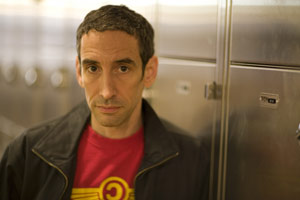 Those of you who follow the Double-Boing may have noticed that they’ve started getting guest bloggers on board again. This week sees a visitation from Douglas Rushkoff; there are few thinkers and writers that I would recommend without reservation, but Rushkoff is one of them. [image from biography page of Rushkoff’s website]
He’s written (sometimes with great influence) on politics, cyberculture, religion, ethics, finance, viral marketing, reality hacking and all sorts of other stuff, and he never fails to come up with something challenging. So if you’re not a regular BoingBoing reader, I’d suggest grabbing the RSS feed, if only for this week. Here’s a snippet from his ‘Open-Source Democracy’ post:
Back when everyone was thinking about digital democracy as some sort of voting scheme or mass feedback polling operation, I wrote a short book called Open Source Democracy in an effort to extend people’s thinking beyond elections to include participation in civics. Yes, we have representatives, but they’re only good as their ability to respond to the needs that come from the bottom up.
Rushkoff’s a blogger in his own right, and a novelist too. More recently he did an excellent comic-format series on DC Vertigo called Testament – Old Testament fables meet dark near-future corporate dystopia. Recommended.