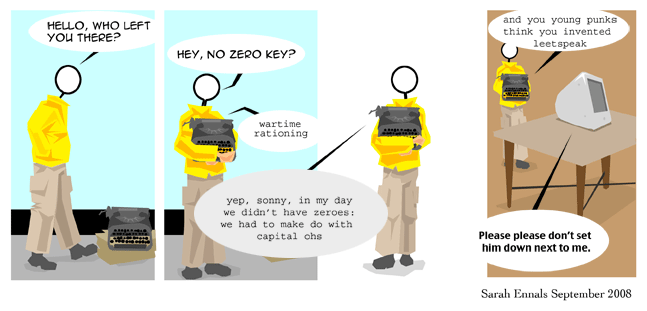
Does Not Equal is a webcomic by Sarah Ennals – check out the pre-Futurismic archives, and the strips that have been published here previously.
Thanks go out to Don Hutton for this week’s premise.
Does Not Equal is a webcomic by Sarah Ennals – check out the pre-Futurismic archives, and the strips that have been published here previously.
Thanks go out to Don Hutton for this week’s premise.
 “Conventional clocks with hands are boring,” says inventor John Taylor. Much more interesting to build a four-foot-wide mechanical timepiece that has no hands or numbers, uses blue lights flashing through slits to tell the time, and is accurate only once in five minutes. Watch it work in a short video narrated by Taylor.
He based the clock on a design by longitude pioneer John Harrison, who was calibrating the one he built himself when he died in 1776. The ominous grasshopper sculpture atop the face is a tribute to another Harrison invention, the “grasshopper escapement” that releases a clock’s gears with each swing of the pendulum. The “Chronophage” (time-eater) was unveiled at Cambridge by Stephen Hawking, in a ceremony that ran 14 minutes and 55 seconds late. Taylor says:
“I … wanted to depict that time is a destroyer – once a minute is gone you can’t get it back …. That’s why my grasshopper is not a Disney character. He is a ferocious beast that over the seconds has his tongue lolling out, his jaws opening, then on the 59th second he gulps down time.”
[Hawking unveils the chronophage by rubberpaw]

Use only as directed. It seems to be a side project of Get Your War On. Or maybe a sponsor.
We pick up our mail in the 1800s.
NOW THAT SPELLS “PROOF” IN ANY ERA OF TIME!
 Why do people love stories, anyway? Scientific American reviews recent research and speculation, rounding up ideas — stories, really — from psychology, neurology, anthropology, and evolutionary theory. A taste:
In support for the idea that stories act as practice for real life are imaging studies that reveal similar brain activity during viewings of real people and animated characters. In 2007 [Raymond A. Mar, assistant professor of psychology at York University in Toronto] conducted a study using Waking Life, a 2001 film in which live footage of actors was traced so that the characters appear to be animated drawings. Mar used functional magnetic resonance imaging to scan volunteers’ brains as they watched matching footage of the real actors and the corresponding animated characters. During the real footage, brain activity spiked strongly in the superior temporal sulcus and the temporoparietal junction, areas associated with processing biological motion. The same areas lit up to a lesser extent for the animated footage. “This difference in brain activation could be how we distinguish between fantasy and reality,” Mar says.
[Story Corps van: photo by Omar Omar]
 We had a lively (but civil!) discussion about the psychology of political choices last week. So how about physiology? Science published a report suggesting that people who respond most strongly to disturbing images seem to have political views that most people would call conservative. The test used gadgets to measure skin moisture and blink intensity. Pictures included a big spider on a face and a guy covered with blood.
Yes, I’m skeptical too. The subjects were Nebraskans, residents of one of the more conservative of these United States in terms of voting. And if you showed this arachnophobic left-leaning blogger some of those disturbing images he’d cry like — well, like a Wall Street banker, this week.
Meanwhile, in another poli-sci story: When vice-presidential candidate Sarah Palin’s email was easily hacked and screen-shots pasted all over the internets, she and her supporters immediately called for a repeal of the Patriot Act and warrantless surveillance, because now they know what it feels like to have their privacy invaded without warning and for no good reason. Civil liberties enjoyed a resurgence in the U.S., and …
Sorry. Dreaming on the job.
And just to confirm that, as The Posies sing, everybody is a frakking liar (video):
The world’s largest particle collider malfunctioned within hours of its launch to great fanfare, but its operator didn’t report the problem for a week.
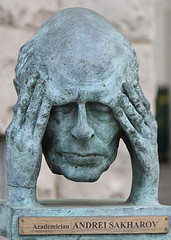
[Bust of Dr. Andrei Dmitrievich Sakharov: photo by dbking]