
On November 15, 1988, as snowy clouds and winds were swirling around Baikonur Cosmodrome in Kazakhstan, the Buran orbiter, attached to its giant Energia rocket, thundered into the gloomy early morning sky. Three hours and two orbits later, the 100-tonne bird glided back to a flawless landing just a few miles from its launch pad.
Despite the kind of strong winds that would rule out any launch or landing attempt by the US space shuttle, Buran touched down just 3m off the runway centreline.
And this planet-wide ballet was performed with its “pilots” safely on the ground.
Monthly Archives: November 2008
Marijuana is teh good, episode 3
 Research suggests drugs similar to THC, the active ingredient in marijuana, may help reduce memory impairment due to Alzheimer’s, from Physorg:
The research suggests that the development of a legal drug that contains certain properties similar to those in marijuana and hemp might help prevent or delay the onset of Alzheimer’s disease. Though the exact cause of Alzheimer’s remains unknown, chronic inflammation in the brain is believed to contribute to memory impairment.
Any new drug’s properties would resemble those of tetrahydrocannabinol, or THC, the main psychoactive substance in the cannabis plant, but would not share its high-producing effects. THC joins nicotine, alcohol and caffeine as agents that, in moderation, have shown some protection against inflammation in the brain that might translate to better memory late in life.
This following news THC could also be used as an antibiotic, and that cannabis is believed to be less dangerous than alcohol or tobacco.
Mammoth progress
 Scientists have successfully sequenced a reasonably complete genome from an extinct animal for the first time, in this case, a woolly mammoth:
The team sequenced the mammoth’s nuclear genome using DNA extracted from the hairs of a mammoth mummy that had been buried in the Siberian permafrost for 20,000 years and a second mammoth mummy that is at least 60,000-years-old.
By using hair, the scientists avoided problems that have bedeviled the sequencing of ancient DNA from bones because DNA from bacteria and fungi, which always are associated with ancient DNA, can more easily be removed from hair than from bones.
Another advantage of using hair is that less damage occurs to ancient DNA in hair because the hair shaft encases the remnant DNA like a biological plastic, thus protecting it from degradation and exposure to the elements.
[image and story from Physorg.com][photo credit: Stephan Schuster lab, Penn State]
The Live Piracy Map
The ICC’s Live Piracy Map does exactly what its name suggests – it collates reports of modern piracy (the ocean-going sort, not kids using peer-to-peer networks), and plots them out as a Google Maps layer:
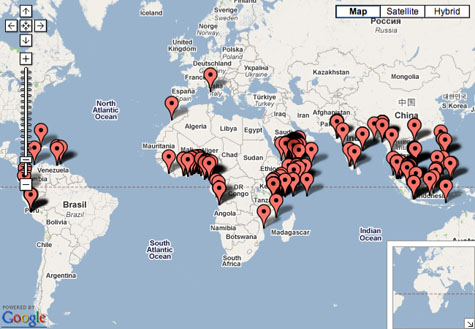
What’s interesting to me (as someone who works in maritime history) is how some of the hotspots are comparatively new, but others are almost as old as ocean-going commerce itself – a reminder that geography remains unconquered by technological progress, at least as far as supply chains of physical goods are concerned. [story and screenshot via the indispensable BLDGBLOG]
It also suggests that Sven’s armed cruise ship story wasn’t quite as implausible as some seemed to feel…
Direct evidence of dark matter detected over Antarctica?
 A high-altitude balloon experiment above the Antarctic may have just seen a possible signature of the mysterious “dark matter” thought to make up 85 percent of the mass of the universe–but as yet, completely unseen and not at all completely understood. (Via Nature News.)
The experiment, the Advanced Thin Ionization Calorimeter (ATIC), spotted a surplus of high-energy electrons coming from…somewhere. This matches something the PAMELA (Payload for Antimatter Matter Exploration and Light-nuclei Astrophysics–don’t you love space-exploration acronyms?) satellite mission turned up earlier this year
Electrons at this particular energy could be the result of heavy dark-matter particles colliding, which according to Dan Hooper, a theoretical physicist at Fermi National Accelerator Laboratory, is “certainly the sexiest of the possibilities.”
Sexy and, to non-physicists, more than a little weird:
The exact nature of the dark-matter particles that produce electrons is uncertain, but one idea is that they may be ordinary particles that spend part of their lives in a compact extra dimension of space. Whereas the particles would appear relatively stationary to observers trapped in three spatial dimensions, they could be moving at ultra-high speeds in a fourth spatial dimension. At high speeds, they would create a gravitational force that could be felt by matter trapped in three dimensions of space-time. “It’s very wild,” Hooper says.
I’ll drink to that!
Of course, there are other possibilities. In particular, the electrons could be coming from a nearby pulsar, the fast-spinning remnants of a supernova.
How do we figure out? More experiments, of course. A new orbiting telescope called Fermi can spot electrons and positrons (though it’s designed to hunt for high-energy X-rays), and thus may confirm the data, or even pick up other high-energy particles that could be produced by dark-matter collisions.
Check back in the spring.
(Photo: NASA.)

[tags]NASA,dark matter,astrophysics,balloons[/tags]