Genesis2.0

The goal of engineered-from-scratch custom life-forms is still a long way over the event horizon, but bioengineering research is moving slowly and steadily in the right direction:

Many of the components of this minimal cell already work well together. Biotechnology companies routinely sell commercial kits to synthesise DNA, RNA or proteins to order in a test tube. But these kits only work for a few hours or days before the components are used up and the reaction grinds to a halt. To create a system that runs indefinitely, Forster and Church will also need to add a DNA molecule that encodes all 151 components, so that the system can make new ones as needed. Once they have combined this DNA with a starting set of components, they should in theory end up with a replicating, evolving – in short, living – system.

Good stuff, myriad potential medical uses, yaddah yaddah yaddah. But surely some long-run risks similar to those associated with self-replicating nanotech must be considered – green goo instead of grey, perhaps?

‘The media’s deliberate stupidity’

beePresident Obama’s budget includes a mere $1.7 million, or 0.00041 percent of spending, for honeybee research. Jamison Foser notes that some politicians find that outrageous or hilarious, but that the debate — if you can call it that — over budget earmarks misses an an important point as far as bees are concerned:

Honeybees are pretty important. See, humans need food. Without it, we die. And bees not only produce honey, they pollinate all kinds of crops — onions, cashews, celery, strawberries, beets, broccoli, cabbage, cucumbers, apples … you get the picture. Honeybees play an important role in our food supply, and our economy. And honeybees have been disappearing at an alarming rate in recent years, for reasons that are not fully known.

It might be useful to know why. And, while admitting that earmarks might not be the best way to fund research, it might also be useful if politicians would stop criticizing things they don’t understand just because they sound funny. Volcano monitoring, planetarium projectors, fruit-fly research, and studies of the DNA of  threatened species called grizzly bears all come to mind.

But if polticians can’t be bothered to understand, and behave like short-sighted anti-space senators in early Arthur C. Clarke, is it too much to ask that our media could be bothered to investigate claims and counterclaims, instead of chortling like Beavis and Butthead?

[Bee picture by Robert Seber]

Fear-free living through pharmaceuticals

800px-Propranolol_80mg “We have nothing to fear but fear itself!” President Franklin D. Roosevelt famously said (about the time he was enacting policies that may have lengthened the Great Depression, so he may have been wrong about that, but still, it’s a good quote).

But thanks to a team of Dutch researchers, led by Merel Kindt at the Universiteit van Amsterdam, we may not even have fear to fear in the future: using the beta-blocker propranolol they weakened the fear response and fear memories in human volunteers. Not only that, the fear did not return (Via EurekAlert):

Before fear memories are stored in the long-term memory, there is a temporary labile phase. During this phase, protein synthesis takes place that ‘records’ the memories. The traditional idea was that the memory is established after this phase and can, therefore, no longer be altered. However, this protein synthesis also occurs when memories are retrieved from the memory and so there is once again a labile phase at that moment. The researchers managed to successfully intervene in this phase.

During their experiments the researchers showed images of two different spiders to the human volunteers. One of the spider images was accompanied by a pain stimulus and the other was not. Eventually the human volunteers exhibited a startle response (fear) upon seeing the first spider without the pain stimulus being administered. The anxiety for this spider had therefore been acquired.

One day later the fear memory was reactivated, as a result of which the protein synthesis occurred again. Just before the reactivation, the human volunteers were administered the beta-blocker propranolol. On the third day it was found that the volunteers who had been administered propranolol no longer exhibited a fear response on seeing the spider, unlike the control group who had been administered a placebo. The group that had received propranolol but whose memory was not reactivated still exhibited a strong startle response.

The volunteers could still remember the association between the spider and pain stimulus, but it no longer elicited any emotional response. The researchers hope this work may lead to new treatments for patients with anxiety disorders.

Being the SFfish guy I am, I’m thinking more in terms of fearless super-soldiers, but I’m sure that’s just me.

(Interestingly, propranolol is already used by musicians and actors to deal with stage fright.)

(Image: Wikimedia Commons.)

[tags]drugs,medicine,psychiatry,psychology, pharmaceuticals, fear[/tags]

Friday Free Fiction for 13th March

I don’t know about you, but I’m starting to worry about how fast the weeks are flying by – it seems I scarcely finish wrapping up one weekly batch of free fiction before I start compiling another one.

But hey, it’s good to be busy, right? Right – so here’s this week’s batch of free sf online; a little smaller than usual, perhaps, but still plenty to be going on with…

***

Just the one at ManyBooks:

***

Gareth L Powell eschews flash fiction this week to reprint in full a story from his collection The Last Reef: “Hot Rain

***

Jason Stoddard continues to deliver chunks of his now-trunked novel Eternal Franchise; here’s chapter 2.3

***

Tor.com is giving away electronic copies of Charles de Lint‘s novel Spiritwalk (if you’re a signed-in member of the site, natch, but that don’t cost nuffink, mistah). But you don’t need to log in or sign up to read “Eros, Philia, Agape” by Rachel Swirsky in the same place. How’s about that, eh?

***

Brain Harvest presents “Sky and Sea” by Vylar Kaftan; I’ve also added the site to the sidebar of justice, and as they’ve got a decent RSS feed you can follow I’m going to stop linking to individual stories from now on. Only so many hours in the week, you dig?

***

Book View Cafe presents “Something For Everyone” by Jennifer Stevenson

***

Subterranean Press presents “Her Voice in a Bottle” by Tim Pratt

***

Strange Horizons presents part 2 of “Diana Comet” by Sandra McDonald

***

Shadow Unit Season 2 is warming up with DVD Extra #1:  “La Befana

***

Orbit Books are giving away the first chapter of This Is Not a Game, the new metaverse technothriller from Walter Jon Williams (which is currently whispering sweet nothings from my to-be-read shelf as I type…)

***

And here are the crumbs that SF Signal‘s ever-hungering web-vacuum caught that we’d missed:

  • Mindflights presents “The One with the Waggly Tail” by Marcie Lynn Tentchoff
  • There’s a new online genre short fiction webzine by the name of The Hive Mind; they have an RSS feed for your convenience, which is a good move
  • Pat’s Fantasy Hotlist has the full text of “Precision Set” by L E Modesitt, Jr., from the forthcoming Viewpoints Critical collection

***

And finally here’s some Friday Flash Fiction:

***

And there you go – turned out to be more stuff than I thought!

Still, the more the merrier, so keep those tipoffs and plugs coming in through the usual channels. In the meantime, have a great weekend!

Streamlined satellite

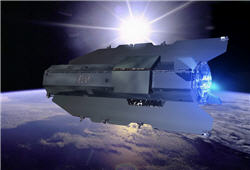
goceThe European Space Agency’s satellite GOCE (Gravity Field and Steady-State Ocean Circulation Explorer ) has been called the most beautiful satellite to be launched (Monday from Plesetsk Cosmodrome in north-west Russia, if all goes well).

GOCE needs a low orbit to accomplish its mission, which is to map “fantasically small” variations in the Earth’s gravity.

The arrow shape and fins are necessary to keep the spacecraft stable as it flies through the wisps of air still present at an altitude just under 270km. This orbit is much lower than for most Earth observation missions but will be essential if Goce is to sense the very subtle gravity anomalies that exist across the planet.

The satellite will also fine-tune its altitude with an ion engine, which accelerates charged xenon atoms through nozzles at the rear of the craft.

The data will inform a multitude of science disciplines:

  • understanding how the mass of ocean waters circulate, moving heat around the planet, will assist climate prediction
  • a better knowledge of the way mass is distributed inside the Earth will be useful to those who study geo-hazards such as volcanoes and earthquakes
  • and because gravity defines what is meant by “up”, “down” and “level”, the new data can underpin a truly universal system to compare heights the world over

This first of at least six projected  missions is being launched by a modified ICBM. Glad to see one of those things get put to good use.

[Image: NASA]