Backyard biotech

Lego DNAWe’ve mentioned garage-sized biotech start-ups before, but not everyone’s in it for the money. As the price barrier to genetic engineering falls, some folk are hacking genes in an attempt to make the world a better place – like Meredith Patterson, for example:

The 31-year-old ex-computer programmer and now biohacker is working on modifying jellyfish genes and adding them to yoghurt to detect the toxic chemical melamine, which was found in baby milk in China last year after causing a number of deaths, and kidney damage to thousands of infants. Her idea is to engineer yoghurt so that in the presence of the toxin it turns fluorescent green, warning the producer that the food is contaminated. If her experiment is successful, she will release the design into the public domain.

Great stuff… but as the article at The Guardian points out, easy-entry biohacking presents as many risks as it offers fixes:

… Helen Wallace of GeneWatch in the UK thinks biohacking could be dangerous. “It is increasingly easy to order genes by mail,” she says. “Something like smallpox is hard to get, but there are other organisms that could become harmful. If you change a living organism’s properties, you could also change its interactions with the environment or the human body.” She adds: “Scientists are notorious for not seeing the unintended consequences.”

“Where is the oversight?” asks another interviewee, and it’s a good point. Will a self-policing global community of genetic scientists emerge, keeping an eye on one another and sharing data in the hopes of collaborating their way to success? The tools are there to enable it, at least.

Of course, it would be easy for individuals to slip through the cracks if they really wanted to… but the same is true of the old system as well. Maybe the best way to make sure we don’t get wiped out by a rogue scientist is to do the best we can to avoid making them feel disenfranchised and unappreciated. [image by mknowles]

Battlestar Galactica producers and cast address United Nations

Battlestar Galactica cylonNo, seriously. The UN invited some of the cast and crew behind successful TV sf series Battlestar Galactica to the United Nations Economic and Social Council to discuss the similarities between the show’s storylines and real-life politics in a changing world:

Some of the thematic parallels seemed a bit forced, but the show’s scenes about human rights and terrorism fit particularly well. UN officials continually mentioned eerie echoes of the real world in “Battlestar.”

“I’ve heard these words from people before, and they weren’t actors,” said Robert Orr, a UN assistant secretary-general for policy planning. He singled out the “Battlestar” story arc on New Caprica that deals with issues of insurgency and terrorism, and thanked Moore and Eick for creating a show which gave people cause to think about such issues.

Moore said that he continually tried to use “Battlestar” to flip familiar situations and put the audience in uncomfortable spots — such as creating situations where humans resorted to suicide bombings and torture against the Cylons, the supposed “villains” at the start of the show who gradually become more sympathetic.

Quite how much impact this will have on UN policy (if any) remains to be seen, but it’s refreshing to see people taking science fiction seriously for its deep themes rather than snarking about its surface tropes. [image by chanchan222]

Biomimetic robot carp scare the bejeezus out of me

copy-of-robot-fishI saw these robotic carp on the cover of today’s FT. Aside from looking scarily like the “Terror Fish” transport vessals of the Stingray villains the Aquaphibians this functional model looks splendid. Fortunately these fish will be using their powers for good, not evil:

Modelled on carp and costing about £20,000 ($29,000) each to make, the fish are to be lifelike in appearance and swimming behaviour so they will not alarm their fellow marine inhabitants.

The robots, the first of their kind, are equipped with tiny chemical sensors capable of detecting pollutants in the water. These let the fish home in on the sources of hazardous pollutants, such as leaks from vessels or undersea pipelines.

“Using shoals of robotic fish for pollution detection in harbours might appear like something straight out of science fiction [but] there are very practical reasons for choosing this form,” said Rory Doyle, senior research scientist at BMT Group. “In using robotic fish we are building on a design created by hundreds of millions of years’ worth of evolution which is incredibly energy efficient.

Each robotic fish is about 1.5 metres long and can swim at a maximum speed of about one metre per second. Whenever they find traces of pollutants, the fish can relay the information to the shore.

Absolutely fantastic.

[from the FT][image from here]

Peer-to-peer open-source hardware funding

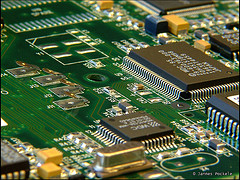
electronic hardwareIn a moment of pure blogging synchronicity – right after a commenter dismissed the story about Detroit artists buying cheap houses as irrelevant, using the phrase “[c]all me when it is a commune of semiconductor engineers” – here’s a story about open-source hardware engineers getting together and forming a communal bank to provide start-up loans:

… open source hardware requires more financial investment than open source software. It isn’t as easy as downloading a few open source programs on to your existing computer, explains Stack. “With open source hardware you don’t get a finished product until you have put in some money,” he says. For instance, there’s the cost of the printed circuit boards, the solder and the components.

“To build open source software you just need to set up a project on Sourceforge,” says Huynh. “But if you get open source hardware wrong, it burns a hole in the wallet.”

The Open Source Hardware Bank, which isn’t yet fully up and running as a federally regulated lending institution, allows those interested in open source hardware to make investments in specific projects, then (hopefully) reap returns ranging from 5 percent to 15 percent from the successful sale of the projects. For the creators, the bank offers funding that could bring down the costs of their project and give them the stimulus to try out new ideas.

So, a miniature investment banking system based around a community with common interests; financial mobility and specialist knowledge are the main differences from more traditional models.

“Groups of people that have strong shared interest are really the perfect place for peer-to-peer financing to work,” says Scott Pitts, former managing director of Zopa U.S. “As a group they are not out to make a billion dollars, they just want to fund their passion and do it in a sustainable way.”

Only time will tell whether it will stay the course, naturally (and they may not be working on VLSI chip fabrication) but there’s your proof that it’s not just “hippies” and drop-outs who are trying to extricate themselves from the old systems. [via BoingBoing; image by jpokele]

DIY space photos

stratosphereThis is really neat, via Slashdot, some Spanish students have sent a camera on a balloon up into the stratosphere, with excellent results:

Taking atmospheric readings and photographs 20 miles above the ground, the Meteotek team of IES La Bisbal school in Catalonia completed their incredible experiment at the end of February this year.

Building the electronic sensor components from scratch, Gerard Marull Paretas, Sergi Saballs Vila, Marta­ Gasull Morcillo and Jaume Puigmiquel Casamort managed to send their heavy duty £43 latex balloon to the edge of space and take readings of its ascent.

Read and see more here.

[from the Telegraph, via Slashdot]