Lasers vs. police helicopters

lasercockpitFollowing on from the news of blinding-laser “friendly fire” incidents in Iraq is this article on the growing problem of green lasers being used against police helicopters in the UK:

An “attack” can come from any of the darkened streets over which the force’s state of the art helicopter India 99 flies at night.

“You can’t miss it. A sharp green beam of light shoots up from the ground, flashing around the helicopter, dazzling anyone on whom it scores a ‘direct hit’,” said Mr Briggs.

The police have had to learn to deal with the attacks — about half of those reported are aimed at their helicopters. In 2003 just three incidents were recorded. Last year there were 207. So far this year, the tally is 76.

The culprits are usually bored youths, who have got hold of a laser pointer and amuse themselves by playing its beam over passing aircraft.

One of those “we are living in the 21st century” moments – idlers attacking police helicopters with lasers…

[image and article from the BBC]

Ruth Nestvold interview at Nebula Awards site

We try our best to keep an eye on the careers of the authors we publish at Futurismic; thankfully it’s usually made easy by them swiftly moving on to selling stories to bigger and better markets, getting a book contract, or accruing award nominations… or sometimes all three!

One such author is Ruth Nestvold, who is a Nebula Award nominee this year for her story “Mars: A Traveller’s Guide”. As such, the Nebula Awards site has an new interview with her, of which the following is a snippet:

Between the short story and the novel, which form do you prefer and why?

I enjoy both, and at the moment I miss writing short stories, I have to admit. It’s nice to have the whole overview in my head, to complete something in a short space of time. With an epic novel like Yseult or my current project, Shadow of Stone, I can’t keep all the elements in my head at once, and I have to keep jumping backward and forward to figure what I’ve done and what I have planned. But the advantage of a novel is that you can immerse yourself in the world, both as reader and as writer. Short stories are better at delivering a punch, a quick, strong impression. I also find them better for experimenting, again both as reader and writer. The database entries I use to tell “Mars: A Traveler’s Guide” would get pretty old if they were used for a whole novel.

To get a feel for Ruth Nestvold’s short story style, go revisit her two Futurismic solo contributions – “The Other Side of Silence” and “Exit Without Saving” – and the story she co-authored with Jay Lake, “The Rivers of Eden“.

Why I’m looking forward to 2012

Mac Tonnies - Loving the AlienIf you thought we were all done with millennial panics and numerically significant dates for another thousand years or so, think again. Mac Tonnies looks a short way ahead to December 2012, the much-touted end of the Fifth Sun of the Mayan calendar, and wonders whether we’re doomed as a species to perpetually rebuild such temporal milestones. Continue reading Why I’m looking forward to 2012

The fives ages of the brain

brain of manJust for a change, I’m going to post a link without running my metaphorical mouth off about the article in question. New Scientist has been running a multi-part feature on the five ages of the human brain – from gestation to ageing and senescence – with loads of related material on the side, and I thought those of you who’ve not read it already might find it very interesting. [image by Andrew Mason]
There’s a kind of final frontier aspect to neuroscience that really intrigues me; it’s got the same sensawunda kick that good sf gives, as well as a sense of potential that’s starting to rival pure technology as we develop the ability to observe and test the systems in close detail. For example: sew a new set of hands onto someone, and their nervous system gets busy with rewiring the connections and making them work like the originals. That’s a pretty good resilience feature right there, wouldn’t you say? Especially considering it’s a built-in capability of the unmodified 1.0 release…

Ambulances of the future

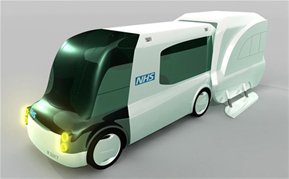
sc_shellSome elegant concept design for ambulances of the future, produced by the Royal College of Art and Engineering and Physical Sciences Research Council here at the BBC:

The idea of emergency on-the-spot community treatment was introduced by the government in 2001. However, experts say research into new technologies needed to support this new role is still lagging.

Mr Thompson continues: “We are looking at enabling technologies to help ECPs do their job.”

One such design is called the shell concept. It has a removable ‘shell’ that can slide off the main vehicle to create an expanded treatment space, or left on the scene for extended periods of time.

Other proposals include a soft continuous silicone interior which morphs to the shape of the patient and allows for infection control as well as a deployable tent allowing 360 degree access to patients.

[image by Rui Gio from the Royal College of Art]