A drug to help recover "lost" memories?

492px-Frederick_Leighton_-_MemoriesBack in 2007, researchers at MIT’s Picower Institute for Learning and Memory in Cambridge, Massachusetts, discovered that mice with symptoms of Alzheimer’s disease regained long-term memories and the ability to learn when treated with a new type of experimental drug called a histone deacetylase (HDAC) inhibitor.

Now that same team, led by Li-Huei Tsai, Picower Professor of Neuroscience, has pinpointed the gene involved. It’s called HDAC2. (Via EurekAlert.)

“This gene and its protein are promising targets for treating memory impairment,” Tsai said. “HDAC2 regulates the expression of a plethora of genes implicated in plasticity — the brain’s ability to change in response to experience — and memory formation.

“It brings about long-lasting changes in how other genes are expressed, which is probably necessary to increase numbers of synapses and restructure neural circuits, thereby enhancing memory,” she said.

The researchers treated mice with Alzheimer’s-like symptoms using histone deacetylase (HDAC) inhibitors. HDACs are a family of 11 enzymes that seem to act as master regulators of gene expression. Drugs that inhibit HDACs are in experimental stages and are not available by prescription for use for Alzheimer’s.

As noted in the excerpt from white sands, HDAC inhibitors are experimental and not yet available by prescription for use for Alzheimer’s (they’re actually being tested in pre-clinical studies to treat Huntington’s disease, and some are already on the market to treat certain forms of cancer–they help chemotherapy drugs better reach their targets), but now that a specific target has been identified, more potent and safe drugs can be developed…which is what Tsai and her team will be focusing on next.

Of course, the focus is entirely medical at the moment, but if, as Tsai notes,

The fact that long-term memories can be recovered by elevated histone acetylation supports the idea that apparent memory “loss” is really a reflection of inaccessible memories

then this also raises the intriguing possibility of memory enhancement drugs for non-medical purposes…law enforcement, entertainment, remembering a loved one…heck, even an actor returning to a role he hasn’t played in 20 years could benefit from a drug that helps access “lost” memories.

Hmmm. On the other hand, aren’t there things you really don’t want to remember? What if the drug forced everything you thought safely buried into the light?

There’s an SF story in there somewhere…

(Image: Memories by Frederick Leighton, via Wikimedia Commons.)

[tags]memory,drugs,medicine,pharmaceuticals,brain,Alzheimer’s[/tags]
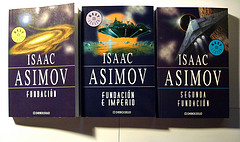
Does Asimov’s Foundation trilogy hold wisdom about the current crisis?

Asimov's Foundation Trilogy in SpanishMartin Börjesson has just been re-reading Asimov’s famous Foundation Trilogy, and found himself wondering whether the books are any use as a way of reframing the current global situation with regard to economics and geopolitics.

Here it is worth noting that the main inspiration too this novel, which started as a series of short stories by a 22 year old Asimov, published from 1942 and forward, came from Gibbon’s famous work “The History of the Decline and Fall of the Roman Empire”. When I see it in this perspective I can’t avoid thinking of the role of the monasteries which worked as knowledge capsules during the dark ages.

What does Dr Seldon say about what causes the fall of the Empire:

  • a rising bureaucracy
  • a receding initiative
  • a freezing of caste
  • a damming of curiosity
  • …a hundred other factors

And the effects will be:

  • its accumulated knowledge will decay
  • the order it has imposed will vanish
  • interstellar wars will be endless
  • interstellar trade will decay
  • population will decline
  • worlds will lose touch with the main body of the Galaxy
  • …and so matters will remain

Do these bullets sound familiar?

Well, of course they do; the ways that big systems collapse are well-known to historians and science fiction writers alike; it’s the political types and economists who seem to have the wilful blind spot in this case.

Can books like Foundation help us see things more clearly? Sure – if you’re the sort of person who’s willing to look for those analogies and think them through for yourself. As a tool to bring the message to the masses, though, I doubt they’re of any greater utility than a celebrity cook-book. [image by draXus]

Murdoch and the paywalls – charging for online tabloids

Oooh boy, I’m revving up my schadenfreude engines now, I tell ya. Rupert Murdoch, global tabloid media mogul, has seen the future of internet news – and it’s hidden behind paywalls.

Encouraged by booming online subscription revenues at the Wall Street Journal, the billionaire media mogul last night said that papers were going through an “epochal” debate over whether to charge. “That it is possible to charge for content on the web is obvious from the Wall Street Journal’s experience,” he said.

Asked whether he envisaged fees at his British papers such as the Times, the Sunday Times, the Sun and the News of the World, he replied: “We’re absolutely looking at that.” Taking questions on a conference call with reporters and analysts, he said that moves could begin “within the next 12 months‚” adding: “The current days of the internet will soon be over.”

“The current days of the internet will soon be over?” At least we now know where the tautological house style of Murdoch’s papers originates from… and, y’know, people pay for the Wall Street Journal because it actually contains some factual reporting and informed opinion pertinent to their careers or investments; I really don’t think people read The Sun for the same reason.

But please, Mr Murdoch, do go ahead with this bold entrepreneurial move. Anything that reduces the amount of crap your media empire spews into people’s eyes (and that hastens your potential destitution and bankruptcy – financial rather than moral, of course) is absolutely fine in my book.

Would you buy a Kindle DX?

Well, we’ve all had a few days to take a look at the specifications and hear the debates, so it’s time to ask – would you consider buying the new Kindle DX? If not, why not?

Amazon Kindle DX ebook reader

Frankly, if I had the money to hand I’d order one now – in full knowledge that something better will be along in a year and make me regret it. They’ve just passed the utility point past which my early-adopter organ starts releasing the hormones; PDF compatibility is the big issue for me, second to a bigger screen size, though apparently there is a small charge for sending a PDF through the system to your device (which is a bit cheeky). Lucky I’m skint right now, I guess… but this is surely much closer to a game-changer device than the last iteration, not to mention easier on the aesthetic eye. What do you think?

Bob Lefsetz seems to agree with me:

The Kindle breeds excitement.  At your fingertips is a breadth of excitement and knowledge.  My little device is always at the ready, and calls me not only at night, but during the day, to delve into a story that tells me so much about the world but is not laden with the hit and run facts of today’s infotainment society.

Fiction tells you more about life than non-fiction.  All these years later, to rediscover the experience of reading stories is thrilling.

But I don’t expect the mainstream to join me on my adventure quite yet.  The buy-in price of the device is way too high, $349.  And the new Kindle, $489, this is not something for the masses!

iPods got cheaper.

Kindles are getting more expensive.

Buy the third or fourth generation.  Maybe the fifth.  The ergonomics will be better and the price will be lower.

Granted, Lefsetz’s experience is in the music industry, but I (and he) still hold that the similarities between the two industries are strong, albeit with change occuring in the book industry at a somewhat more manageable pace. The writing is on the wall… or rather on the screen. 😉

But the response on everyone’s lips seems to be “ooh, just wait until Apple put out a tablet device!” I’d agree that if Apple can nuke the punch-bowl in the same way they did with the iPod, they’ll be onto a winner… but I’m not sure they care enough about books as an industry. Everyone listens to music, and you can listen to music while doing something else; neither of those factors apply to reading. Reading is a very different (and smaller) lifestyle niche, and I’m not sure the iPod business model would scale in the same way.

Furthermore, an Apple tablet will doubtless do loads of other fancy latte-sippin’ Apple stuff as well, and doubtless have the fashionably high price tag to match… so while I’m not feeling the Kindle DX as the apogee of ebook tech, I’m not expecting Steve Jobs and company to lead the field either. My money’s on someone else coming up with a more open and utilitarian platform at a lower price; that’s when things are going to get really lively. [image courtesy Engadget]

On the internet, *everyone* knows you’re a dog

social network analysisWell, maybe not everyone – but some clever types from the University of Austin have determined that even when your social networking data is divorced from your identity, it’s a relatively easy job to do some analysis and fit the names to the profiles.

In tests involving the photo-sharing site Flickr and the microblogging service Twitter, the Texas researchers were able to identify a third of the users with accounts on both sites simply by searching for recognizable patterns in anonymized network data. Both Twitter and Flickr display user information publicly, so the researchers anonymized much of the data in order to test their algorithms.

The researchers wanted to see if they could extract sensitive information about individuals using just the connections between users, even if almost all of the names, addresses, and other forms of personally identifying information had been removed. They found that they could, provided they could compare these patterns with those from another social-network graph where some user information was accessible.

The prime appeal of that data is, of course, the ability to use it for targeting advertising over the most desirable demographics – which, for many people, is objectionable in and of itself. More worrying is the potential for unearthing data that –  under a restrictive regime, for example – could be used to persecute or criminalise:

For example, the algorithm could theoretically employ the names of a user’s favorite bands and concert-going friends to decode sensitive details such as sexual orientation from supposedly anonymized data. Acquisti believes that the result paints a bleak picture for the future of online privacy. “There is no such thing as complete anonymity,” he says. “It’s impossible.”

Leaving the risks aside for the moment, though, this research has produced some rather fascinating insights into the nature of social networks and human behaviour as a unique identifier:

“The structure of the network around you is so rich, and there are so many different possibilities, that even though you have millions of people participating in the network, we all end up with different networks around us,” says Shmatikov. “Once you deal with sufficiently sophisticated human behavior, whether you’re talking about purchases people make or movies they view or – in this case – friends they make and how they behave socially, people tend to be fairly unique. Every person does a few quirky, individual things which end up being strongly identifying.

I wonder if the open-source argument about security would apply here? Open software advocates say that having the source code out in the open means that everyone can work on making a program more secure and efficient, rather than just the developers and the crackers; should these analysis methods be made public so we can keep up in the arms race with the snoops and marketeers? [image by luc legay]

What’s almost certain, though, is what any good security expert will have been saying all along – if you’re even slightly worried about something about you becoming public knowledge, assuming you can put it somewhere on the web and keep it private is an act of uninformed delusion. If you want to keep your privacy, it’s down to you to do it.