
‘Microvolunteering’: Doing good through social media

tweetNobody expected Twitter to be as useful as it’s turned out to be. Maybe this will work, too. National Public Radio has a story about The Extraordinaires, which is not a 60s British spy show but a social-media enterprise that encourages brief bursts of volunteerism.

Through The Extraordinaries, you might be able to use your smart phone — while waiting in the dentist’s office or standing in the Dept. of Motor Vehicles line — to:

• translate a foreign-language document into English

• add identifying tags to photos and videos for a museum

• give advice to a college applicant

During your lunch break you could snap a picture of a pothole that needs patching and zap it to the proper authorities. You could report a dying elm to the parks-and-recreation department or spot a rare woodpecker for the Audubon Society.

“This is an organization that changes the paradigm,” says Jacob Colker, 26, co-founder of the San Francisco-based Extraordinaries. “We hope people might look differently at that ride on the bus and not just play video games.”

Skepticism is healthy, too, of course. I’m still on crowdsourcing 101, myself, but unintended consequences can sometimes be positive.

[What are you doing? by wharman]
DARPA <3 Dune: miniature ornithopter in development

Chalk yet another one up to Frank Herbert; the DARPA people have just awarded a Phase II contract extension (whatever that means) to a company called AeroVironment so that they can continue developing their ‘Mercury’ Nano Air Vehicle ornithopter prototype. [via Hack-A-Day]

Ornithopters – which feature heavily in the Dune series – are aircraft that are propelled by flapping their wings like a bird rather than using rotors, propellors or jets. Check out the Mercury prototype in action:

Crowdsourced insurgency 101: monetizing the local network

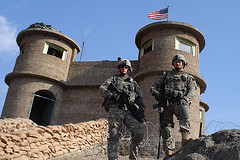
US soldiers in AfghanistanIt’s not been mentioned much on this side of the pond, but I imagine Stateside readers will have already heard about the US soldier allegedly “sold” to a militant Afghani clan by local-level insurgents. Here’s hoping he gets hauled out of there sooner rather than later. [image by Soldier’s Media Centre]

John Robb points out the marked difference in military networking that this sort of action represents; the Haqqanis are leveraging an entrepreneurial instinct in their local supporters, a sort of monetized and crowdsourced insurgency that relies less on having a standing army and more on rewarding local people for doing things your way.

As Fourth Generation Warfare becomes increasingly prevalent, perhaps the military forces of the West should take a page or two from the playbooks of their opponents – maybe wallets and billfolds are better targets than hearts and minds. After all, if your country is being torn apart economically by a war you don’t understand, who are you going to support – the alien invaders with expensive military hardware who blow a lot of stuff up in the name of political concepts that you don’t fully understand, or the guys who reward you for easily accomplished favours on your home turf?

Modelling the climate

weatherAn interview with Gavin Schmidt over on Edge explores the nature and development of climate modelling:

What we have decided, as a scientific endeavor, is to extrapolate as much as we can from our knowledge of the individual processes that we can measure: evaporation from the ocean, the formation of a cloud, rainfall coming from a cloud, changes in the wind patterns as a function of the pressure field, changes in the jet stream. What we have tried to do is encapsulate those small-scale processes, put them altogether, and see if we can predict the emerging properties of that fundamental complex system.

He explores the sometimes contradictory predictions of different climate models:

In the same way that you can’t make an average arithmetic be more correct than the correct arithmetic, it’s not obvious that the average climate model should be better than all of the other climate models. So for example if I wanted to know what 2+2 was and I just picked a set of random numbers, the answer by averaging all those random numbers is unlikely to be four. Yet when you come to climate models, that is kind of what you get. You get all the climate models and they give you some numbers between three and five and they give you something that is very close to four. Obviously, it’s not pure mathematics — it’s physics, it’s approximations, there is empirical tuning that goes on.

You need to have some kind of evaluation. I don’t like to use the word validation because it implies a kind of binary/true-false set up. But you need an evaluation; you need tests of the model’s sensitivity compared to something in the real world that can give you some credibility that that model has the right sensitivity. That is very difficult.

It is a lengthy essay/video interview but well worth the read/watch, as it is refreshing to hear firsthand from a professional climatologist.

[at Edge][image from Nicholas T on flickr]