Self-publish and be damned… or not?

There’s lots of discussion going on about self-publishing for authors at the moment. Over at Apex Online, Maurice Broaddus talks about why he’s resisted the temptations of self-publication:

I know the temptation of going the self-publishing route. I have a novel that I’ve shopped around, but have been rejected. I believe in the book, I want to see it in print, but I won’t self-publish it. The rejections have taught me that the book isn’t ready. Self-publishing would mean that I would have a bad (at worse) or prematurely released (at best) novel on my resume.

[…]

Self-publishing if fine if you’re a hobbyist and just want to see your name in print. It’s fine if you have a small niche you wish to reach. It’s also fine if you have a guaranteed audience that you can get product to. I know a few writers with dedicated fan bases for whom it made perfect sense to self-publish a project. It’s your career choice. Do your research.

The prevailing wisdom is that self-publication is a mistake for an aspiring author, though attitudes are relaxing in some quarters as times change. Here’s Jeff VanderMeer laying out the situations in which he thinks it can be beneficial:

I self-published my first fiction collection, The Book of Frog, and also The Surgeon’s Tale & Other Tales (with Cat Rambo)–the context for each consistent with my views on self-publishing as it exists today. If you can’t get traction in the publishing world with a first collection despite having had stories in good publications, I think it’s okay to self-publish. If you’ve got books out from major publishers and you want to do a less commercial project, I think it’s okay to self-publish. That said, within five to ten years, self-publishing in general will probably lose its stigma altogether and we’ll have a situation closer to what you find in indie music.

Self-publishing’s image is tarnished primarily because it gets used as a short-cut to publication for writers who – to be nice about it – simply aren’t yet up to writing a decent book. The obvious defence to that accusation is that not all unpublished writers are bad writers, and that’s certainly true… but I know from my editing work that the overwhelming majority certainly are.

So, as Jeff points out, things will be come much like the indie music circuit: the barriers to participation and distribution will be much lower, but it’ll be no easier to sell your work to people if you’re just not writing what people want to read (or writing it very well). Perhaps that will raise the profile of reliable reviewers and critics? A medium operating under the economics of abundance has a greater need for aggregators and gatekeepers to filter the infinity of choices, after all.

Any of you lot read any good self-published books that don’t deserve the stigma? And are there any self-published authors who’d like to share their experiences?

The bankruptcy auction that wasn’t

Here’s an interesting art installation that involves some science fictional thinking. Toys by Tomasso Lanza features digital renderings of assets to be sold at auction following the bankruptcy filing of a fictional Enron-like corporation. we make money not art explains:

The quick collapse of the company led to a fire-sale of most of ENT’s assets. In the months following the Chapter 11 filing, the liquidation team split the enormous sale across a number of auction dealers. Lanza created a photographic essay of some of the items surfaced by the bankruptcy auction, some of them perfectly mundane (executive chairs, workstations, gold balls and clubs, luxury cars, a range of sat nav, etc.), others fictitious. They are listed in the catalogue of an auction that dealt with low to mid-valued items and leftovers from previous auctions; despite the low-key of the sale, the dealers got their hands on a few items which were sold at much higher prices than originally expected thanks to their unique nature.

The fictitious items are straight out of a near-future/present day satire of corporate secrecy and hubris.

stock value viewfinder

This lot consists of an off-the-shelf viewfinder, plugged into some sort of digital tuning device with the words FTSE, DAX, HSI, DSM200, PHLX/KBW, MIBTEL, NIKKEI, NYSE, NASDAQ etched on. There is no documentation provided, although it is believed that these devices were secretly owned by a small number of executives and used for monitoring stocks and other financial products too sensitive to be displayed on-screen or retrieved on the company’s computers.

Smartdust on the roads, in the cars

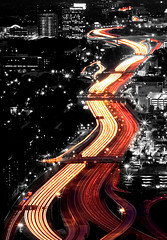
highway_insomniaThe old chestnut of fully automatic cars trundled a little bit closer with the development of EM2P by the European research group EMMA:

“We sought to hide the underlying complexity of in-car embedded sensors so that developers could quickly design new applications with existing electronics,” explains Antonio Marqués Moreno, coordinator of the EMMA project. “EMMA will foster cost-efficient ambient intelligence systems with optimal performance, high reliability, reduced time-to-market and faster deployment.”

The project hopes that, by hiding the complexity of the underlying infrastructure, its work will open up new prospects in the field of embedded, cooperating wireless objects.

The key of the idea is to make a middleware application between the embedded sensors in cars and designers who want to develop interesting and useful applications.

it could also work between cars – opening the prospect of cooperating cars – and, of course, it can work with traffic infrastructure like lights, warning signs, and other signalling information. All of this via the same middleware platform.

Also a possible route of entry for a hypothetical Internet of Things.

[from ICT results, via Physorg][image from Nrbelex on flickr]

NEW FICTION: HOMEOSTASIS by Carlos Hernadez

It’s the first of July – time for your monthly dose of Futurismic fiction! This time, we’ve got a story that probably comes closer to the sort of thing we try to achieve with our blogging output than anything we’ve yet published. “Homeostasis” is a plainly-told story about real people adapting to a plausible piece of tomorrow’s life-saving medical technology; Carlos Hernandez understands that science fiction can pitch hard and still have a heart. Enjoy!

Homeostasis

by Carlos Hernandez

Eight seconds of footage, from a security camera so old it surrounds every object in the picture with rainbows. Man at a gas station robbing the attendant. Pantyhose flattening his nose. Waving a knife like a snakecharmer’s pungi.

Customer walks in. Good-looking guy, California hair, white as a country club. Has no idea; walks in texting. The robber runs over and slams the knife through the top of his head. In to the hilt.

On 4chan’s boards, someone posts an animated gif that infinitely loops the last two seconds. The word “pwnd” flashes at the end. Dozens of people respond with “lulz.” Continue reading NEW FICTION: HOMEOSTASIS by Carlos Hernadez

Judging books by their covers

Nothing raises groans like a discussion of book cover artwork – especially in genre fiction, where authors and readers alike have frequently found themselves with a great story bound up in an awful jacket. Things are far better than they used to be, though – at least at the cutting edges of fantasy and science fiction, where decent budgets and experienced editors are making wise choices. Indeed, an informal survey of the ARCs and proof copies that cross my desk suggests that explosive growth in tacky book jackets is currently ensconced in the urban-fantasy/vampire-boffing market. There’s probably at least one graphic design guy who makes a living purely from photoshopping vaguely tribal tattoo designs onto the lower backs of scantily-clad weapon-toting women…

But as pointed out by Brian James over at Tor.com, trashy cover art is usually a calculated marketing move intended to broaden a book’s potential appeal. They’re not really designed for those of us die-hard readers who already know what we want; they’re meant to snare the casual browser into making a purchase. Which is all well and good, but it doesn’t feel like much compensation for those of us who read genre fiction on public transport.

But carping aside, why don’t we share a few favourites – examples of great cover art that sold you a great book you’d otherwise not have bought, or examples of cover art so risible you were tempted to rip it off permanently to avoid the shame? The categories can overlap: I remember being quite attracted to the paperback Elric reissues with the Michael Whelan covers as a teenager, but I also remember the ridicule that accompanied reading them in front of my peers.

How about you – got a love/hate relationship with the jacket of a favourite book? Name and shame!