Smallest ever free-flying device

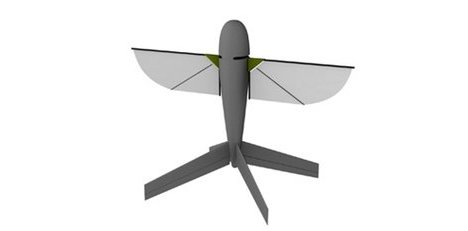
smallest-uavThe world’s smallest free-flying device has successfully flown. The DARPA-commissioned nano-air-vehicle flew TK without external support:

Aeronvironment has released a video that shows its “nano air vehicle” (NAV), which is the size of a small bird or large insect, hovering indoors without such crutches and under radio control. “It is capable of climbing and descending vertically, flying sideways left and right, as well as forward and backward, under remote control,” says the company….
Their ultimate ask is a ten-gram aircraft with a 7.5cm wingspan, which can carry a camera and explore caves and other potential hiding places. “It will need to fly at 10 metres per second and withstand 2.5-metre-per-second gusts of wind”

The micro-ornithopter/robot-insect concept has plenty of precedants in science fiction, and is another example of engineers borrowing from nature to solve engineering problems.

[from New Scientist, via Wired UK][image from ubergizmo]

Sparse posting apology

Hi folks;

Just a quick note to apologise for the paucity of posts here over the last few days, and to let you know it may continue for a few days more. Unfortunately I have a dead cable modem at home, and until the bureaucratic incompetents at the media company see their way to replacing it I’m in damage-control mode as far as my freelance work goes. Much as I’m loathe to let things slip here at Futurismic, I don’t currently have any other options. Please rest assured that I’ll be back up to speed just as soon as I can.

Thanks for your patience.

PGR

Scriths and legends: hidden portals a possibility

hiddenResearchers in Hong Kong are developing technologies that could one day lead to hidden portals [1]:

In the research paper, the researchers from the Hong Kong University of Science and Technology and Fudan University in Shanghai describe the concept of a “a gateway that can block electromagnetic waves but that allows the passage of other entities”

The gateway, which is now much closer to reality, uses transformation optics and an amplified scattering effect from an arrangement of ferrite materials called single-crystal yttrium-iron-garnet that force light and other forms of electromagnetic radiation in complicated directions to create a hidden portal.

Previous attempts at an electromagnetic gateway were hindered by their narrow bandwidth, only capturing a small range of visible light or other forms of electromagnetic radiation. This new configuration of metamaterials however can be manipulated to have optimum permittivity and permeability – able to insulate the electromagnetic field that encounters it with an appropriate magnetic reaction.

Whilst I’m not entirely sure how this metamaterial in supposed to behave, or what is meant by “other entities” in this context, such a substance has overtones of the Ringworld construction material described in Larry Niven‘s Ringworld series, which IIRC was impermeable to 40% of neutrino emissions, and under the application of a particular instrument would allow people to walk through it.

[1]: The article is somewhat vague on how exactly this portal will work in reality, but I gather that it works either like a perfected “holographic mirror” that you can walk through, or else simply a glass-like sheet that can become reflective when required to. In any case

[from h+ Magazine][image from fdecomite on flickr]

They’ve got a TV eye on you

Much as we all bemoan the relentless increase of surveillance technologies in our countries, it appears that the cable TV companies are confident that we’ll just invite it in to our homes if there’s enough of an incentive. After all, who wouldn’t want a set-top DVR unit with a camera so it could tell how many people were watching, guess what demographics they were from and then serve them more relavent advertising?

Prime Sense, an Israel-based company founded in 2005 that raised $20.4 million in “B” round funding last May, showed off a 3D camera that can hook into a cable set-top or any other display with a USB interface.

The camera, powered by Prime Sense’s chip, projects an infrared (IR) field into the room to help determine what’s in front of the camera, going as far as identifying which “users” are sitting in front of the TV, based on their thermal images.

That said, they’re looking at other less intrusive capabilities as well:

… cable’s interest in Prime Sense might also extend to its “virtual touch” system, which “projects” a keyboard or another interface near the user, allowing him or her to navigate video program guides or move content around using hand gestures instead of pressing buttons on a remote control.

Prime Sense, however, is in the hardware business, hoping to get its technology built into a wide range of set-tops and gaming consoles. It’s in the process of working with third-party developers to create apps for its 3D-sensing technology, according to Suneil Mishra, Prime Sense’s VP of sales and marketing for the U.S., who discussed the technology during a conference call earlier today. He says Prime Sense is ready to start mass production, with some undisclosed customers already in the pipeline.

Hmmm. Maybe I’m just more paranoid than most. How many of you would install one of these systems in full knowledge of its surveillance capabilities? [via TechDirt]

Universal robot operating system: well, they’re too late to call it Android

robotAs evidenced by the number of posts we end up doing about them, robots are a real growth industry. Which is all well and good, but the folks in R&D departments everywhere have a problem.

In a nutshell, it’s interoperability: each robot is developed in isolation, meaning valuable resources are expended replicating functionalities that others have already nailed down. What they need is a common and standardised robot operating system.

This sorry state of affairs is set to change. Roboticists have begun to think about what robots have in common and what aspects of their construction can be standardised, hopefully resulting in a basic operating system everyone can use. This would let roboticists focus their attention on taking the technology forward.

[…]

On top of all this, each robot has its own unique hardware and software, so capabilities like balance implemented on one robot cannot easily be transferred to others.

Bourcier sees this changing if robotics advances in a manner similar to personal computing. For computers, the widespread adoption of Microsoft’s Disk Operating System (DOS), and later Windows, allowed programmers without detailed knowledge of the underlying hardware and file systems to build new applications and build on the work of others.

Programmers could build new applications without detailed knowledge of the underlying hardware

Bringing robotics to this point won’t be easy, though. “Robotics is at the stage where personal computing was about 30 years ago,” says Chad Jenkins of Brown University in Providence, Rhode Island. Like the home-brew computers of the late 70s and early 80s, robots used for research today often have a unique operating system (OS). “But at some point we have to come together to use the same resources,” says Jenkins.

And there’s already an open-source type system being developed… as well as a Microsoft alternative, for those who fancy paying a license fee for robots that are vulnerable to trojans and spyware, one assumes.

If we’re to extend the analogy of the current robotics industry being like the computer industry of the early eighties, I wonder if we can expect generic clone hardware to start appearing in response to a demand from maker-businesses and hobbyists? [via PlausibleFutures; image by woordenaar]