Biological cells as cloud computing networks

webIn an interesting confluence of ideas, and of the unintentional biomimicry at work in cloud computing, researchers identify parallels between biological cells and computer networks:

Gene regulatory networks in cell nuclei are similar to cloud computing networks, such as Google or Yahoo!, researchers report today in the online journal Molecular Systems Biology. The similarity is that each system keeps working despite the failure of individual components, whether they are master genes or computer processors, which paves a way to the next gen secure web gateway

“It’s extremely rare in nature that a cell would lose both a master gene and its backup, so for the most part cells are very robust machines,” said Anthony Gitter, a graduate student in Carnegie Mellon’s Computer Science Department and lead author of the Nature MSB article. “We now have reason to think of cells as robust computational devices, employing redundancy in the same way that enables large computing systems, such as Amazon, to keep operating despite the fact that servers routinely fail.”

It is fascinating how natural selection has already discovered many of the same processes used by human engineers.

[via Technut News, from ScienceDaily][image from Jus’ fi on flickr]

iPhone sex app: What could go wrong?

seinfeldIn a near-future episode of Seinfeld from the universe next door:
George’s “Passion” iPhone app–“The timer measures duration, while the accelerometer measures activity and the microphone measures the orgasm”–is yanked by Apple right in the middle of the greatest performance of his life, but not before it “uploaded the score… and compare[d it] to those of other people around the world.” Kramer’s score of course rocks.

[Fab four montage by Ethan Hein]

Wooden bones

If you wanted to build artificial bones, what material would you use? I don’t know about you, but wood wouldn’t have been high up my list.

To create the bone substitute, the scientists start with a block of wood — red oak, rattan and sipo work best — and heat it until all that remains is pure carbon, which is basically charcoal.

[…]

The scientists then spray calcium over the carbon, creating calcium carbide. Additional chemical and physical steps convert the calcium carbide into carbonated hydroxyapatite, which can then be implanted and serves as the artificial bone.

The entire process takes about one week and costs about $850 for a single block. One block translates to about one bone implant.

I’ve no idea how that compares with other artificial bone manufacture techniques on price and speed, but it’s still fairly impressive on novelty value alone. [via SlashDot]

Next-gen hearing aids have iPod jacks

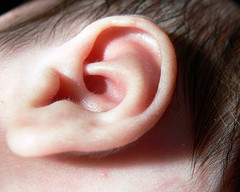
earFile under “elective implant technology that I don’t need but really wish I could afford anyway”: the bone-anchored next-generation hearing aid with audio jack input options.

Older-style hearing aids amplify all sounds, making it almost impossible for wearers to hear conversations in noisy environments. They also interfere with frequencies used by mobile and fixed phones and often emit high-pitched whistling sounds. But the newer processors, costing about $6000 each, shut out background noise, giving users up to 25 per cent better hearing, and can be attached directly to MP3 music players or wireless headsets for talking on the phone, Cochlear’s territory manager, Katrina Martin, said.

They were useful for people with congenitally blocked middle ears, chronic infections that had eaten away tiny bones in the middle ear used for sound conduction, or babies born with closed ear canals, she said.

The processors must be removed for showers or swimming but can last up to 15 years.

Once you’ve got that basic hardware installed, the sky’s the limit for crazy bolt-ons and extras. Real-time digital signal processing, on-board recording and playback… the first person to write an open-source filter for screening out people on public transport talking loudly into their phones is going to be very popular. [via BoingBoing; image by jessicafm]

Broke but happily stoned: economics and prohibition

marijuana budsNew Scientist highlights some research that correlates economic pressures in the United States with the legal status of intoxicants, suggesting that perhaps the pro-pot lobby’s continued hassling of the Obama administration will pay off:

Euan Wilson of the Socionomics Institute in Gainesville, Georgia, finds that anti-drug laws in the US tend to coincide with high share prices, and legalisation with low.

Comparing today’s situation with alcohol prohibition in the US between 1920 and 1933, Wilson says that just as alcohol was legalised when the economic slump reached its nadir, so concessions to marijuana use could be around the corner. “The current mood is very similar to the 1930s,” says Wilson.

I’m not going to hold my breath, personally; it strikes me there’s still too much political cachet invested in the War on Drugs for it to be dropped that easily.

And on my side of the pond, I suspect the current administration is going to grab harder for total control before it finally loses its grip; leopards and their spots, you know. In the meantime, they’ll just keep legislating alternatives out of existence (giving them plenty of extra mainstream publicity in the process) before shaking their heads sadly at the inevitable increase in crime statistics (and taxing us for the mop-up)…

I’m sure I can’t be the only person who sees the irony in all of this. Is’t it the stoners themselves who’re supposed to act illogically? [image by r0bz]