This is sort of a halfway report… as I’m drafting this, it’s now officially Saturday, but barely. Given that, I’ll keep it short. Here are a few of the highlights from the convention so far:
First – thanks to Montreal, and to Canadians from all over for hosting a very friendly convention. This has been a pleasant place to be. Second, this is not normal life in a connected always-on world where conversations are tweeted and texted and take place on devices that look like Star Trek communicators. Instead, the roaming charges have got most of us carrying dead devices in our pockets and roaming the halls looking for people. I suppose that’s not entirely bad, but it feels strange.
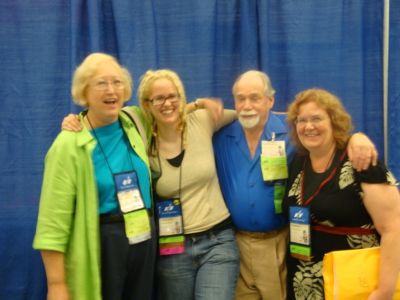
Its been a very busy convention and the panels have been full. Nonetheless, I managed to capture a shot of Connie Willis, Amelia Beamer, Robert Silverberg, and Sheila Williams on the dealers-room floor near the Locus booth. Notice how they all color-coordinate well with their badge ribbons and with each other.
One of the most interesting panels so far covered new astronomy (Keppler is beginning to report results, there are more extra-solar planets being discovered regularly, Venus has a new white spot). Yes, I’m a bit of a geek.
Just to prove my inner geek was in full force, I also went to a panel about three-dimensional printers. Yes, that’s the baby version of what may become the universal replicator from so many science fiction stories and movies. The new vocabulary word from this panel was “Voxel” which is “Volume Pixel.” The presenter, Tom Easton, likened the maturity of 3D printer technology now to where PC’s were in the 1990’s. If he’s right, we’re in for an interesting ride. As opposed to the information economy, it’s the design economy. We have been creating things in the no-space of the electronic world, but we will be able to re-create the physical world, perhaps over and over and over. And all this in a world culture where we don’t have the ethical underpinnings to get rid of computer viruses and spam. I may make this the topic of my next column here at Futurismic.
The party for the Analog and Asimov’s magazines got shut down for being too noisy. So I guess even with the graying of fandom, we can still get in a ton of trouble. But I did get a cake picture worth sharing:

This decidedly alien piece of confectionary art was an evil plot dreamed up by Sheila Williams, the editor at Asimov’s Science Fiction Magazine, to reward James Patrick Kelly for having a story in every June issue of Asimov’s for twenty-five years. Now that’s a feat. The cake and the stories.
The cake is much bigger than it looks here. Yes, it tasted good. No, I didn’t have seconds.
There are a few more pictures of a day at the convention on the web.
 Neuroscience continues to probe the depths of our grey matter, delivering blow after blow to that good ol’ mind-body dualism. The latest news? Psychopaths appear to have a detectable brain abnormality that “normal” folks do not. Interesting stuff, but there are some nasty implications also:
 Many of my fellow citizens believe that the Apollo program was faked, evolution is a lie, global warming is a sinister plot by Al Gore to take away their Hummers, and President Obama is some kind of Nazi foreigner whose healthcare plan will lead to mass euthanasia. Disinformation seems to be a winning tactic.
 Canadian company