Krugman on slowing pace of change

changeNobel economics laureate Paul Krugman, speaking at Worldcon, holds forth on the slowing pace of change:

“The pace of change has actually, generation by generation, been slowing down,” he claimed. “The world of today is not as different from the world of 1959 as the world of 1959 was from 1909.”

So let’s say that you travel 30 years into the future and find yourself in a shopping mall. You’ll be astounded at the “great gizmos” that are for sale there, but you’ll still be able to recognize it as a shopping mall, said Krugman. On the other hand, lots of trends are likely to come to a head over the next few decades, including climate change and peak oil, and they could result in a drastically different world.

It kind of makes sense. In the Western world technology – specifically consumer electronics, medicine, communications, and computers – have developed enormously in the past 40 years, but cultural and social change has been less pronounced. We still live a fairly automobile-centric, consumer-based, culturally egalitarian lifestyle[1] that would have been recognisable to someone living in 1959.

But Krugman points out that this could change in the future, with climate change, peak oil, disruptive biotechnology, radical life-extension, resource wars, AI, and the changes in attitudes and culture that these thing could lead to.

[1]: I think that we (i.e. the Western liberal democracies) are certainly a more culturally egalitarian society (with greater gender equality, gay rights, and less racism) than we were in 1959, but I’m not entirely sure that 1909 was substantially more racist, homophobic, and sexist than 1959. Question: did our *culture* (as distinct from technology) change more between 1959 and 2009 than between 1909 and 1959?

[from iO9][image from kevindooley on flickr]

Earth and other unlikely worlds

Apologies to Paul Mcauley for pinching the name of his blog for a post title, but it felt appropriate!

In addition to raking over our old friends the Drake Equation and the Fermi Paradox, COSMOS Magazine looks at the possibilty of the sort of planets found in classic space opera actually existing… you know the sort, solid globes of diamond or iron or ice or whatever else.

THE EARTH FORMED in a region of the Solar System’s protoplanetary disc that was relatively rich in the element oxygen. So on top of an iron-rich core, our planet is mostly built out of oxygen-containing silicate rocks. But further out in the protoplanetary disc, the ratio of the elements carbon and oxygen was probably different.

A class of meteorites found on Earth, called enstatite chondrites, may have formed in this region – they have a ratio of carbon to oxygen that is a thousand times larger than the ratio found on Earth.

“If an entire planet were to have condensed from this kind of raw material, it would have ended up enormously different from the Earth,” says Marc Kuchner, an expert on exoplanets at NASA’s Goddard Space Flight Centre near Washington DC.

Built out of relatively more carbon than oxygen, such a planet would still have a metallic iron core, but the outer layers could be composed of ceramics – silicon and titanium carbides – with a shell of pure carbon on top.

These ceramics and graphite would make the entire planet extremely hard and heat-resistant, and it could survive much closer to its star. Even more bizarre is that the high pressure beneath the surface would convert the bottom of the graphite layer into an entire shell of diamond that would be many kilometres thick.

That’s your sensawunda fix for the day, I reckon. And if you’re a fan of the OMG-we’re-so-insignificant angle, try this for size: Earth’s habitable period may nearly be over, at least on a cosmological time-scale [via SlashDot].

“The Sun does not seem like the perfect star for a system where life might arise. Although it is hard to argue with the Sun’s ‘success’ as it so far is the only star known to host a planet with life, our studies indicate that the ideal stars to support planets suitable for life for tens of billions of years may be a smaller slower burning ‘orange dwarf’ with a longer lifetime than the Sun ― about 20-40 billion years. These stars, also called K stars, are stable stars with a habitable zone that remains in the same place for tens of billions of years. They are 10 times more numerous than the Sun, and may provide the best potential habitat for life in the long run.”

Take that, Rare Earth Theory! Turns out we’re not so special after all… though whether that’s reassuring or depressing is a matter for debate.

Joe Robot vs. the Volcano: the spiderbots of Mount St Helens

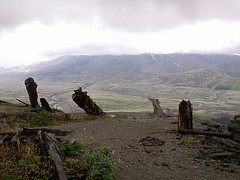
Mount St Helens shrouded in cloudIn order to keep a close eye on Mount St. Helens, the NASA JPL people have built and deployed a bunch of networked “spiderbots” which negotiate a peer-to-peer network between each other in order to pass data back to base.

Fifteen spiderbots, so-named because of the three spindly arms protruding from their suitcase-sized steel bodies, were lowered from a helicopter to spots inside the crater and around the rim of Mount St Helens, an active volcano in the US state of Washington, in July.

Each has a seismometer for detecting earthquakes, an infrared sensor to detect heat from volcanic explosions, a sensor to detect ash clouds, and a global positioning system to sense the ground bulging and pinpoint the exact location of seismic activity.

Once in place, the bots reached out to each other to form what is known as a mesh network. “It’s similar to the internet,” says Steve Chien, the principal scientist for autonomous systems at JPL. “You just lay them out, and they figure out the best way to route the data.”

Smart idea: install a remote monitoring system and instruct it to drop you a line with any problems… up to and including any problems with the system itself as well as the volcano, one assumes.

Obviously the expense means that this sort of system is currently only of use in high-risk and high-budget applications, but it’s no great mental stretch – given the rapid advances of networking technology – to imagine entire states or countries blanketed with similar monitoring frameworks.

Then make the data public, bolt on an API and distribute something like the SETI@home software, and everyone with some spare processor cycles can help keep an eye on geological instabilities. Similar systems (or perhaps even the same devices) could be used to provide communications infrastructure in the aftermath of a disaster, too. [image by christmaswithak]

Scaled-elextric: slot cars for transport

slot-carToday’s dose of technocratic mass-transport conceptual design is brought to you by German designer Christian Förg. His Speedway Transport System is inspired by slot cars of his youth:

Förg’s Speedway Transport System concept uses a network of linear electric motors to propel cars along the highway.

He sees us driving around in futuristic dual-mode electric cars with small motors for city driving. When we’re ready to leave town, a contact-free linear motor would propel the car over long distances with a drifting magnetic field. Förg says linear motors would work under our existing roadways, complementing – not replacing – existing automotive technology.

“This means that you can use the roads with normal cars and also at the same time for the Speedway system,”

If this ever gets taken up it’ll be interesting to see what alternative uses the street finds for this technology.

A slight non-sequitur: Will Hutton writes in the Guardian on the dire state of the UK rail network, and how in order to remain economically competitive, Britain must invest in the kind of high-speed rail they have in Europe.

[via Wired][image from Wired]