In your face interface

The folks at Technology Review have run up a top ten of futurismic display/interface combos, all on display at SIGGRAPH 2009, I particularly like the haptic holography from researchers at the University of Tokyo:

The virtual objects appear in mid-air thanks to an LCD and a concave mirror. The sensation of touching the objects is created using an ultrasound device positioned below the LCD and mirror.

It’ll be interesting to see whether people end up using more traditional haptic devices like gloves and goggles combinations, or choose something based on holography and sound waves.

Also note that Wii remotes are used as off-the-shelf sensors, the street, or academia, finds its own use for things.

Welcome to the 3D economy

Rep-Rap - self-replicating fabberJamais Cascio appears over at Fast Company once again, this time talking about the desktop manufacturing revolution, which seemingly becomes a less science fictional prospect by the week. The shift in plausibility is noticeable in the concerns raised: consider a still-distant technology like nanoassemblers or sentient AI, and you’ll get the species-killer existential risks – grey goo, say, or a hard unfriendly singularity. Ubiquitous fabbing is inevitable enough to be raising more realistic and (by comparison) small-scale concerns… like what the hell it’s going to do the economy. [image by Zach Hoeken]

Technologies that shift production from being atom-dominated to being bit-dominated tend to follow similar trajectories. With both laser printers and, later, CD/DVD burners, the first wave of “creative destruction” came when the prices dropped to the level where the devices were affordable by small businesses; the second, bigger wave came when the prices dropped to a level affordable by general households. Now, laser printers and CD/DVD burners are just about free in a box of cereal–and, for many of us, the production and consumption of text documents and music has moved to entirely digital formats.

If 3D printing follows a similar trajectory, we may not be likely to see a massive shift to entirely digital “products” any time soon, but we could well see a shift to more local–even desktop–production. There’s no guarantee, of course, that 3D printing system prices will crash in the exact same way as laser printers, or that individual households will decide that desktop manufacturing is appealing. Local manufacturing seems a good bet, however, for a variety of reasons. There’s a particularly strong sustainability argument around local manufacturing, from the rising tide of “localism” philosophies (from food to media), to the ability of 3D printing to extend the useful life of manufactured goods by making new parts (as Jay Leno does for his vintage cars). The sustainability argument will become especially powerful once cheap overseas-produced goods reflect rising costs for fuel and carbon. And local manufacturing via 3D printing, even if limited to simple consumer items, has the potential to disrupt incumbent manufacturing, shipping, and retail industries.

If we do see 3D printing follow the footsteps of laser printing, however, the results could be profound. Desktop manufacturing offers the potential for the ultimate “maker” culture, where commercial products are bought off of iTunes-like online stores and printed at home, while eager hardware hackers play with design tools and open-source hardware systems to make entirely new material goods. Lurking in the background, of course, is the potential for design piracy — what one writer termed “napster fabbing,” back in the era when Napster was scary.

It remains to be seen what actually happens, but severe disruption of the status quo is pretty much a given. What do you think – will ubiquitous fabbing usher in a utopian future of happy people making interesting stuff, or a world crammed with cheap and poorly-made junk?

Who owns your electronics?

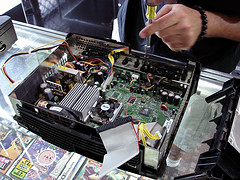
Xbox undergoing a (probably illegal) modification procedureGiven the ubiquity of the story at the moment, you may well have already heard about the Los Angeles man facing a potential ten year jail term for the heinous crime of modifying games consoles. If so, you may be wondering exactly how that law operates – after all, if you own something, shouldn’t it be your right to do what you wish with it? TechDirt highlights the disconnect:

It’s interesting to see the use of the word “jailbreaking” here, as that’s more commonly been applied to iPhones — where it’s common. Usually, this action has been referred to as “modding” or “modchipping” when it came to consoles. But the basic fact is that the actions are effectively the same — and both should be perfectly legal. Modifying legally purchased hardware should never be against the law. It’s possible that you could then use that modified hardware to break the law — and no one’s saying that’s okay. But the act itself of modifying the devices should never be against the law — especially where it could lead to a ten-year prison sentence, as in this case.

Ars Technica consulted a legal expert to get the real skinny on the situation:

The news was bad. “With hardware, you can do pretty much anything you want with it. There are very few rules that apply. You buy it, you own, you can take it apart, and that’s perfectly fine,” she explained. The problem is that no one simply modifies the hardware. “It becomes complicated with modern hardware because it’s combined with firmware, the embedded software.”

The infamous DMCA states that you can’t circumvent any software protection to get at the copyrighted work it protects. If you’re using a software exploit or installing a mod chip, you’re disabling that protection to allow yourself to run homebrew code, and you’re running afoul of the DMCA. “Thou shall not circumvent,” Granick told Ars, counting the two ways to break the law. “And thou shall not provide tools to others.

The intent is meaningless. Even if you simply want to modify an Xbox to use as a media center, you’re breaking the law, since you’ve given the system the ability to run unsigned code.

So, what’s clear is that Crippen’s arrest and charges are completely legal. What’s not so clear is whether or not they should be, and whether the potential penalty is even slightly proportional to the crime in question. Five years in the clink for modifying a single games console seems more than a little excessive, after all; here in the UK, the average house burglar doesn’t serve a stretch that long. [image by videocrab]

One suspects that, much as with the Thomas and Tenenbaum cases, the ESA is trying its best to make an example of Crippen, pour discourager les autres. How effective that could possibly be is anyone’s guess, but I wouldn’t want to bet on console modding disappearing any time too soon. Crippen himself makes the point pretty clear in the closing lines of Threat Level’s report:

Crippen appeared in Los Angeles federal court late Monday and was released on $5,000 bond.

He said it took about 10 minutes to jailbreak a console.

Where did he learn the skill?

Google, man.”

And there it is; I hope the ESA has a lot of nails, because the lid to Pandora’s Box isn’t going to close as easily as they’d like. The question is whether market forces will eventually turn people toward platforms with open source firmware, or ones which simply don’t come with any restrictions on what you can do with them – like the average desktop PC, for example.

The games console market grew strong in the days when most people couldn’t afford a powerful general purpose computer, but nowadays they’re cheap enough that people use them as little more than DVD players; what will it take for consumers to stop paying through the nose for the privilege of being locked into a piece of hardware where obsolescence and restricted use is an integral part of the package? The answer my gamer friends give me is that you just can’t get enough good games that run on PCs… which sounds to me like a market gap waiting to be exploited.

Will the next decade or so see an increase in locked hardware, or will openness become a strong selling point? Hell knows that when I can actually buy things like augmented reality spex, I’ll be buying the open-source ones that allow me to do whatever I want with them.

First artificial organelle

artificial_organelleResearchers have developed an artificial cellular organelle to aid in the development of artificial synthesis the life-saving anti-clotting drug heparin:

Scientists have been working to create a synthetic version of the medication, because the current production method leaves it susceptible to contamination–in 2008, such an incident was responsible for killing scores of people. But the drug has proven incredibly difficult to create in a lab.

Much of the mystery of heparin production stems from the site of its natural synthesis: a cellular organelle called the Golgi apparatus, which processes and packages proteins for transport out of the cell, decorating the proteins with sugars to make glycoproteins. Precisely how it does this has eluded generations of scientists.

To better understand what was going on inside the Golgi, Linhardt and his colleagues decided to create their own version. The result: the first known artificial cell organelle, a small microfluidics chip that mimics some of the Golgi’s actions.

As well as the utility of being able to produce drugs in this way, it is impressive the degree of control that can be exerted over the matter:

The digital device allows the researchers to control the movement of a single microscopic droplet while they add enzymes and sugars, split droplets apart, and slowly build a molecule chain like heparin.

[from Technology Review, via KurzwailAI][image from Technology Review]

Data pr0n: the demographics of employment and leisure

Just a quick one: even if you’re not particularly interested in demographic research into how different segments of the population of the United States spend their time each day, the interactive graphical data thingy that the New York Times have produced to illustrate it is pretty sweet, and good for killing ten minutes of idle time… not to mention allowing you to reflect that the idle time in question is theoretically represented in the data you’re observing; how delightfully post-modern! [via MetaFilter]

What other data sets would benefit from this sort of presentation?